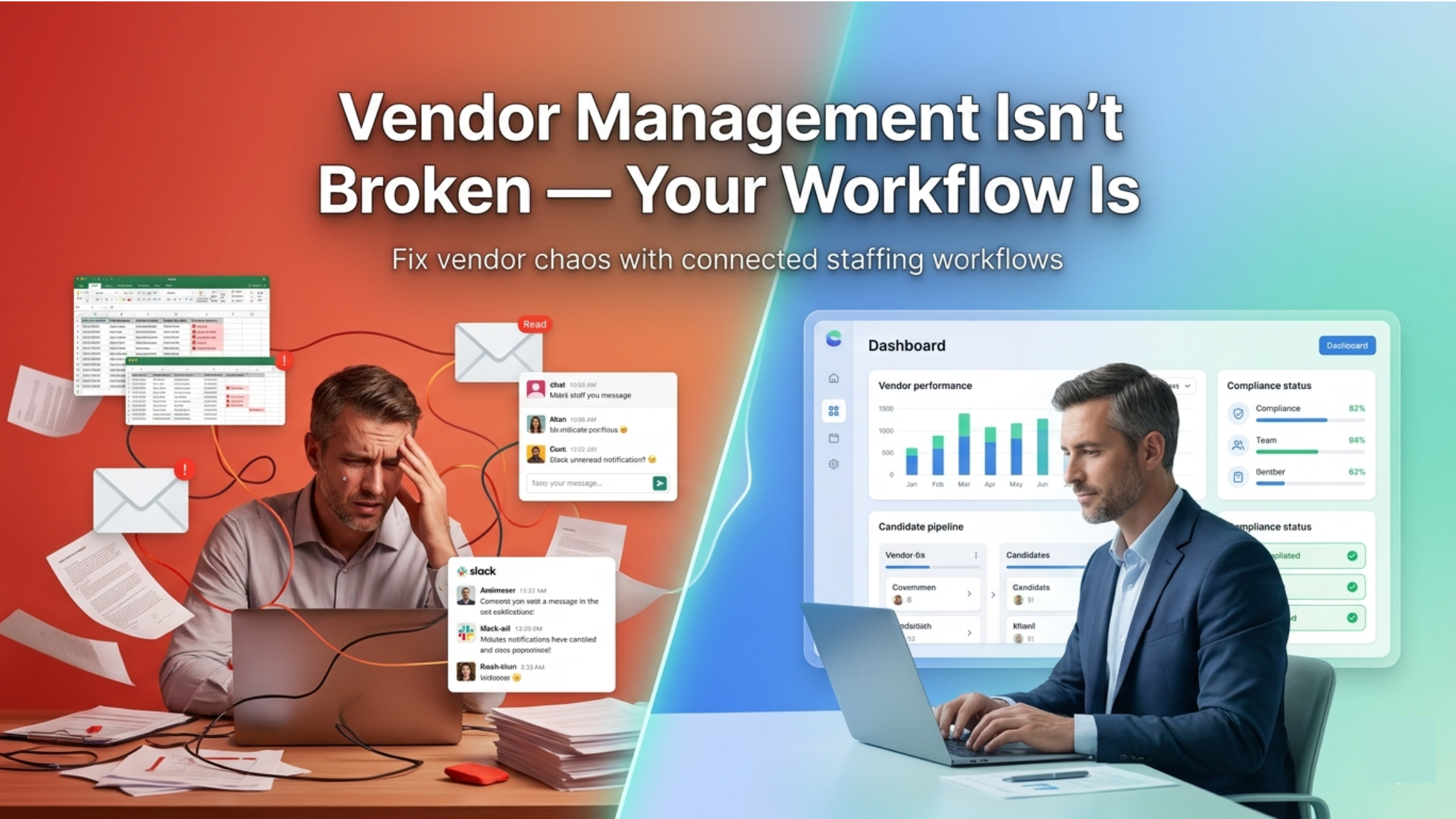
If you’re evaluating the best vendor management software, especially a vendor management system for staffing agencies, you’re probably already feeling some friction in your current setup.
Most agency owners don’t start looking for a VMS because things are “fine.”
They start when vendor coordination starts slowing down placements, or worse, creating blind spots.
Here’s the blunt reality:
Vendor management isn’t just admin work in staffing
It directly affects how fast you can deploy talent and how confidently you can scale
When vendors are involved, everything becomes interconnected:
Submissions
Compliance
Recruiter follow-ups
Deployment readiness
Billing accuracy
The best Vendor Management System (VMS) in 2026 isn’t just about tracking vendors.
It’s about:
Seeing what’s happening across vendors in real time
Reducing back-and-forth between teams
And keeping candidate flow, compliance, and deployment in sync
How do staffing agencies actually struggle with vendor management at scale?
One operations manager we worked with put it pretty clearly:
“We don’t have a vendor problem, we have a visibility problem.”
They were working across multiple locations with dozens of vendors. On paper, everything looked structured. In reality, it wasn’t.
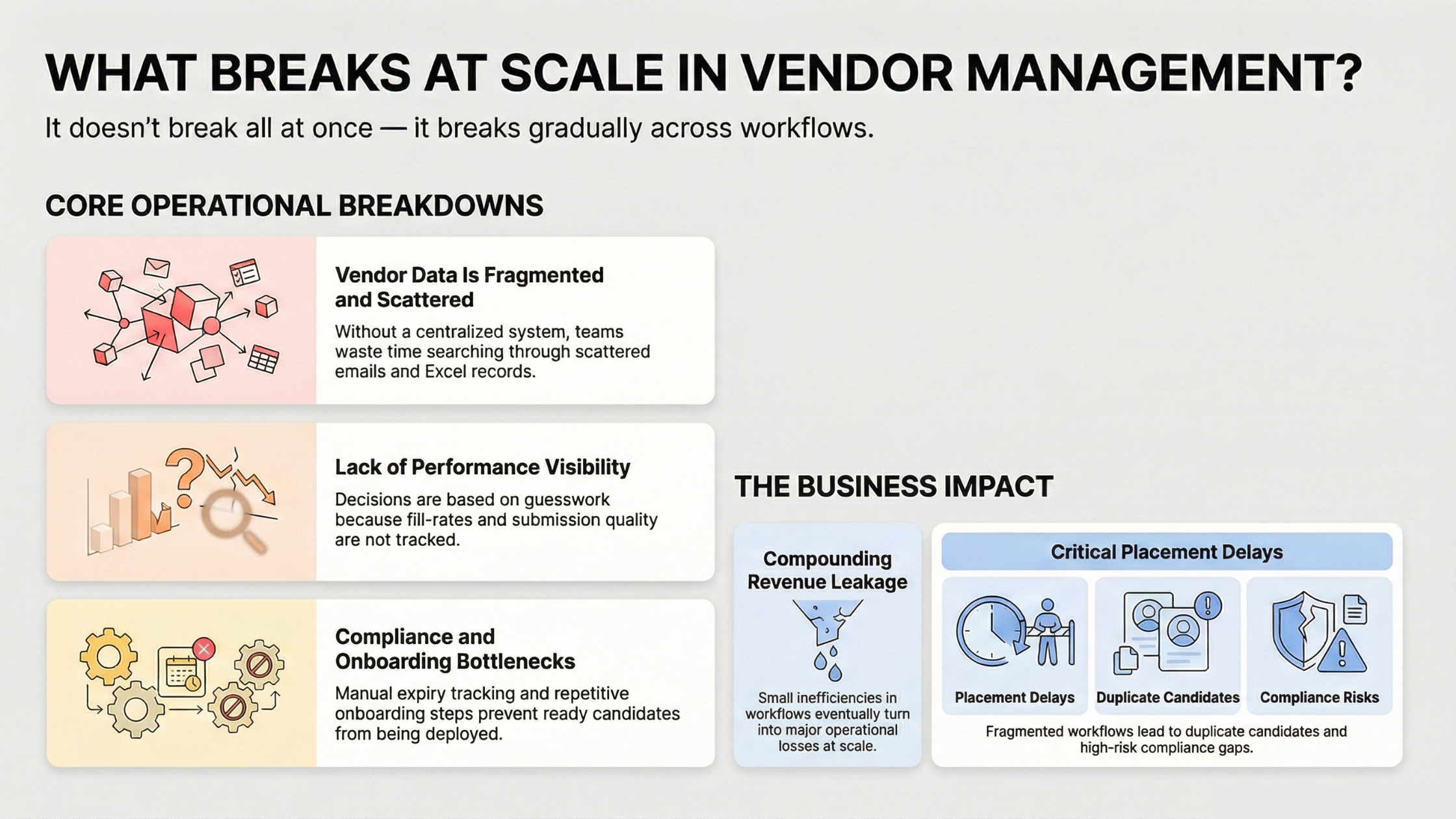
What usually starts breaking:
Vendor data lives across emails, Excel sheets, and disconnected tools instead of a centralized staffing operations platform
Performance tracking becomes reactive instead of proactive without a proper staffing analytics dashboard
Compliance documents are scattered, with no single source of truth
Vendor onboarding becomes repetitive, manual, and inconsistent
And this doesn’t fail loudly; it fails quietly.
You start noticing:
Roles are taking longer to fill
Vendors sending duplicate or irrelevant candidates
Compliance checks are slowing things down at the worst time
Teams asking, “Where are we at with this candidate?”
Key takeaway for operations leaders:
Vendor management rarely breaks in isolation; it breaks as part of a larger workflow gap.
What are the top-rated vendor management software options in 2026?
See how Vars covers this for your agency
Scheduling, credentialing, and payroll in one platform.
If you’ve started comparing tools, you’ve probably come across these:
SAP Fieldglass
Widely used in enterprise environments. Strong on analytics, governance, and contingent workforce visibility.
Beeline
Well-known in staffing and vendor ecosystems. Offers structured workflows and vendor performance tracking.
Coupa Contingent Workforce
Combines vendor management with spend control. Useful if procurement is a big focus.
Workday VMS / VNDLY
Fits well if you’re already in the Workday ecosystem. Strong compliance and workforce tracking.
Ivalua / GEP SMART
Flexible systems focused on vendor lifecycle and analytics.
Where things get tricky
These are solid tools, no question.
But most of them were designed for:
Procurement teams
Enterprise vendor ecosystems
Finance-led workflows
Not for the day-to-day reality of staffing agencies.
Why do traditional VMS tools fall short for staffing agencies?
Here’s where things usually break during implementation.
The system tracks vendors well… but doesn’t connect cleanly with recruiting.
That gap between vendor input and recruiter action becomes the bottleneck.
In most cases, the disconnect happens between vendor management and recruiting workflows inside an applicant tracking system.
What that looks like in practice:
Step
What actually happens
Vendor submits candidate
Sits outside ATS or a structured candidate pipeline management system
Recruiter follow-up
Manual, often delayed
Compliance check
Separate workflow
Deployment readiness
No shared visibility
So even with a strong VMS:
Recruiters are still chasing updates
Compliance is still a checkpoint, not a flow
Ops teams don’t have real-time clarity
Common operational mistake:
Trying to fix staffing workflow problems with a standalone VMS
What is the best way to manage vendors across multiple locations?
From what we’ve seen, agencies that scale well don’t treat vendor management as a separate system.
They treat it as part of the workflow.
That means you’re not just managing vendors, you’re managing:
Submissions
Candidate flow
Compliance
Deployment readiness
All in one place.
Which is why you need:
Vendor management
visibility into candidate movement inside a staffing and scheduling system
compliance tracking
operational visibility
Not separate tools stitched together, but a connected system.
Where a modern VMS (like Join Vars) fits in
Let’s take a simple, real-world scenario.
A vendor submits a candidate.
Without integration:
Recruiter logs details manually
Compliance checks happen later
Ops team waits for updates
No one has a full picture
With an integrated VMS layer:
Vendor submits candidate → instantly captured
Candidate is evaluated using AI candidate matching software for staffing agencies
Compliance is tracked alongside the candidate
The ops team can see readiness without asking three different people
What this actually fixes:
Managing multiple vendors across locations becomes structured
Visibility improves through a shared vendor and compliance tracking system
Onboarding becomes faster and more consistent
Manual coordination drops significantly
What features actually matter in vendor management software?
A lot of feature lists look impressive. But in real staffing workflows, only a few things truly make a difference.
1. Vendor onboarding automation
Not just collecting documents but structuring the process.
This is where vendor onboarding and credentialing workflows matter.
Without structure:
Onboarding takes longer
Compliance becomes reactive
Vendors follow different processes
2. Vendor performance tracking
You need more than basic metrics.
What actually matters:
Fill rate by vendor
Submission quality
Response time
Without this, decisions stay subjective.
3. Compliance tracking across vendors
This is often underestimated.
A proper staffing compliance management system should:
Track documents
Flag expirations
Maintain audit readiness
Otherwise, compliance becomes a last-minute blocker.
4. AI-driven candidate matching
This is where things start improving significantly.
Instead of manually reviewing vendor submissions, systems using:
AI matching
Role-fit scoring
Automated shortlisting
Help reduce recruiter workload.
You’ll typically see this as part of broader automation in staffing recruitment workflows.
5. Workflow integration (this is the big one)
If your VMS doesn’t connect to:
ATS
Onboarding
Compliance
Scheduling
You’re just adding another layer of work.
Pro tip for staffing agencies:
Disconnected tools don’t scale; they compound problems.
How do you choose the best vendor management software for your agency?
Instead of starting with features, start with your current bottleneck.
Step 1: Identify where things slow down
Vendor coordination messy → need structure
Compliance delays → need visibility
Slow placements → need workflow integration
Step 2: Match the tool to your agency stage
Agency Type
What works best
Small agency
Lightweight VMS
Mid-size
Integrated VMS + ATS
Enterprise
Full ecosystem integration
Step 3: Evaluate integration depth
Ask yourself:
Does vendor data flow into your pipeline?
Can ops track readiness in real time?
Is everything visible inside your staffing software ecosystem?
Step 4: Don’t rely on software alone
This part gets ignored too often.
Even the best system won’t fix:
Unclear processes
Lack of ownership
Poor vendor communication
You still need:
Defined workflows
Clear SLAs
Internal accountability
What are the benefits of implementing a dedicated vendor management platform?
When done right, the impact is noticeable pretty quickly.
You start seeing:
A centralized vendor ecosystem inside a unified workforce management platform
Better visibility across teams
Faster onboarding cycles
Fewer compliance surprises
More predictable billing
FAQ – Vendor Management Software for Staffing Agencies
What is the best vendor management software for staffing agencies?
The best option is one that connects vendor management with recruiting, compliance, and deployment workflows.
How long does it take to implement a VMS?
Basic setup: 2–4 weeks
Full integration: 6–12 weeks
Can small staffing agencies benefit from a VMS?
Yes, especially when managing multiple vendors or compliance-heavy roles.
Which vendor management software supports automated onboarding?
Look for systems that support vendor lifecycle management workflows.
What features matter most for compliance tracking?
Document tracking
Expiry alerts
Audit logs
How much does vendor management software cost?
Smaller tools: $50–$500/month
Enterprise tools: custom pricing
Not sure yet whether you need one at all? Start with what a vendor management system actually does day to day, or see the concrete benefits agencies see once a VMS is in place.
Final takeaway for staffing leaders
If you’re evaluating the best vendor management software in 2026, don’t just compare feature lists.
Look at your workflow.
Where does coordination break?
Where do delays happen?
Where does visibility drop?
Because that’s where your real problem is.
A practical next step
Take 30 minutes and map your current process:
Vendor submission
Recruiter action
Compliance tracking
Deployment readiness
Then map it end-to-end using a structured vendor management workflow for staffing agencies.
That exercise alone will tell you what kind of system you actually need.
Frequently Asked Questions
What are the top-rated vendor management software options in 2026?
Widely used VMS platforms include SAP Fieldglass, Beeline, Coupa Contingent Workforce, Workday VNDLY, and Ivalua/GEP SMART, each with different strengths for contingent workforce management.
How do staffing agencies actually struggle with vendor management at scale?
As agencies add clients and vendors, tracking compliance, rates, and performance manually starts breaking down, which is exactly the friction a VMS is built to remove.