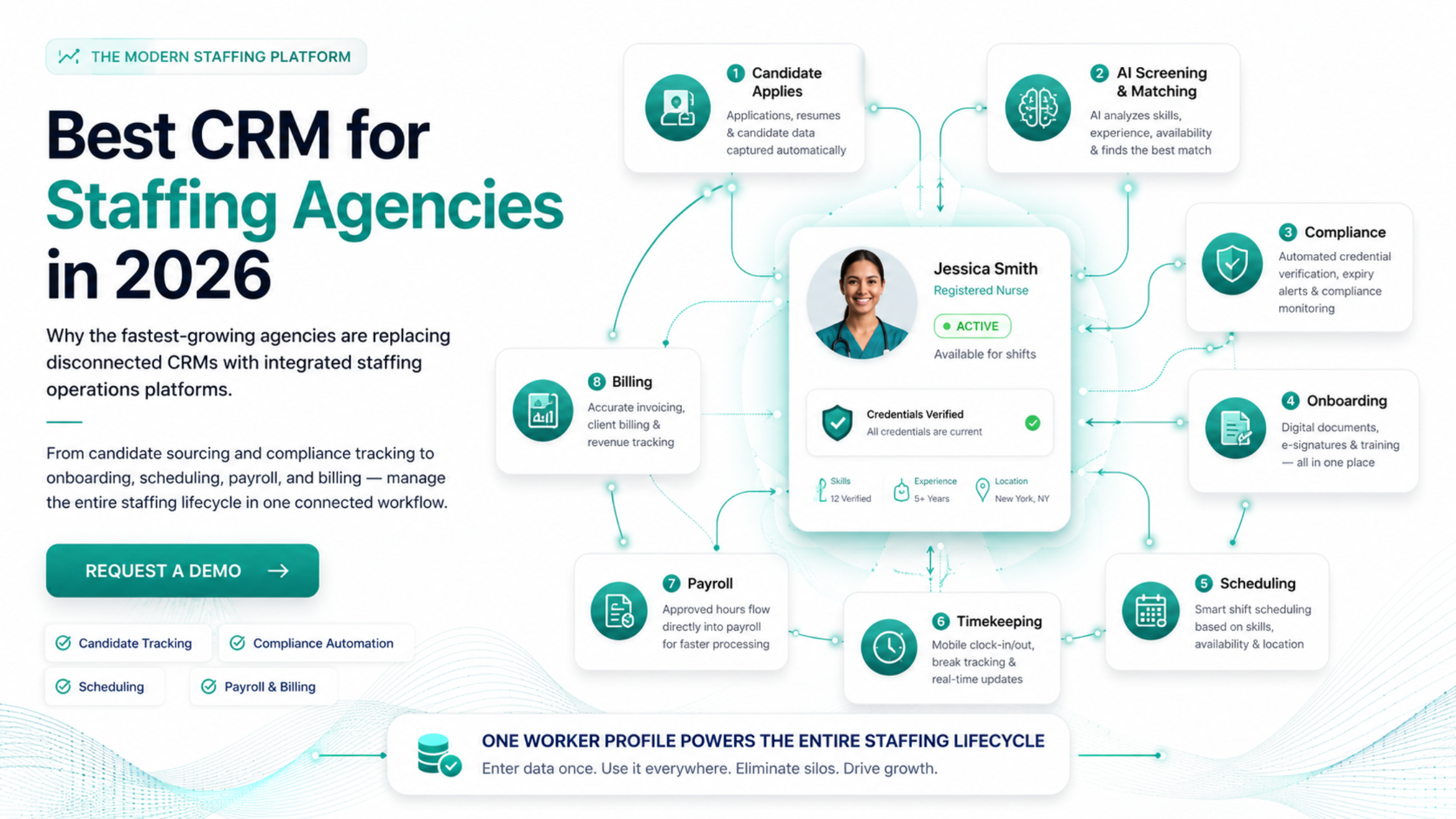
If you’re searching for the best CRM for staffing agencies in 2026, the honest answer is: a standalone CRM is rarely enough. The agencies growing fastest aren’t using a CRM bolted on top of their existing stack; they’re running on platforms where candidate tracking, onboarding, compliance, scheduling, and billing all talk to each other.
This guide breaks down what to actually look for, where traditional CRMs fall short for staffing workflows, and what a modern staffing platform like Join Vars does differently.
For the full category breakdown, see our staffing agency CRM guide.
THE CORE PROBLEM
Why Most Staffing Agencies Outgrow Their CRM Within 18 Months
A generic CRM is built for sales pipelines: contact records, deal stages, and follow-up reminders. That works well for a B2B sales team. It does not work well when your “pipeline” includes credentialing checklists, shift scheduling, I-9 verification, payroll syncing, and multi-location compliance tracking.
We’ve seen this pattern repeatedly at agencies across healthcare, light industrial, hospitality, and IT staffing: they invest in a well-known CRM, customize it heavily for recruiting, and 18 months later their team is juggling four separate tools including a separate applicant tracking system for staffing agencies that doesn’t connect to compliance or scheduling, a spreadsheet for compliance expiry dates, and a third-party payroll system that doesn’t sync automatically.
The operational cost of that fragmentation is real: missed credential renewals, duplicated data entry, recruiter handoff errors, and delayed deployments. Time-to-fill climbs. Margins get squeezed. Good recruiters get frustrated and leave.
WHAT USUALLY BREAKS AT SCALE
The first thing that breaks when an agency grows from 50 to 200 active workers isn’t recruiting it’s compliance visibility. Spreadsheets tracking license expirations can’t notify multiple stakeholders automatically, can’t trigger document re-collection workflows, and can’t integrate with staffing and scheduling software to prevent a worker with a lapsed credential from being deployed.
FEATURE BREAKDOWN
What Does a CRM for Staffing Agencies Actually Need to Do in 2026?
See how Vars covers this for your agency
Scheduling, credentialing, and payroll in one platform.
Before comparing platforms, it’s worth being clear about what “CRM functionality” means in a staffing context, which is substantially broader than what most staffing agency software platforms were designed to handle even five years ago. It’s not just contact management.
Candidate Pipeline Management
Track every candidate from sourcing through credentialing, onboarding, and active deployment in one view.
Credential & Compliance Tracking
Automated expiry tracking, document collection workflows, and alerts before a worker becomes non-compliant are core functions of a dedicated workforce compliance software layer.
Client Relationship Tools
Job order management, client communication logs, and contract visibility, not just candidate-side data.
Onboarding Automation
Digital document collection, e-signatures, and task checklists that move a candidate from offer to deployment-ready without manual follow-up.
Scheduling & Dispatch
Match credentialed, available workers to open shifts with conflict checking and confirmation workflows built in.
Reporting & Operational Visibility
Real-time dashboards showing recruiter productivity, fill rates, compliance status, and deployment readiness at a glance.
PRO TIP FOR STAFFING AGENCIES
When evaluating any platform, ask vendors a simple question: “If a worker’s nursing license expires next week, what happens automatically in your system?” If the answer requires a manual step from your team, that’s a gap, especially at scale.
PLATFORM COMPARISON
How Do the Main CRM Options Compare for Staffing Agencies in 2026?
Below is a practical comparison of the main approaches agencies take. This isn’t a promotional ranking it’s a functional breakdown of what each category does and doesn’t handle well for staffing-specific workflows, from basic vendor management to full workforce operations.
Capability
Generic CRM (Salesforce, HubSpot)
Standalone ATS (Bullhorn, Ceipal)
Staffing Platform (Join Vars)
Candidate pipeline tracking
Partial (requires customization)
Yes
Yes — with AI matching
Credential & license tracking
No — manual workarounds
Basic — limited automation
Yes — automated expiry alerts
Digital onboarding & e-docs
No
Partial
Yes — full digital workflow
Shift scheduling & dispatch
No
No
Yes — with availability matching
Timekeeping & billing
No
Via integrations
Yes — native module
Payroll & invoicing sync
Via integrations
Via integrations
Yes — built-in
White-label mobile app
No
No
Yes — branded for your agency
AI voice recruiting
No
No
Yes — Vars AI Voice Recruiter
Vendor management (VMS)
No
Limited
Yes — native VMS module
Labor law compliance tracking
No
Partial
Yes — national, state & local
The pattern in the table is consistent: general-purpose CRMs require significant customization and third-party integrations to approximate what a purpose-built staffing platform handles natively. Every integration point is a potential failure point and another tool your team has to manage.
NAMED PLATFORM COMPARISON
How Do Bullhorn, Crelate, Vincere, Loxo & JobAdder Actually Compare?
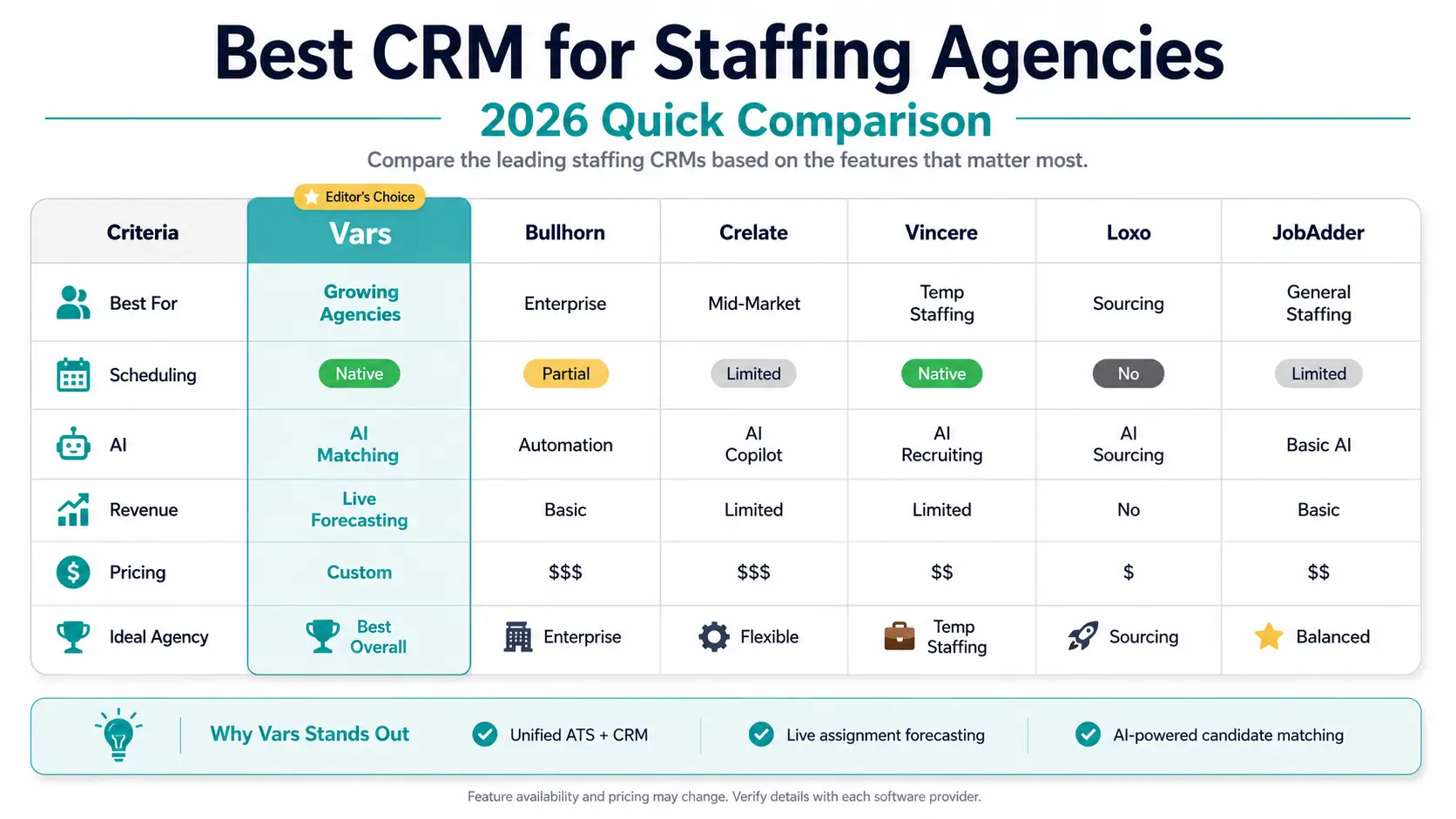
The category comparison above covers the functional gap between generic CRMs, standalone ATS tools, and a staffing platform. Here’s how the specific named platforms agencies evaluate most often stack up, including where each one actually fits and what it costs.
Bullhorn
Bullhorn is the incumbent in staffing software, and for firms above 50 seats it’s often the safe, expected choice since most recruiters coming in already know how to use it. Pricing starts around $99 per user per month for a 1 to 2 person Starter tier and $165 per user per month for the Core plan, with anything larger moving to a custom quote. It combines ATS and CRM on one database and has the deepest marketplace of integrations in the category. Where Bullhorn Fits: the tradeoff is cost and complexity — implementation alone can run $2,000 to $10,000, and smaller agencies often find themselves paying for enterprise-scale features they don’t need yet.
Crelate
Crelate positions itself as a “living platform” combining ATS, CRM, and AI-assisted tools like an AI co-pilot and candidate rediscovery. Pricing starts at $119 per user per month on the Business plan, with a five-seat minimum and a contract escalator that raises the price roughly 7 percent at each renewal. Where Crelate Fits: a solid fit for mid-market teams that want client portals and customizable workflows in one system; a weaker fit for solo recruiters or agencies watching every dollar.
Vincere
Vincere markets itself as an AI-powered recruitment CRM built specifically for staffing agencies, with native timesheet and invoicing functionality built around contingency placement billing, including split-fee management for multi-recruiter placements. Pricing runs roughly $74 to $99 per user per month on published tiers. Where Vincere Fits: agencies running contract or temp desks that need back-office billing tools built into the same platform as the CRM.
Loxo
Loxo positions itself as an AI-native recruiting platform, with a free tier available before paid plans kick in. It leans outbound and sourcing-heavy, with strong automated messaging and candidate rediscovery tools. Where Loxo Fits: agencies whose biggest bottleneck is sourcing volume rather than account management depth; a weaker fit when the main pain point is billing, compliance, or multi-site client tracking.
JobAdder
JobAdder combines ATS and CRM with a reputation for flexible workflow configuration, running around $99 per user per month. Where JobAdder Fits: agencies wanting a middle-ground option between the enterprise weight of Bullhorn and more specialized, sourcing-first tools like Loxo — a reasonable generalist pick, though it doesn’t carry the staffing-specific back-office depth that Vincere or Vars build in natively.
HIDDEN COSTS
What Does a Staffing CRM Actually Cost Once You Add the Extras?
The per-user price on a pricing page is rarely the real number. Three costs tend to hide underneath it:
Implementation. Enterprise-style platforms can charge $2,000 to $10,000 or more to get set up, on top of the subscription — a cost that’s usually invisible until you’re already deep in a sales conversation.
Annual escalators. Some vendors build a yearly price increase into the contract itself. A 7 percent annual bump sounds small until you’re three renewals in and paying noticeably more per seat than what you signed up for.
Module and add-on fees. Several platforms in this category price advanced features (AI search and matching, deeper reporting, API access) as separate add-ons rather than including them in the base tier.
The honest way to compare CRMs isn’t the sticker price — it’s the total cost at the seat count and feature depth your agency will actually be using eighteen months from now, not on day one.
JOIN VARS IN PRACTICE
How Does Join Vars Actually Fit Into a Staffing Agency’s Day-to-Day Workflow?
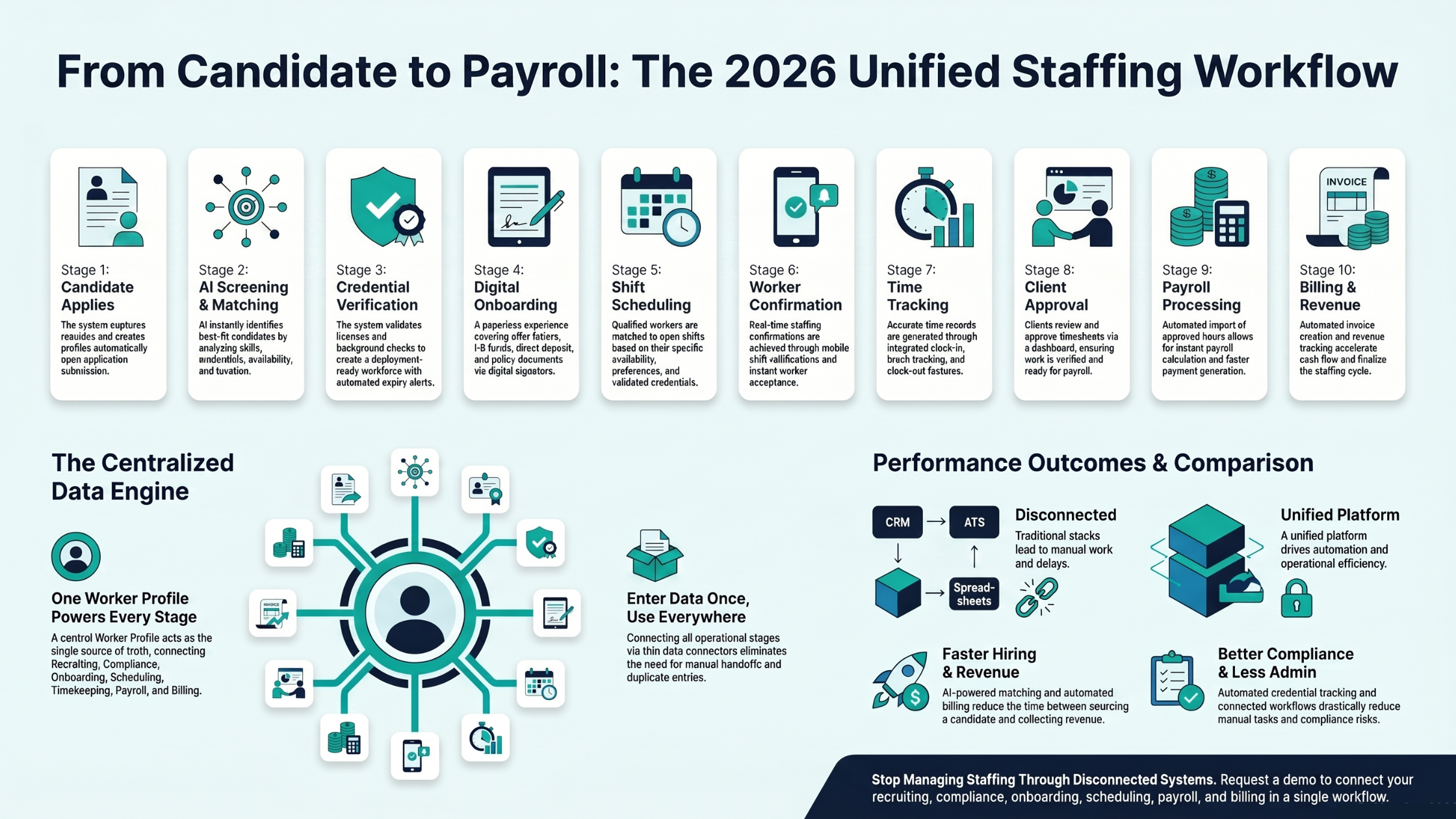
Join Vars isn’t a CRM in the traditional sense. It’s an end-to-end staffing operations platform, meaning it covers the full lifecycle from sourcing a candidate to deploying them on a shift and processing their timesheet. Here’s where it fits at each stage:
Sourcing & Candidate Management
The platform’s AI-powered ATS module handles inbound applications, pipeline tracking, and candidate scoring. The AI Candidate Matching feature surfaces the right workers for open roles based on skills, credentials, availability, and location, reducing the manual sifting time that kills recruiter productivity.
The Vars AI Voice Recruiter goes further: it engages candidates in automated phone conversations, screens them against role-specific criteria, and updates their pipeline status so recruiters wake up to qualified candidates, not cold outreach queues.
Credentialing & Compliance
Join Vars tracks license types, expiry dates, and required documentation at the worker level as part of a broader onboarding and credentialing workflow that moves workers from offer to deployment-ready without manual follow-up. When a credential is approaching expiry, the system triggers automated reminders and document re-collection requests. Workers who are non-compliant are flagged before scheduling, not after a deployment error.
For healthcare and other regulated industries, this isn’t a convenience feature. It’s a liability management tool.
Onboarding
Once a candidate clears credentialing, the onboarding module generates a digital paperwork workflow: I-9, offer letter, direct deposit authorization, certifications, all collected electronically and stored against the worker’s profile. No printing, scanning, or chasing documents via email.
Scheduling, Timekeeping & Billing
After onboarding, workers move directly into the scheduling module. Availability, certifications, and shift preferences are already in the system. Managers assign shifts, workers confirm via the white-label staffing mobile app, and clock-in/clock-out data flows automatically into timekeeping. Client-facing timesheet approval happens through a web portal, and the data feeds directly into payroll and billing software, reducing payroll processing time and eliminating duplicate entry errors.
KEY TAKEAWAY FOR OPERATIONS LEADERS
The value of a connected platform like Join Vars isn’t any single feature; it’s that data flows forward without manual handoffs. A credential tracked at onboarding is visible to the scheduler. A timesheet approved by the client feeds directly into billing. When information moves automatically, errors don’t accumulate, and teams don’t spend hours reconciling systems.
DECISION GUIDANCE
Should You Replace Your CRM or Add a Staffing Platform — and Where Do You Start?
The honest answer depends on where your biggest operational pain is right now. Most agencies don’t need to rip and replace everything at once. Here’s a practical framework:
If credential and compliance tracking is your biggest headache, prioritize a platform with native credentialing automation. Join Vars’ employee attestation module handles this automatically. Getting compliance under control has downstream effects on scheduling and client trust.
If onboarding is taking more than 3–5 business days, digital onboarding and document management should be your first investment. Speed-to-deploy is a direct revenue lever.
If your recruiters are spending more than 30% of their time on administrative work, ATS automation, AI matching, and pipeline tooling will compound the most value over time.
If payroll errors or billing discrepancies are a recurring problem, the fix is timekeeping and billing software that connects directly to payroll, not better spreadsheets.
If you’re scaling into new markets or verticals, that’s when you need a platform, not a CRM. The complexity of managing multiple compliance frameworks, client portals, and worker populations across locations exceeds what general CRMs handle well.
COMMON OPERATIONAL MISTAKE
Agencies often try to solve operational problems by adding more integrations to an existing CRM. Each integration adds a maintenance burden, a potential sync failure point, and a vendor relationship to manage. If you’re on your third integration to make your CRM “work like a staffing tool,” it’s usually less expensive and less risky to move to a purpose-built platform.
FAQ
Frequently Asked Questions
How long does it take to implement staffing CRM software for a mid-size agency?
For a purpose-built platform like Join Vars, most agencies are operationally live within 4–8 weeks, depending on data migration complexity and how many modules are being activated simultaneously. Starting with onboarding and ATS, then layering in timekeeping and billing, tends to produce faster results than trying to go fully live all at once. The platform is designed to be phased.
What CRM features actually matter for healthcare staffing compliance tracking?
In healthcare staffing, the non-negotiables are: automated credential expiry tracking with proactive alerts, document storage at the worker level (licenses, certifications, background checks), compliance status visibility before scheduling, and audit-ready reporting. Any platform that relies on your team manually monitoring spreadsheets for expiry dates is not a compliance tool; it’s a liability.
Can a small staffing agency with fewer than 50 workers benefit from a staffing platform?
Yes, and often more immediately than larger agencies. Smaller agencies have less administrative bandwidth, so manual processes like chasing onboarding documents and tracking credential expiries consume a disproportionate share of operations time. A platform that automates these workflows can return meaningful recruiter capacity within the first 30 days.
Is a standalone ATS still worth it, or should agencies look for an all-in-one staffing platform?
A standalone ATS made sense when the rest of the staffing workflow was manageable manually. In 2026, the agencies outperforming their competitors are the ones with tighter connections between recruiting, credentialing, scheduling, and billing. A standalone ATS solves one part of the problem; an integrated platform solves the operational chain. The decision usually comes down to whether your current pain is at the front of the funnel (sourcing/recruiting) or distributed across the full workflow.
Does Join Vars work for non-healthcare staffing industries like warehouse or events?
Yes. Join Vars serves healthcare, warehouse, hospitality, event, construction, restaurant, retail, IT, and several other verticals, each with industry-specific configuration options. The core platform handles the staffing workflow universally; compliance and credentialing requirements are configurable by industry and role type.
What is the difference between a staffing CRM and a workforce management platform?
A CRM manages relationships and communication pipelines, primarily the pre-placement stages of candidate and client management. A purpose-built staffing agency software platform extends further into the operational side: credential verification, onboarding, scheduling, shift management, timekeeping, and payroll. Join Vars is the latter; it starts where CRM ends and manages the full staffing lifecycle through deployment and billing.
How does AI recruiting fit into a staffing agency’s workflow without replacing recruiters?
Tools like Join Vars’ AI Voice Recruiter and AI Candidate Matching are designed to handle volume and repetition in initial candidate outreach, screening calls, pipeline scoring. What they can’t replace is relationship-building, complex client communication, and judgment calls on nuanced placements. The practical value is that recruiters stop spending time on high-volume, low-complexity tasks and can focus on work that actually requires human judgment and relationship capital.
CONCLUSION
What’s the Right Next Step for Your Agency?
The best CRM for staffing agencies in 2026 isn’t a CRM at all; it’s a platform that handles the full operational chain from candidate sourcing through deployment and billing, without requiring your team to patch together multiple disconnected tools.
If you’re currently running on a generic CRM with spreadsheets for compliance and separate tools for staffing and scheduling, and payroll, the real question isn’t which CRM to switch to. It’s whether your current stack is actually holding your growth back.
The immediate step worth taking: Map out where your team spends the most unplanned time each week. Credential chasing? Onboarding follow-ups? Timesheet reconciliation? That’s where your operational leverage is and where a platform like Join Vars will return the most value first.
See How Join Vars Fits Your Agency’s Workflow
Book a 30-minute demo to walk through the modules relevant to your current operational challenges, no generic pitch, just your workflow on screen.
Frequently Asked Questions
What does a CRM for staffing agencies need to do in 2026?
A modern staffing CRM should unify candidate pipelines, client relationships, credential tracking, onboarding automation, and scheduling in one connected system rather than a standalone contact database.
Is a standalone CRM enough for a staffing agency?
Rarely. Agencies that scale quickly tend to outgrow a bolt-on CRM within 18 months because it does not connect to compliance tracking, scheduling, or payroll, the operational data that actually drives placements.