Setting a staffing agency bill rate markup correctly matters less at the moment a rate is agreed and more over the months that follow, as overtime, burden costs, and small client concessions quietly erode a margin that looked fine on paper. This is where most staffing agency margin erosion actually happens, not in the initial rate negotiation. A rate that looked healthy in January can be quietly underwater by June, and nobody notices until someone finally runs the numbers.
What is the difference between markup and margin, and why does the distinction matter?
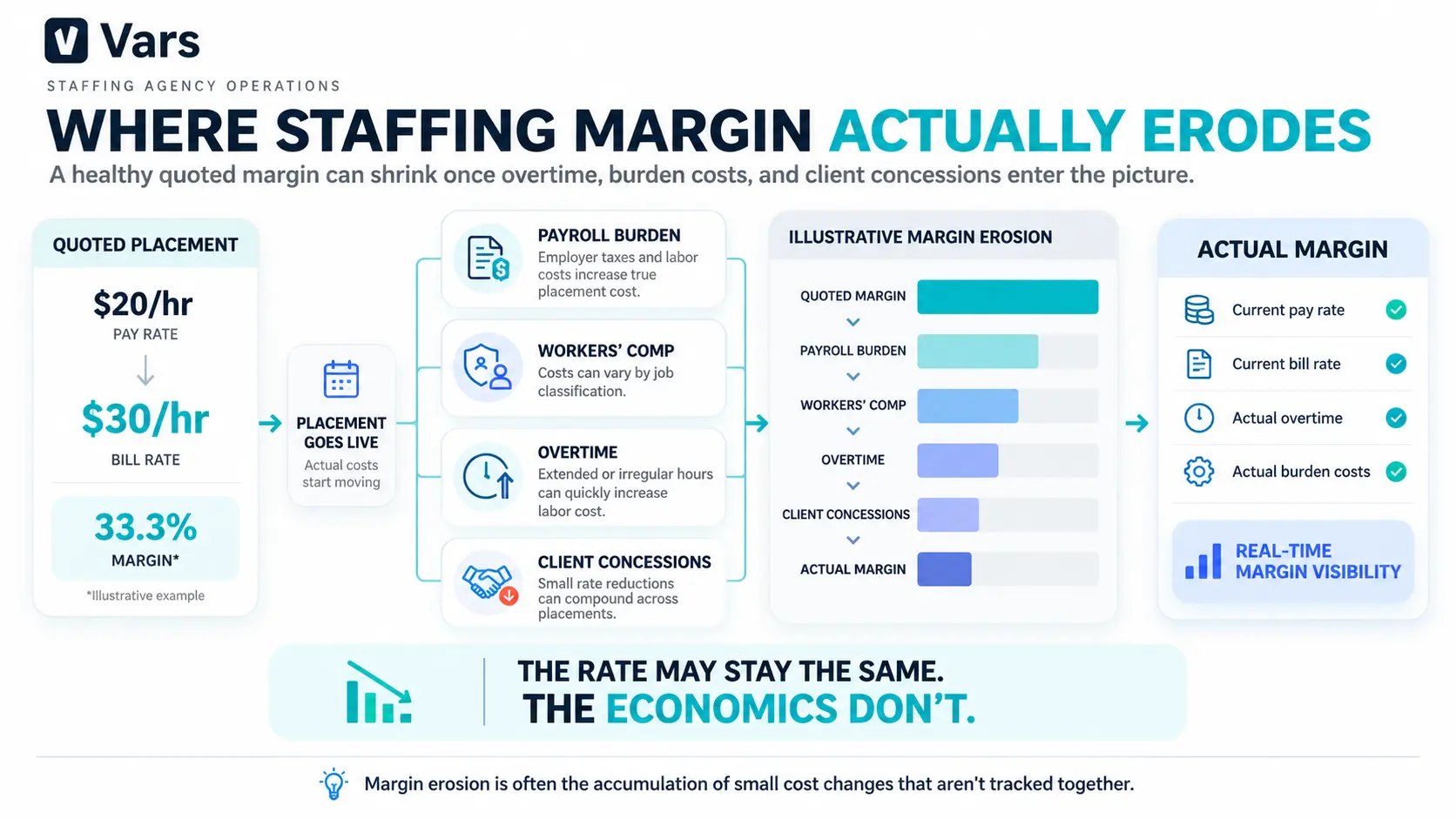
These two terms get used interchangeably, but they are not the same, and confusing them leads to pricing mistakes. Markup is the percentage added to the pay rate to reach the bill rate: a $20-an-hour pay rate with a 50% markup bills at $30 an hour. Margin is the percentage of the bill rate that represents profit, and that same $20/$30 example is a 33% margin, not 50%.
Agencies that price based on a markup target without checking the resulting margin often end up with thinner profit than intended, especially as pay rates rise and the markup percentage stays fixed. The gap between the two numbers widens quietly, which is exactly why it goes unnoticed for so long.
What factors erode margin after a bill rate is set?
See how Vars covers this for your agency
Scheduling, credentialing, and payroll in one platform.
A bill rate agreed at the start of a placement is rarely the full picture of what it actually costs to fill that role over time. Payroll tax burden varies by state and can shift the effective cost of a pay rate meaningfully, as does how consistently overtime and rate spreads are tracked (see our piece on timesheet and billing disputes). Workers’ compensation costs vary by job classification and can be easy to underestimate at quoting time. Overtime, particularly on placements with irregular or extended hours, adds up fast. And small client concessions, individually reasonable rate adjustments, compound across a roster over time in ways nobody tracks in aggregate.
Common operational mistake: setting a markup target once at the start of a client relationship and never revisiting it as burden costs or overtime patterns shift over the life of the engagement.
How does manual rate tracking cause margin leakage?
When pay rates, bill rates, and burden costs live in a spreadsheet separate from timekeeping and invoicing, margin visibility depends on someone manually recalculating it, which tends to happen sporadically rather than continuously. The result is that margin erosion is often discovered at quarter-end review, well after the placements that caused it have already run their course.
| Where margin tracking happens | Visibility | Typical failure point |
|---|---|---|
| Spreadsheet, updated periodically | Delayed, manual | Rate changes made without updating the spreadsheet |
| Accounting software alone | Aggregate revenue only | No per-placement rate spread visible |
| Connected timekeeping and billing system | Real time, per placement | Requires the right system in place from the start |
An agency running twenty active placements with a spreadsheet-based rate tracker is effectively asking one person to catch every small drift across twenty separate moving parts, every month, without fail. That is a lot to ask of manual attention, and it usually does not hold up.
Pro tip for staffing agencies: pick your three largest active placements right now and calculate the actual current margin on each, including burden costs and any overtime from the last month. If that number is meaningfully lower than what was quoted at the start of the placement, that gap is your margin leak.
Where do timekeeping and scheduling connect to margin protection?
Margin protection is not really a pricing problem. It is a visibility problem that starts with how hours are recorded and flows through to how invoices are generated. When overtime, shift patterns, and approved hours are visible in the same system that tracks pay and bill rates, margin erosion shows up immediately rather than at month-end.
Vars’ Timekeeping module connects approved hours directly to both pay rate and bill rate on the Payroll & Billing module, so overtime and rate changes are reflected in real placement margin rather than a static quoted number. The Staffing & Scheduling module keeps shift assignments and hours tied to the same placement record, so scheduling decisions that affect overtime are visible before they show up as a margin surprise on an invoice. Together with the broader Payroll & Billing module, margin becomes something an agency can check in real time, not something reconstructed at quarter-end.
What usually breaks at scale: margin tracking rarely breaks because the initial rate was set wrong. It breaks because nobody is checking whether the actual margin still matches the quoted margin as overtime, burden costs, and small concessions accumulate over the life of a placement.
How should an agency approach markup and margin decisions going forward?
- Calculate margin, not just markup, when evaluating whether a rate is actually profitable.
- Build burden costs into the rate calculation from the start, rather than treating them as a separate line item to check later.
- Review actual margin against quoted margin periodically, not just at contract renewal.
- Flag placements with heavy overtime for a margin recheck, since overtime is one of the fastest ways a healthy quoted margin erodes.
- Keep rate changes and timesheet data in the same system, so a rate adjustment does not require a separate manual update somewhere else.
Key takeaway for operations leaders: the biggest margin risk in staffing is rarely the rate you set. It is the rate you stop checking once the placement is running.
No system replaces the judgment call of what to charge a client. What a connected system changes is whether that judgment is based on real-time margin data or a number that was accurate months ago and has since drifted.
FAQ
What is a healthy markup percentage for staffing agencies?
This varies significantly by vertical, job classification, and local labor market, so there is no single benchmark that applies broadly. What matters more is checking actual margin, not just the markup percentage, against burden costs specific to each placement.
How often should bill rates be reviewed?
At minimum, whenever burden costs, state payroll tax rates, or a placement's overtime pattern change meaningfully, not only at the scheduled contract renewal date.
Can small staffing agencies benefit from margin tracking tools, or is a spreadsheet enough?
A spreadsheet can work for a handful of placements. It becomes a liability once burden costs and overtime patterns vary enough across placements that manual recalculation cannot keep pace.
What is the fastest way to check if margin is being lost right now?
Compare quoted margin at contract start against current actual margin, including this month's overtime and burden costs, for your largest active placements. The gap between those two numbers is usually where the leak is.
Should markup differ by job classification within the same client?
Often yes, since burden costs like workers' compensation vary by classification even within one client relationship, and a single flat markup across very different roles tends to under-price the riskier or higher-burden classifications.
Next step
Pick your three largest active placements and calculate their real current margin today, not the quoted margin from when the contract was signed. That single exercise usually reveals whether margin tracking needs to change before any software decision does.