Staffing agency automation fails most often not because the technology does not work, but because agencies automate the wrong workflow first, usually the most visible one rather than the one causing the most actual friction. Here are the five workflows worth automating first, and the order that tends to produce results fastest. Get the order wrong and the same amount of software spend produces a fraction of the payoff.
Why does automation order matter more than which tools you pick?
Automating a broken process just makes the breakage happen faster. Before automating anything, it is worth identifying which workflow currently consumes the most manual staff time relative to how repetitive and rule-based it actually is. Automation works best on tasks that follow a consistent, predictable pattern, not on tasks that require judgment calls every time.
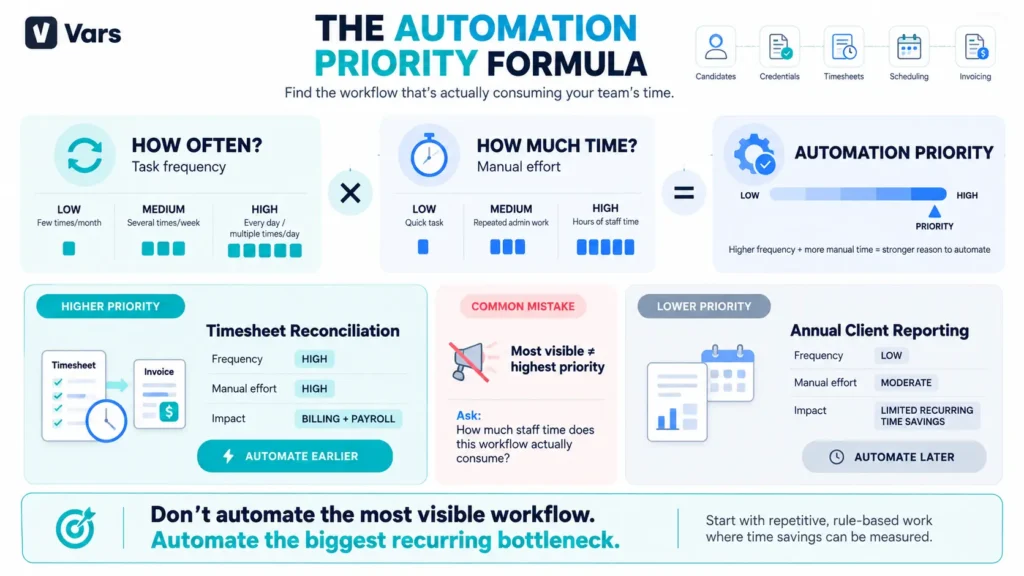
Common operational mistake: starting with candidate sourcing or outreach automation because it is the most visible, client-facing area, while ignoring backend workflows like timesheet approval or credential tracking that are quietly consuming far more staff time.
What are the five workflows to automate first?
See how Vars covers this for your agency
Scheduling, credentialing, and payroll in one platform.
1. Timesheet approval and invoicing
This is usually the single highest-friction manual workflow in a staffing agency, because it sits at the intersection of payroll, billing, and client relationships. Automating the flow from approved hours directly into payroll and invoicing removes a manual re-entry step that is a common source of both errors and delay.
2. Credential and compliance expiration tracking
Manual tracking of licenses, certifications, and background check renewals depends entirely on someone remembering to check dates. Automated expiration alerts remove that dependency and catch renewals before they become placement-ending problems.
3. Candidate onboarding paperwork
Onboarding documentation, work eligibility, tax forms, policy acknowledgments, is highly repetitive across candidates and rule-based enough to automate cleanly, freeing up recruiter and onboarding staff time for the parts of onboarding that actually require judgment.
4. Communication and status updates
Routine status notifications, a candidate’s application received, an interview scheduled, a placement confirmed, are high-volume and low-judgment, making them a strong automation candidate that reduces manual follow-up without removing the human touch from decisions that matter.
5. Scheduling and shift confirmation
For agencies managing recurring shift-based placements, manual scheduling confirmation eats significant coordinator time, and it compounds the multi-site tracking problems covered in our piece on stopping buddy punching and location fraud. Automating routine shift confirmations and reminders frees that time for handling the exceptions that actually need a person.
| Workflow | Why it ranks high | What breaks if left manual |
|---|---|---|
| Timesheet approval / invoicing | High volume, direct revenue impact | Billing errors, payment delays |
| Credential/compliance tracking | High risk if missed | Placements running on expired paperwork |
| Onboarding paperwork | Repetitive, rule-based | Recruiter time consumed by admin work |
| Communication/status updates | High volume, low judgment | Manual follow-up backlog |
| Scheduling/shift confirmation | Recurring, coordinator-heavy | Coordinator time consumed by routine confirmations |
Pro tip for staffing agencies: rank your own workflows by multiplying how often a task happens by how much manual time it takes. The workflow with the highest score, not the most visible one, is usually the right place to start.
What usually goes wrong when agencies automate the wrong thing first?
Agencies that start with a highly visible but low-frequency workflow, an annual client reporting process, say, often see little practical return, because the time saved does not add up to much. Meanwhile, the workflow quietly consuming the most staff time each week, often timesheet approval or credential tracking, stays manual and continues to be the actual bottleneck. A team can feel busy automating for months and still not touch the process that was eating the most hours all along.
What usually breaks at scale: as placement volume grows, the workflows that were merely annoying at a small scale, manual timesheet reconciliation, credential tracking by memory, become the workflows that actively limit how much the agency can grow without adding headcount just to keep up with admin work.
How does connected automation differ from automating each workflow separately?
Automating five workflows in five disconnected tools creates five separate points where data can drift out of sync. The more durable approach connects these workflows so they share the same underlying data, rather than automating each one in isolation.
Vars’ Timekeeping module connects approved hours directly to Payroll & Billing, removing manual re-entry between timesheet approval and invoicing. The Compliance module handles expiration alerts for credentials tracked through Candidate Onboarding, so the same intake data carries forward automatically rather than resetting at each renewal. The ATS module keeps candidate and placement records connected from first contact through active deployment, and the Communication module routes routine status updates without pulling recruiter attention away from placements that actually need judgment calls.
Key takeaway for operations leaders: the value of automation compounds when workflows are connected, because the output of one step, an approved timesheet, a verified credential, becomes the input to the next automatically, rather than each workflow needing to be automated and maintained separately.
What to fix first vs later
Fix first: timesheet approval and invoicing, and credential and compliance tracking. These carry the highest financial and compliance risk when left manual, and automating them tends to produce the clearest, fastest measurable improvement.
Fix later: highly judgment-dependent workflows, like final candidate selection or client relationship management, where automation risks removing decisions that genuinely need a person. Automate the routine surrounding work in these areas, status updates, scheduling logistics, rather than the decision itself.
FAQ
What is the first workflow a staffing agency should automate?
Timesheet approval and invoicing, because it usually consumes the most manual staff time and carries direct revenue and billing-accuracy impact.
Can small staffing agencies benefit from workflow automation, or is it only worth it at scale?
Even small agencies benefit from automating credential tracking and timesheet-to-invoice workflows, since the risk of a missed expiration or a billing error does not scale down proportionally with agency size.
Does automating a workflow remove the need for staff oversight?
No. Automation removes repetitive manual steps and reduces the chance something gets missed, but exceptions and judgment calls still need a person reviewing them.
How long does it typically take to see results from automating staffing workflows?
Timesheet and invoicing automation tends to show measurable time savings within the first full billing cycle, since the manual reconciliation step is removed immediately.
How should an agency measure whether automation is actually working?
Track the specific manual hours it was meant to remove, not a general sense of things feeling smoother. If timesheet reconciliation used to take six hours a week and now takes one, that is a concrete result worth confirming rather than assuming.
Next step
Rank your current manual workflows by frequency times time spent, and pick the single highest-scoring one to automate first. Resist the urge to start with the most visible workflow instead of the one actually consuming the most staff time.