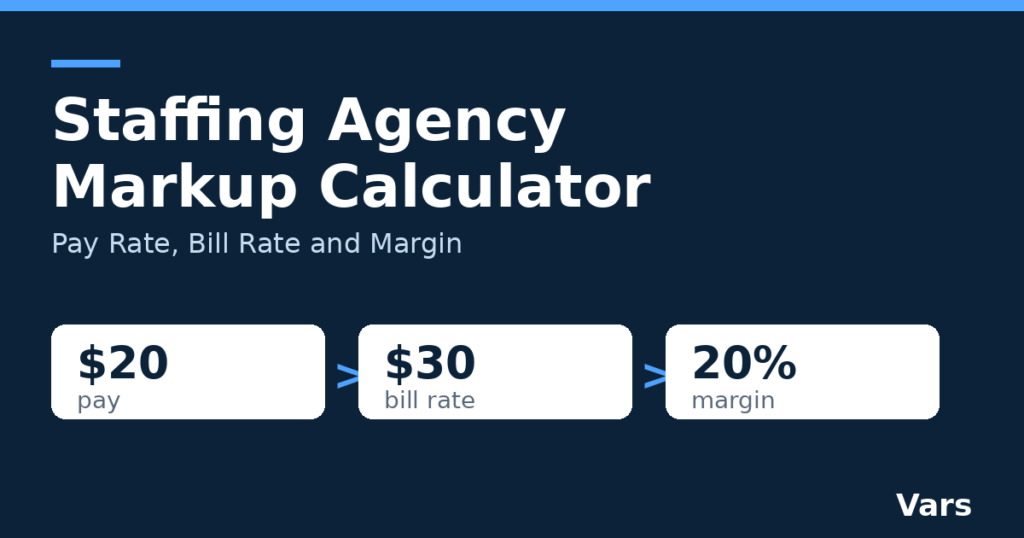
A staffing agency markup calculator needs only three inputs: pay rate, burden per hour and either a target markup or a target gross margin. Two published formulas cover it: Markup % = (Bill Rate − Pay Rate) ÷ Pay Rate, and Gross Margin % = (Bill Rate − Direct Costs) ÷ Bill Rate (Advance Partners). Use the margin formula to price; use the markup to talk to clients.
What are the four numbers in every quote?
Pay rate: the worker’s hourly wage. Burden: employer costs on top of wages, such as payroll taxes, unemployment insurance, workers’ comp and any benefits. Bill rate: what the client pays per hour. Markup: the percentage added to pay to reach the bill rate.
How does a staffing agency markup calculator work in a worked example?
See how Vars covers this for your agency
Scheduling, credentialing, and payroll in one platform.
Pay rate $20, target markup 50%. Bill rate = $20 × 1.50 = $30. Margin before burden is $10 ÷ $30 = 33%.
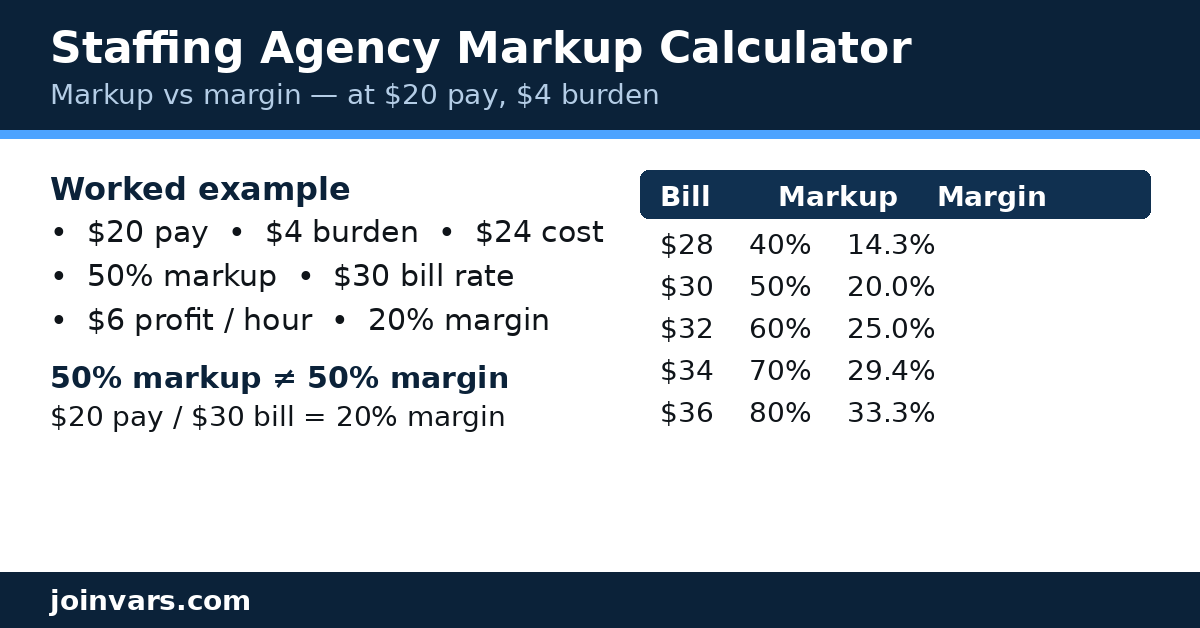
Add $4 of burden (20% of pay; illustrative). Direct cost is $24, gross profit $6, gross margin 20%. One accounting guide walks through the same example with the same figures (Beancount).
Common operational mistake: assuming a 50% markup produces a 50% margin.
How do you price from a target margin?
Bill rate = (Pay rate + burden per hour) ÷ (1 − target margin)
With $20 pay, $4 burden and a 25% target: $24 ÷ 0.75 = $32. Markup is ($32 − $20) ÷ $20 = 60%. Reaching 25% margin needed a 60% markup, not 50%.
What does a reference table look like?
Assuming pay $20 and burden $4:
| Bill rate | Markup | Gross profit/hr | Gross margin |
|---|---|---|---|
| $28 | 40% | $4 | 14.3% |
| $30 | 50% | $6 | 20.0% |
| $32 | 60% | $8 | 25.0% |
| $34 | 70% | $10 | 29.4% |
| $36 | 80% | $12 | 33.3% |
How do you build it in a spreadsheet?
With pay in A2, burden in B2, bill rate in C2 and target margin in D2:
- Markup:
=(C2-A2)/A2 - Gross profit per hour:
=C2-A2-B2 - Gross margin:
=(C2-A2-B2)/C2 - Bill rate from target margin:
=(A2+B2)/(1-D2)
What ranges should you expect?
One payroll-funding firm puts temporary staffing markups at about 20% to 75% and cites Staffing Industry Analysts gross margins of 14% to 41% with a 25% average (Advance Partners, Q&A). Light industrial and clerical lean lower, specialized roles higher (RecruitBPM).
What should burden include, and what do agencies forget?
Employer Social Security and Medicare, federal and state unemployment, workers’ compensation (varies by job class), liability insurance, required paid leave and per-hour onboarding costs. Agencies often forget overtime (bill and pay differ), cost of money on slow-paying clients and unbilled time such as orientation and minimum-shift pay.
What usually breaks at scale: one flat markup applied to every role even though workers’ comp rates differ widely.
Where does Vars fit in the workflow?
A calculator helps at quote time. In most agencies, margin leaks later, when approved time, pay rates and invoices disagree. Vars payroll and billing software and staffing billing software keep rates, approved hours and invoices in one place so realized margin per placement is visible, not guessed. Software shows the number; the rate card still needs your judgment.
What should you fix first?
- Get real burden per role from payroll and insurance records.
- Price new work from target margin.
- Review overtime billing rules.
- Compare quoted margin with realized margin monthly.
What mistakes do agencies make when using a markup calculator?
Using a rule-of-thumb burden is the first. Applying one markup to every role is the second. Forgetting overtime, orientation and paid no-shows is the third. Not checking realized margin against quoted margin is the fourth.
Key takeaway for operations leaders: a calculator is only as good as the burden you feed it.
How do you roll a pricing method out to the team?
Build one sheet with role-level burden and target margin, give account managers the bill rate output and a floor, and require approval below it. Review actual margin monthly for the first quarter.
FAQs
What is a good markup for a staffing agency?
It depends on segment and burden; compute the margin it produces instead.
Is markup applied to pay or to bill rate?
To pay rate. Margin is calculated on bill rate.
How often should I recalculate burden?
Whenever comp, unemployment or benefit costs change, and at least annually.
Should overtime use the same markup?
Often no; confirm your contract and compute margin on overtime hours separately.
Conclusion
A staffing agency markup calculator only protects you if the burden input is real and margin is rechecked against actuals.
Next step for agency owners: recompute margin on your three largest accounts using your actual burden.
Numbers are illustrations. Use your own burden and confirm tax and insurance costs with your payroll provider.