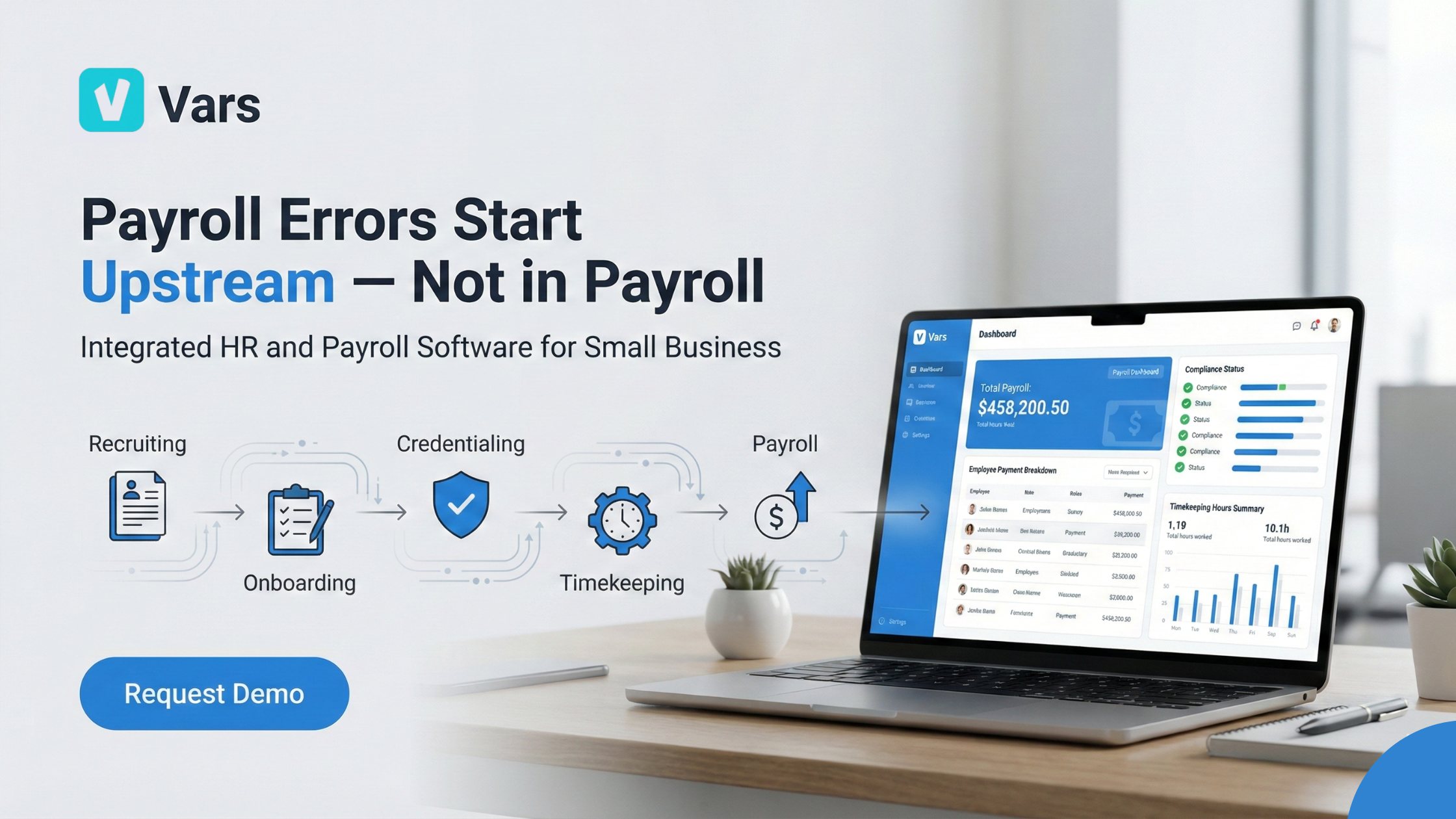
If you’re searching for the best HR and payroll software for small business, you’re likely trying to fix one of three problems: payroll errors, compliance stress, or too many disconnected tools.
In 2026, small businesses, especially staffing agencies, don’t just need payroll processing. They need a system that connects recruiting, onboarding, compliance, timekeeping, payroll, and reporting in one operational workflow.
Let’s break down what actually works and what breaks at scale.
Why Do Small Businesses Outgrow Basic Payroll Tools So Quickly?
Most small companies start with simple payroll services. That works until:
You hire contractors and W2 employees at the same time
You operate across multiple states
You manage variable hours and overtime
Compliance documentation becomes harder to track
Your recruiter and payroll systems don’t talk to each other
When we worked with a mid-size healthcare staffing agency, they were running:
An ATS
A separate payroll tool
Spreadsheets for credential tracking
Email threads for onboarding
The result?
Delayed payroll runs
Incorrect classifications
Manual year-end corrections
No real-time operational visibility
Common operational mistake: Choosing payroll software without considering how it connects to hiring and deployment workflows.
What Makes the Best HR and Payroll Software for Small Businesses in 2026?
See how Vars covers this for your agency
Scheduling, credentialing, and payroll in one platform.
The definition has changed.
Today, the best payroll service for small businesses must do more than cut checks.
It must:
Automate multi-state tax calculations
Handle W2 and 1099 classifications correctly
Sync with onboarding documentation
Track compliance requirements
Integrate with ATS systems
Provide real-time reporting
Here’s a simplified comparison:
Basic Payroll Tool
Modern Workforce System
Processes payroll only
Connects payroll to hiring & onboarding
Manual compliance tracking
Built-in compliance workflows
Limited reporting
Custom, on-demand analytics
Standalone system
Acts as a system of record
Key takeaway for operations leaders: If payroll isn’t connected to candidate readiness and deployment, errors will surface at scale.
How Do Staffing Agencies Handle Payroll Without Breaking Compliance?
Staffing agencies face added complexity:
Multiple pay rates per worker
Overtime rules by state
Reimbursements
Timekeeping variations
Credential-dependent deployment
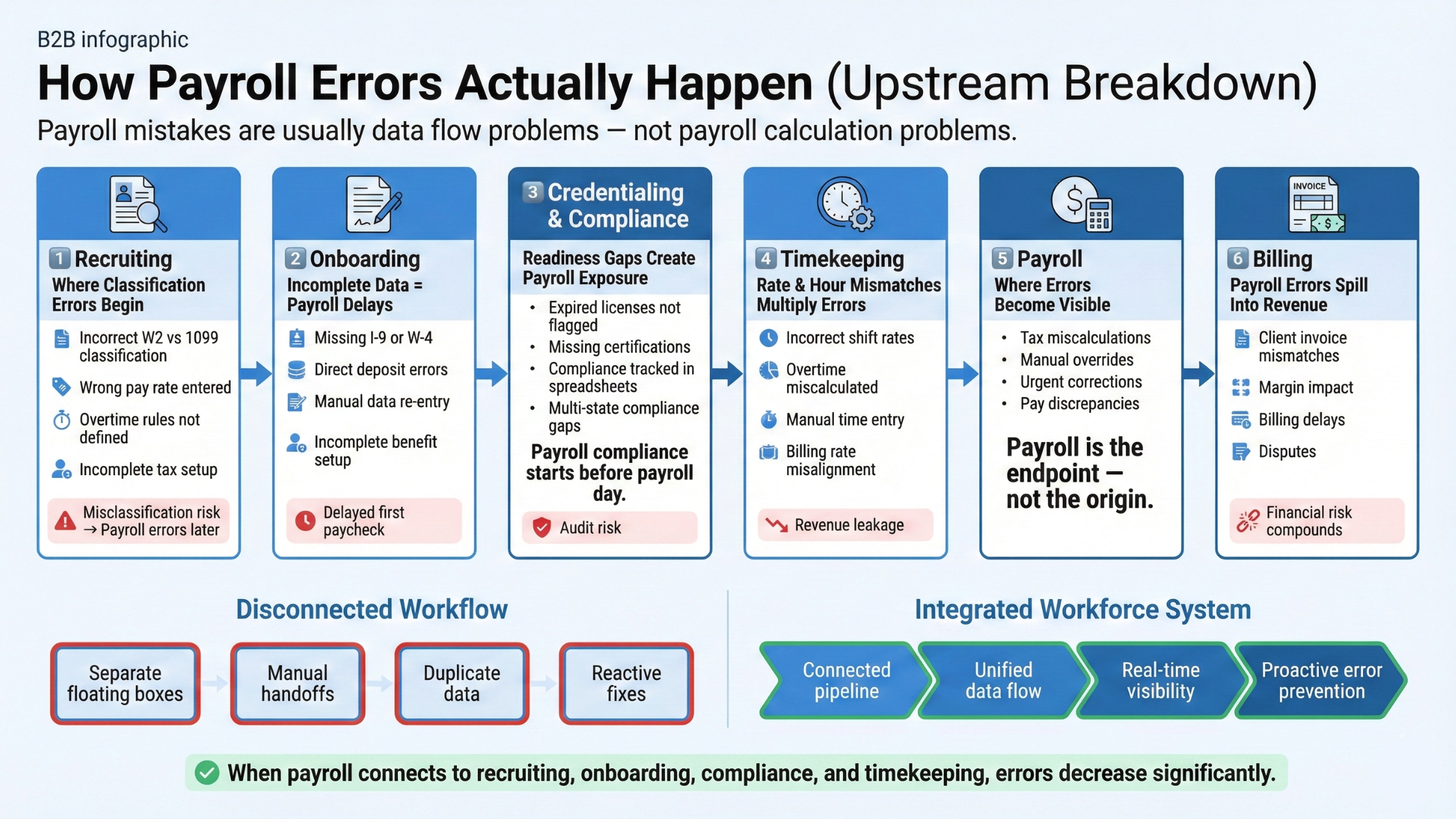
In real implementations, the biggest bottleneck is usually not payroll processing itself but data accuracy before payroll runs.
If onboarding documents are incomplete
If credentialing status isn’t updated
If time entries are mismatched
Payroll becomes reactive instead of controlled.
Pro tip for staffing agencies: Payroll compliance starts at onboarding, not at payroll day.
Where Does VARS Fit in the Workflow for Small Staffing Agencies?
VARS is built specifically for staffing operations, not generic HR use cases.
Instead of treating payroll as a standalone module, VARS connects:
Timekeeping
How does this change operations:
1. Automated Payroll Management
Accurate calculations for full-time, part-time, and contract staff
Built-in tax handling
Reimbursements and benefits tracking
2. Seamless ATS Integration
Payroll pulls directly from recruitment and onboarding data, reducing duplicate entry and manual reconciliation.
3. Compliance Assurance
Federal, state, and local payroll requirements are embedded into workflows.
4. Custom Reporting & Analytics
Operations managers can generate:
Client-specific payroll reports
Employee-level breakdowns
Year-end documentation
5. Employee Self-Service Portal
Staff can:
View pay stubs
Update personal details
Access documentation
6. Mobile-Ready Access
Field teams and managers can monitor payroll and workforce data in real time.
Why Is Payroll Integration With ATS and HR Tools So Important?
One operations lead once told us:
“Payroll errors aren’t payroll mistakes. They’re upstream data problems.”
When payroll doesn’t integrate with ATS and onboarding:
Recruiters miss classification changes
Compliance documentation isn’t updated
Timekeeping data must be re-entered
Billing mismatches occur
What usually breaks at scale:
Manual spreadsheets
Parallel systems
Unclear system of record
With an integrated system like VARS:
Payroll acts as the operational endpoint
Data flows forward, not sideways
Reporting is centralized
This is especially important for small agencies planning growth.
How Can Small Businesses Ensure Error-Free Payroll Processing?
Here’s a practical implementation sequence:
Step 1: Map Your Current Workflow
Identify:
Where data enters
Where it’s re-entered
Where approvals are manual
Step 2: Define System of Record
Choose one platform to own:
Employee data
Classification
Compliance documentation
Pay structure
Step 3: Automate Compliance Tracking
Especially for:
Multi-state payroll
Healthcare staffing documentation
Tax filing
Step 4: Enable Real-Time Reporting
Operations leaders should not wait for the month-end to identify payroll errors.
Important: Software alone will not fix broken processes. Standardized workflows must exist before automation.
What Should Small Businesses Look for in HR and Payroll Software?
If you’re evaluating tools in 2026, prioritize:
Cloud-based infrastructure
Secure employee data handling
Automated tax filing
Integrated onboarding
Role-based access controls
Custom reporting dashboards
Avoid:
Tools that require heavy manual exports
Platforms without ATS integration
Systems that treat compliance as an afterthought
Is VARS the Best HR and Payroll Software for Small Businesses?
For general retail or restaurant businesses, simpler payroll platforms may work.
But for staffing agencies and workforce-heavy small businesses, VARS functions as:
Payroll engine
Compliance tracker
Reporting hub
System of record
That distinction matters when:
You scale across states
You manage multiple client accounts
You deploy workers rapidly
You need audit-ready documentation
The best HR and payroll software for small businesses isn’t the one with the flashiest interface; it’s the one that supports operational clarity.
FAQ: HR and Payroll Software for Small Business
What is the best all-in-one HR and payroll software for startups?
Startups benefit from platforms that combine onboarding, compliance, and payroll in one system. Integrated workforce systems reduce future migration costs.
What is the easiest-to-use payroll and HR software for a small business?
Ease of use depends on workflow design. Systems that unify ATS, onboarding, and payroll eliminate manual reconciliation.
Which cloud-based HR and payroll services are best for small business compliance?
Look for tools that automate multi-state tax filing, track documentation, and generate audit-ready reports.
What are the most secure HR and payroll software platforms for small business data?
Platforms with encrypted cloud infrastructure, role-based permissions, and centralized system-of-record architecture provide stronger protection.
How do small businesses handle payroll and HR tasks with specialized software?
They centralize employee data, automate tax calculations, connect payroll to onboarding, and enable real-time reporting for operations leaders.
Final Takeaway for Staffing Leaders
If you’re evaluating the best payroll service for a small business, start by auditing your current workflow:
Where are payroll errors coming from?
How many systems hold employee data?
Can you see compliance status in real time?
Before buying new software, map your process.
Then choose a platform that supports how your agency actually runs.
For staffing-focused small businesses, integrated systems like VARS can reduce payroll friction not by adding features, but by aligning operations end-to-end.
That alignment is what makes payroll predictable, compliant, and scalable in 2026.
Frequently Asked Questions
What makes the best HR and payroll software for small businesses in 2026?
It needs automated payroll processing, built-in compliance safeguards, and seamless ATS integration so payroll data does not have to be re-entered by hand.
How do staffing agencies handle payroll without breaking compliance?
Automated tax calculation and worker classification tools help agencies stay compliant even as pay rates and worker types vary from client to client.