A locum physician placement can fall through for reasons that have nothing to do with the physician or the facility, most often because a license, DEA registration, or board certification quietly expired while everyone assumed it was still current. Locum physician credentialing software exists specifically to catch that gap before it costs a placement, and the difference between catching it and missing it usually comes down to how expiration tracking actually works. A single missed renewal can end a placement that was otherwise going well.
Why does credentialing carry more risk in locum staffing than other verticals?
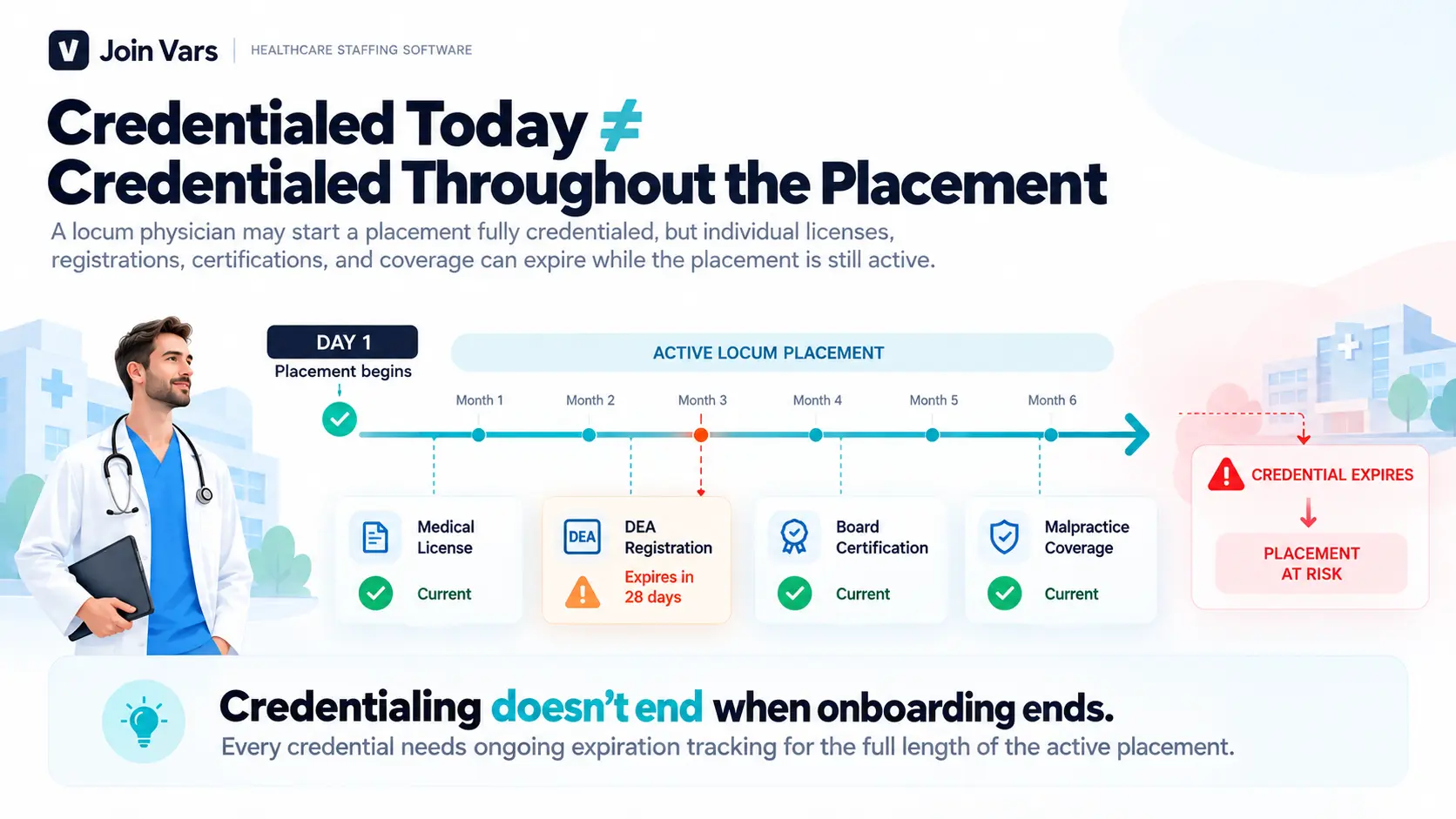
Locum tenens staffing compounds two things that make credentialing harder than in most other staffing categories: physicians often hold multiple state licenses and certifications simultaneously, and placements are frequently short-term, which means credentialing has to happen faster and more often than for a permanent hire. A single physician might be juggling state medical licenses in more than one state, DEA registration, board certification, malpractice insurance coverage, and facility-specific privileging requirements, all at once.
Each of these has its own expiration date, its own renewal process, and its own lead time. Tracking all of them manually across a roster of locum physicians is where the risk concentrates, and it rarely announces itself until a placement is already affected.
What actually happens when a credential expires mid-placement?
See how Vars covers this for your agency
Scheduling, credentialing, and payroll in one platform.
The immediate problem is operational: a facility cannot legally continue using a physician whose license or DEA registration has lapsed, regardless of how the placement was going otherwise. The placement stops, the facility scrambles to cover the gap, and the agency’s relationship with that facility takes the hit, even when the expiration was a paperwork failure rather than anything related to the physician’s performance.
That last point is worth sitting with. From the facility’s side, an expired credential looks like the agency dropped the ball, not like an administrative oversight buried in a spreadsheet somewhere. The reputational cost often outlasts the operational disruption.
Common operational mistake: assuming that because a credential was verified at the start of a placement, it will remain current for the full duration without a separate ongoing check. Locum placements can run long enough that a credential verified at intake expires well before the placement ends.
How do healthcare staffing agencies track credentials at scale?
Most agencies start with a spreadsheet or a shared calendar tracking expiration dates per physician. This works at a small scale, but healthcare staffing credentialing tracking breaks down for a specific reason: the number of individual credentials per physician multiplies fast. A roster of fifty locum physicians, each holding three to five separate credentials with different expiration dates, means tracking 150 to 250 individual deadlines, not fifty.
| Tracking method | Works well at | Breaks down when |
|---|---|---|
| Spreadsheet, manual review | A handful of physicians | Credential count exceeds what one person can review weekly |
| Shared calendar reminders | Single-person oversight | The person is out, or reminders get buried |
| Automated expiration alerts | Any scale | Rarely breaks, since the system rather than a person is checking dates |
Pro tip for staffing agencies: ask whether your current tracking method would still catch an expiring DEA registration if the person who normally monitors it were out for two weeks. If the honest answer is no, that is the actual gap to close, not a hypothetical one.
Where does credential tracking connect to onboarding and compliance?
Credentialing does not stop at initial verification. The real risk window is the middle of a placement, well after onboarding is complete and before anyone is actively thinking about renewal. This is why credentialing needs to be connected to ongoing compliance tracking rather than treated as a one-time intake step.
Vars’ Credentialing module tracks each license, certification, and registration individually, with expiration alerts that fire ahead of the deadline rather than after it, tied directly to the physician’s active placement record. The Compliance module extends that visibility across the full placement, so an expiring credential is flagged before it becomes a facility-facing problem rather than after. Because the Candidate Onboarding module captures credential data at intake, that same data carries forward into ongoing tracking instead of being re-verified from scratch each renewal cycle.
What usually breaks at scale: it is rarely the initial credentialing check that fails. It is the renewal tracking mid-placement, because that step depends on someone remembering a date months after the original verification happened.
What should a healthcare staffing agency evaluate in credentialing software?
- Does it track individual credentials separately, not a single bundled “credentialed” status per physician?
- How far ahead does it alert before expiration, and can that lead time be adjusted per credential type?
- Does it tie credential status directly to active placements, so an at-risk placement is visible immediately?
- Does onboarding data flow into ongoing tracking, or does credentialing reset at each renewal?
- Can it handle multi-state licensure for physicians credentialed in more than one state at once?
Key takeaway for operations leaders: the goal is not just to verify credentials once. It is to keep visibility on every individual expiration date for the full length of every active placement, without depending on one person’s memory to catch it.
Software reduces the manual burden of tracking, but an agency still needs a clear owner for reviewing alerts and following up with physicians on renewals. The system surfaces the risk; a person still has to act on it.
FAQ
How long does it take to implement healthcare staffing credentialing software?
Implementation timelines vary with roster size, but most of the work is migrating existing credential data and confirming expiration dates are accurate at the start, which can often be done within a week or two for a mid-size roster.
What features actually matter most for locum credentialing?
Individual credential-level tracking with automated, adjustable expiration alerts matters most, since bundled or manual tracking is where expirations get missed.
Can small locum staffing agencies benefit from credentialing software?
Yes. Even a roster of a dozen physicians can represent 40 to 60 individual credentials to track, which is more than most teams can reliably monitor by memory alone.
Does credentialing software replace the credentialing team?
No. It removes the manual tracking burden and surfaces risk earlier, but verifying documents and following up with physicians still requires human review.
What happens to a physician’s placement if a credential lapses briefly and is then renewed?
This depends on the facility's own policy and the specific credential involved, so it is worth confirming directly with each facility rather than assuming a brief lapse is automatically forgiven.
Next step
Pull your current locum roster and count how many individual credentials, not physicians, credentials, are being tracked right now, and by what method. That count is usually the clearest signal of whether manual tracking still fits your current scale.