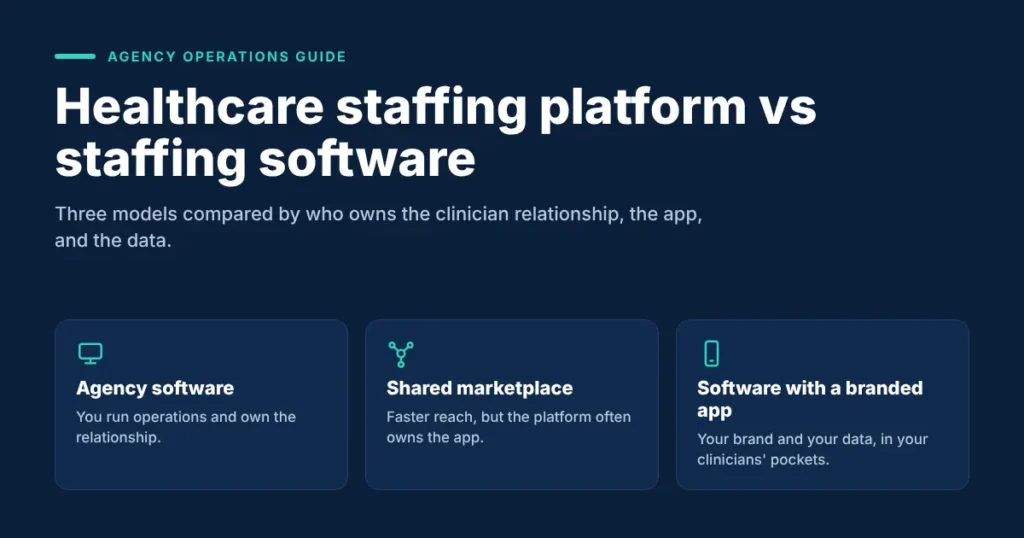
A healthcare staffing platform usually means a marketplace or network where clinicians find shifts, while healthcare staffing software is the system an agency runs its own operations on. The terms overlap, so check who owns the clinician relationship, the app, and the data. Agencies that want their own brand and control may prefer software with a branded app.
Search for either term and you will find the same vendors described both ways. One page calls a product a platform. The next calls the same kind of product software. For an agency owner, the labels matter less than what sits behind them.
The difference shows up in who the clinician sees, who holds the records, and who carries the compliance work. Pick the wrong model, and you can end up paying for a system that does not fit how your agency makes money.
This guide separates the terms, compares three common models, and gives you questions to ask before you buy. It is written for agency owners and operations leaders.
Key takeaway for operations leaders: ignore the label and ask three things. Who owns the relationship with the clinician? Who owns the app and brand? Who owns the data?
What does healthcare staffing software mean?
Healthcare staffing software is the system a staffing agency uses to run its own business. The agency recruits clinicians, places them with facilities, and pays them. The software supports each step.
Typical parts include:
- Recruiting: an applicant tracking system and candidate communication
- Credentialing and onboarding: document collection, expiry tracking, and checklists
- Scheduling and deployment: shift offers, assignments, and confirmations
- Time, payroll, and billing: timesheets, pay rules, and invoices
- Reporting: fill rate, time to fill, and credential gaps
In this model, the agency owns the relationship with the clinician and the facility. The software is a tool inside the agency. Clinicians usually know the agency’s name, not the software vendor’s.
The agency decides pay rates, bill rates, and rules. It also carries the responsibility for compliance, since it is the one placing clinicians.
Common operational mistake: assuming software alone brings clinicians or shifts. Software runs the work. The agency still has to source clinicians and win facility business.
What does a healthcare staffing platform mean?
See how Vars covers this for your agency
Scheduling, credentialing, and payroll in one platform.
A healthcare staffing platform usually refers to a network that connects clinicians and facilities, often through an app. Clinicians browse and book shifts. Facilities post needs and receive qualified clinicians.
In this model, the platform owns the app, the brand, and much of the clinician audience. Agencies may participate as suppliers, or the platform may act as the employer or intermediary. Terms vary a great deal, including how clinicians are engaged and how fees are set, so read the agreements closely.
Platforms can be useful for reaching clinicians quickly. They can also place the platform between the agency and its own people. Clinicians may build loyalty to the app, not to the agency that sourced them.
The word platform is also used more loosely. Some vendors call their agency software a platform because it covers many functions. That use describes breadth, not a marketplace.
What usually goes wrong: an agency joins a marketplace expecting to keep its clinicians’ loyalty, then finds that the app and the data belong to someone else. Ask who owns the relationship before you sign.
For related guidance on how apps change the picture for agencies, see our look at healthcare staffing in the gig app era.
How do software, marketplace platforms, and branded apps compare?
Most offers fall into one of three models. Use the table to see where each one puts ownership and responsibility.
| Question | Agency staffing software | Shared marketplace platform | Software with a branded app |
|---|---|---|---|
| Who owns the clinician relationship? | The agency | Often the platform, sometimes shared | The agency |
| Whose brand do clinicians see? | The agency’s, if it chooses | The platform’s | The agency’s |
| Who runs operations? | The agency | Varies by platform | The agency |
| Who holds the data? | The agency, under its vendor contract | Depends on the platform’s terms | The agency, under its vendor contract |
| How do clinicians find shifts? | Through the agency’s channels | In the shared app | In the agency’s own app |
| What does the agency need to bring? | Clinicians, clients, and a process | Qualified clinicians or capacity | Clinicians, clients, and a rollout plan |
| Main trade-off | Needs its own sourcing and engagement | Faster reach, less control | More control, needs adoption effort |
The models are not exclusive. Some agencies run their own software and branded app, and also list shifts on a marketplace to fill gaps. What matters is that they know which relationship each channel creates.
Key takeaway for operations leaders: the three models differ most in ownership of the relationship and the data. Cost and features come second.
Why do people use healthcare staffing platform and software interchangeably?
Three things blur the line.
- Marketing language. Vendors choose words for search and appeal. A single product can be described as software, a platform, a system, or a solution on different pages.
- Overlapping features. Both models can include shift booking, credential tracking, and mobile apps. The difference lies in who runs them and for whom.
- Hybrid offers. Some vendors sell agency software and also operate a marketplace. Others let an agency run its own branded marketplace-style app.
The practical effect is that a comparison chart can mislead. Two products can list the same features while giving you very different control.
Pro tip for staffing agencies: when you read a vendor page, replace the word platform with a question. Does this product run my agency, or does it run a marketplace I join? The answer changes what you are buying.
Which model fits which kind of healthcare staffing agency?
There is no single right answer. Match the model to your situation.
- A new or small agency with few clinicians. A marketplace can help you reach clinicians and shifts quickly. Plan to build your own software and relationships as you grow.
- An established agency with a loyal roster. Agency software protects your relationships and gives you control of the process. A branded app can make shift booking easier for your clinicians.
- An agency that wants to compete on convenience. A branded app gives clinicians a modern way to book, while you keep the brand and the data.
- An agency with seasonal or uneven demand. A mix of your own channel and an outside marketplace can fill gaps, if you track what each channel creates.
- A hospital or health system internal team. Look for software that manages your own pool first, then outside labor.
What usually breaks at scale: the hybrid. When an agency runs several channels, clinician records and hours end up in several places. Decide which system is the source of truth for credentials, time, and pay.
Common operational mistake: choosing a model based on this quarter’s demand. Look at where you want your clinician relationships to sit in two years.
What does an agency keep and give up under each model?
Every model involves trade-offs. Naming them early avoids surprises.
Agency software
- You keep: the relationship, the brand, the data, and the rules
- You give up: the built-in audience a marketplace offers, so sourcing remains your job
Shared marketplace
- You keep: speed of access to clinicians and shifts
- You give up: some control over the relationship, the brand, and often the data
Software with a branded app
- You keep: the relationship, the brand, and the data, plus a modern booking experience for clinicians
- You give up: time and effort to roll out the app and bring clinicians onto it
Compliance sits with the agency in each case when it places clinicians, though how the work is shared differs. Marketplaces may take on some steps. Others leave them to you. Ask exactly which credential checks, records, and reports you are responsible for, and confirm requirements with your own compliance team.
Key takeaway for operations leaders: control and convenience often pull in opposite directions. Decide which one your agency needs most, and choose the model that gives it to you.
What should you ask a vendor to find out which model you are buying?
Use these questions in a demo or a written review.
- ☐ Who owns the relationship with the clinicians who use this product?
- ☐ Whose name and brand appear in the clinician app?
- ☐ Can the agency publish its own app under its own developer account, and what happens if we leave?
- ☐ Who owns the clinician and shift data, and can we export it?
- ☐ Does the product also run a shared marketplace, and does our data or our clinicians appear in it?
- ☐ Which credential checks, records, and reports are our responsibility, and which does the vendor handle?
- ☐ How do pay rules and bill rules work, and who sets them?
- ☐ How do clinicians move from texts or another app to this one?
- ☐ What support exists for rollout and adoption?
- ☐ What are the contract terms for ending the relationship?
Common operational mistake: accepting a verbal yes to the ownership questions. Ask for the contract language that supports the answer.
Pro tip for staffing agencies: if you plan to use a branded app, ask for a walkthrough of how a new clinician downloads it, signs up, uploads documents, and books a first shift. That path decides adoption.
How can an agency move from software only to a branded app?
Many agencies start with software for operations and add a branded app later. A phased path reduces risk.
- Stabilize the core. Get recruiting, credentialing, scheduling, and payroll running in one system before you change the clinician experience.
- Clean your clinician data. Fix duplicates, missing expiry dates, and outdated contact details.
- Define the clinician journey. Write the steps from download to first shift, and note where each clinician might stall.
- Pilot with a small group. Pick clinicians who work often and will give feedback.
- Move shift offers to the app first. Send offers through the app, and reduce parallel texting over time.
- Promote and support. Announce a date, offer help with sign-up, and answer questions quickly.
- Review. Look at time to fill, confirmations, document status, and how many clinicians use the app each month.
Where process matters as much as the tool: adoption is a people task. If coordinators keep texting shifts out, clinicians have no reason to open the app. Agree on one channel for offers and stick to it.
What usually breaks at scale: app updates and support. Mobile systems change often, so ask who handles updates, store listings, and fixes before you commit.
What mistakes do agencies make when choosing between a platform and software?
- Buying the label. A product called a platform may be a marketplace, agency software, or both.
- Ignoring who owns the relationship. The answer shapes your long-term position.
- Assuming features equal control. Two products can list the same features and differ in ownership.
- Skipping the contract. Terms on data, app ownership, and exit matter more than the feature grid.
- Running several channels with no source of truth. Records and hours drift apart.
- Launching an app with no rollout plan. Clinicians keep using old habits.
- Treating software as a sourcing strategy. Software helps you run and scale. You still need to win clinicians and clients.
What usually breaks at scale: control over the clinician experience. An agency that relies on a shared channel for most of its shifts can find its position weakens as the channel grows.
Common operational mistake: comparing price without comparing ownership. A lower fee does not help if you cannot take your clinicians and data with you.
Tools worth considering
If you are building a shortlist, these are two to include in your review:
- Vars Health, a healthcare staffing and scheduling software platform. It offers a custom-branded healthcare staffing app alongside applicant tracking, credential management, scheduling, timekeeping, and payroll.
- Join Vars: an AI-native staffing platform that also serves agencies placing outside healthcare, which matters if your business spans industries.
Match any tool to your agency size, placement mix, and compliance requirements, and ask each provider for a demo before deciding.
Frequently asked questions
Is a healthcare staffing platform the same as healthcare staffing software?
Not always. The terms overlap. A platform often means a marketplace connecting clinicians and facilities, while software is the system an agency uses to run its own operations. Check who owns the relationship, the app, and the data.
What is a white-label staffing app?
It is a mobile app built on a vendor’s technology and published under the agency’s own name and branding. Clinicians see the agency, not the vendor.
Can an agency run its own marketplace-style app?
Yes, some software vendors let agencies publish a branded app where clinicians browse and book shifts. The agency keeps the brand and the relationship.
Who owns clinician data on a shared marketplace?
It depends on the platform’s terms. Ask for the contract language, and ask whether you can export the data if you leave.
Do I need both a platform and staffing software?
Not necessarily. Some agencies use only their own software and branded app. Others add a marketplace for extra reach. If you use both, decide which system holds credentials, time, and pay.
How can I tell whether a vendor is a marketplace or a software company?
Ask whose brand the clinicians see, who owns the app listing, and who runs operations. The answers show which model you are buying.
Which model suits a new staffing agency?
It depends on your clinicians and clients. A marketplace can speed early reach, while agency software helps you build your own process and relationships. Many agencies plan to add the second as they grow.
Does a branded app replace recruiters?
No. It reduces routine messaging and makes booking easier, so recruiters can focus on relationships, exceptions, and hard-to-fill needs.
What is the practical next step when choosing a healthcare staffing platform or software?
When you compare a healthcare staffing platform with staffing software, start with ownership, not features. Who holds the relationship with the clinician, who owns the app and brand, and who holds the data? Those answers decide how much control your agency keeps as it grows.
There is room for both models. Many agencies run their own software and branded app, and use a marketplace to fill gaps, as long as they know what each channel creates.
One thing to do this week: take the shortlist you have, and ask each vendor the ownership questions from the checklist above in writing. Compare the answers side by side, and ask for the contract language behind them.