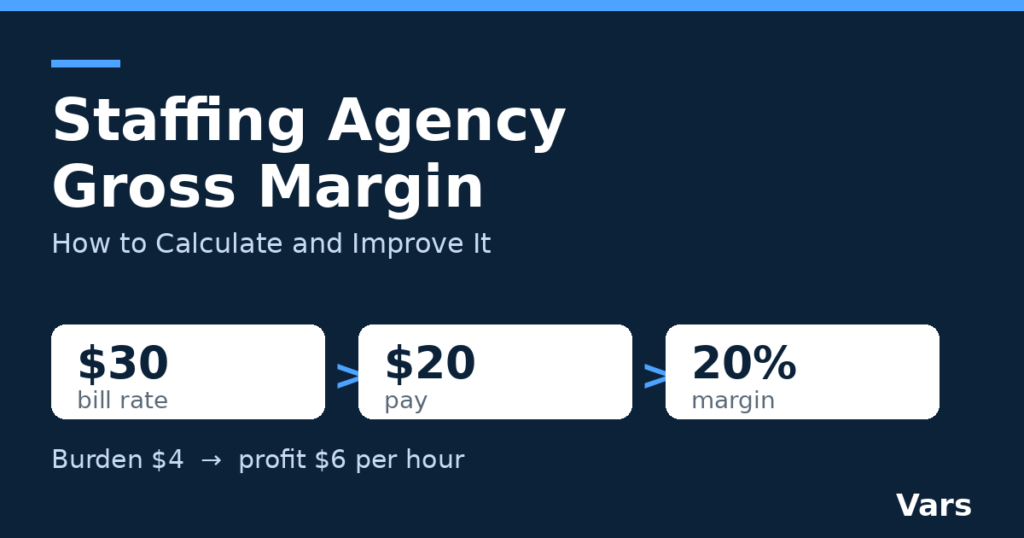
Staffing agency gross margin is gross profit divided by revenue, where gross profit is the bill rate minus pay rate minus burden. For one hour: Gross profit = Bill rate − Pay rate − Burden, and Gross margin % = Gross profit ÷ Bill rate (Beancount). Revenue can grow while margin shrinks, and many agencies notice only when cash tightens.
How do you calculate it for a shift and for the business?
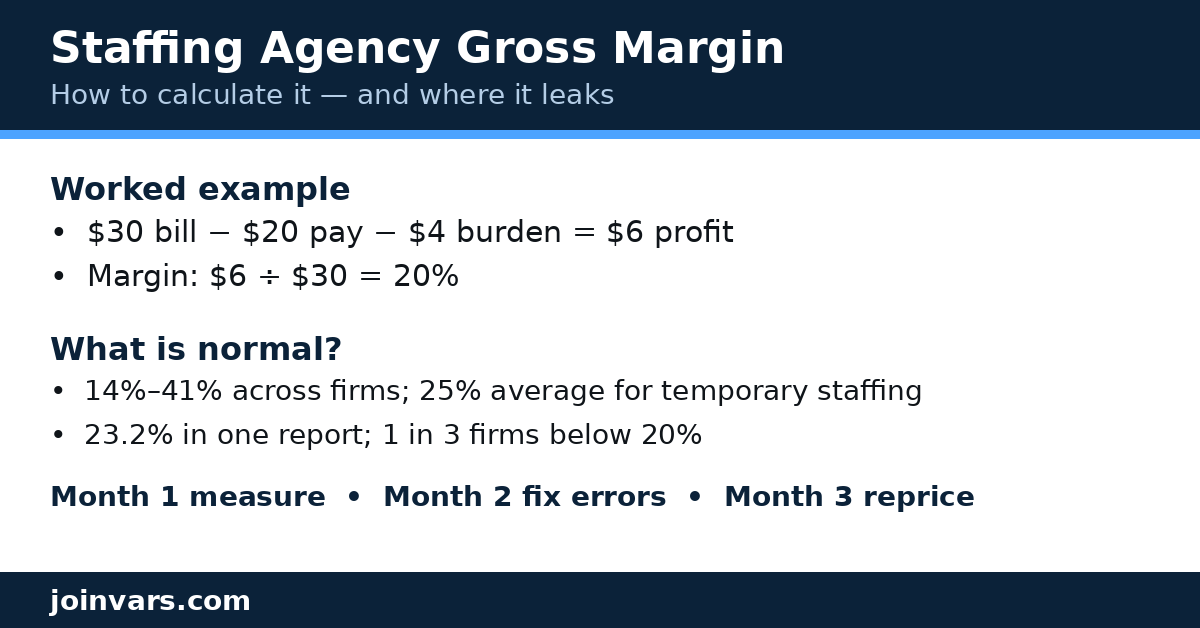
Bill rate $30, pay $20, burden $4: gross profit $6, gross margin 20%. For the business, add revenue and direct costs for a period and divide. Burden includes employer payroll taxes, unemployment, workers’ comp and paid benefits. Gross margin is what remains to pay internal overhead and the owner’s profit (Advance Partners).
Is gross margin the same as net profit?
See how Vars covers this for your agency
Scheduling, credentialing, and payroll in one platform.
No. Gross margin must still cover recruiters, commissions, rent, software, marketing, legal, extra insurance, financing and owner profit (Advance Partners).
What is a normal gross margin for a staffing agency?
Staffing Industry Analysts data cited by one payroll-funding firm shows 14% to 41% across firms with a 25% average for temporary staffing (Advance Partners Q&A). A vendor-published report summary mentions 23.2% and says one in three firms operates below 20% (Staffing Hub), one data point only. Light industrial sits lower, IT and finance higher (Level, a secondary compilation). Compare with your own segment and size.
Where does margin leak?
| Leak | Typical cause |
|---|---|
| Underpriced contracts | Rates set by markup, not updated for comp or unemployment changes |
| Overtime | Pay rises 1.5x but bill rate does not follow |
| Unbilled hours | Orientation, paid no-shows, minimum shifts |
| Billing errors | Missed hours, wrong rates, write-offs |
| Payroll rework | Corrections and off-cycle checks |
| Workers’ comp class codes | Wrong codes and audit charges |
| Bad debt and cost of money | Late payers, funding fees |
Common operational mistake: judging profitability from average margin. Averages hide the losing client.
How do you improve margin without losing clients?
- Measure by client, role and recruiter. The largest client often has the lowest margin; decide knowingly.
- Reprice at renewal and pass through statutory increases per contract.
- Fix overtime rules so bill rates reflect higher pay and burden.
- Tighten billing: invoice on a fixed schedule from approved time and resolve disputes fast.
- Reduce back-office cost per placement by automating timesheets, approvals and reconciliation.
- Review workers’ comp classifications and quotes.
- Manage collections with weekly aging reviews.
- Add higher-margin work such as specialized roles or conversion fees.
What usually breaks at scale: manual timesheet and invoice work, which grows with every new worker.
What should a monthly margin review include?
Gross margin by client and role, overtime share and its margin, unbilled hours, invoice errors and credits, days sales outstanding and workers’ comp cost as a share of payroll. Set a target and note what moved.
Where does Vars fit in the workflow?
In most agencies the margin number arrives weeks late because pay, bill rates and hours live in different places. Vars staffing billing software and payroll and billing software hold approved time, pay and invoices together so margin per shift can be read when work is done. They show the problem; pricing and contract changes still take a person.
What should you fix first?
Overtime billing and burden accuracy, then invoice timeliness, then client-level reporting.
What mistakes do agencies make when managing margin?
Looking at one blended number is the first. Measuring only at month end is the second. Ignoring overtime margin is the third. Discounting to win a client and never revisiting it is the fourth.
Key takeaway for operations leaders: margin by client and role, every month, beats a single annual figure.
What does a realistic improvement plan look like?
Month one: measure margin by client and role. Month two: fix overtime and burden errors. Month three: reprice the weakest accounts at renewal. Expect to see movement within a quarter if billing is already timely.
FAQs
What is a healthy gross margin?
It depends on segment; compare with similar agencies and your overhead.
Does automation raise gross margin?
It mainly cuts overhead, though fewer billing errors also protect margin.
Should I raise rates on every client?
No; start with the lowest-margin accounts.
How often should I review?
Monthly.
Conclusion
Staffing agency gross margin is manageable once it is measured by client and role every month.
Next step for agency owners: compute last month’s gross margin for your top five clients and compare.
Benchmarks come from third-party sources and vary by segment and year.