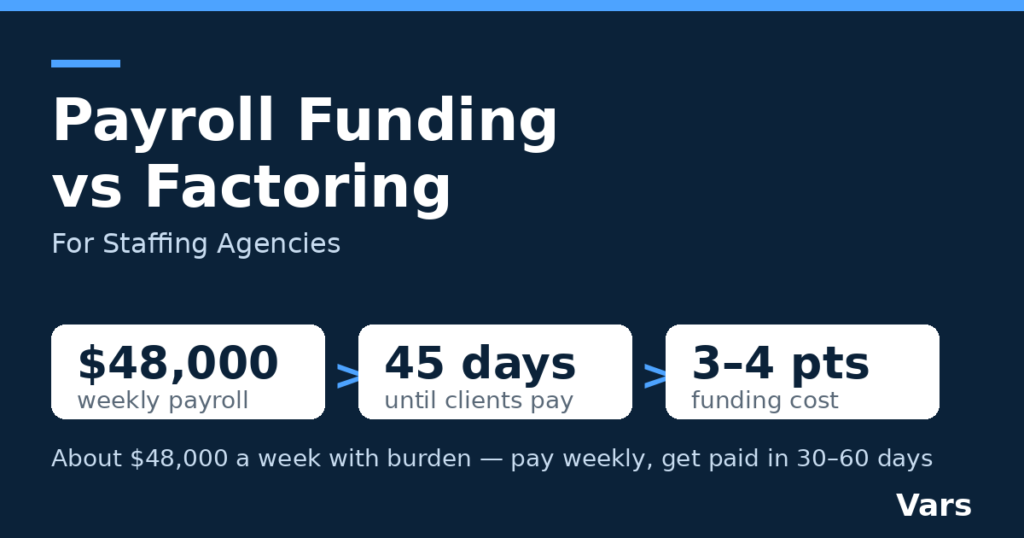
In the payroll funding vs factoring for staffing agencies decision, the core difference is scope. Factoring buys your invoices at a discount; payroll funding is factoring built for staffing, often adding payroll and tax handling. Both exist to close the gap between paying workers weekly and getting paid by clients in 30 to 60 days.
Why does the cash flow gap stall growth?
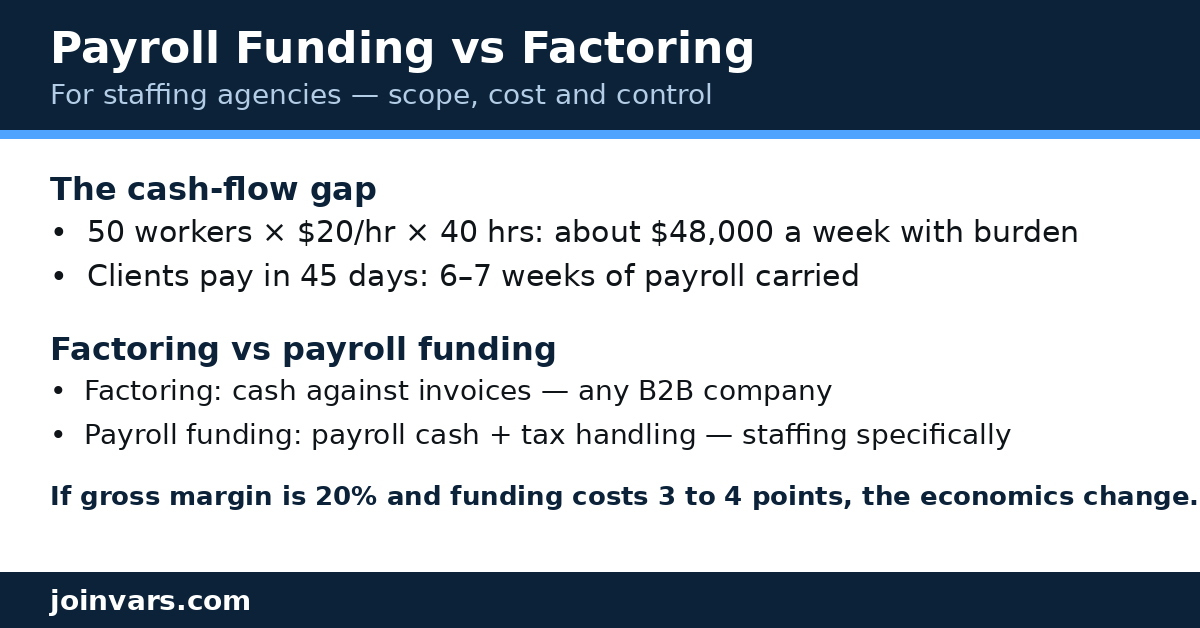
Place 50 workers at $20 an hour, 40 hours a week, and you fund about $48,000 weekly with burden. If clients pay in 45 days, you carry six to seven weeks of payroll before the first invoice clears, several hundred thousand dollars at any time. Growth makes it worse.
How does invoice factoring work?
See how Vars covers this for your agency
Scheduling, credentialing, and payroll in one platform.
You sell invoices to a factor at a discount. The factor advances most of the value up front and pays the remainder, minus fees, when the client pays. It usually collects from your client, so client credit matters. Terms to read: advance rate, a fee that grows with time outstanding, client notification, and recourse (you cover unpaid invoices) vs non-recourse (the factor takes some credit risk, usually for more).
How does payroll funding differ?
A payroll funder advances the cash for payroll and often payroll taxes, and takes invoices as repayment. One provider describes it as covering wages, taxes and other costs, with the funder collecting from your client (Advance Partners; a payroll-funding provider, so read it as one provider’s view). Some also handle tax filing and back-office tasks.
| Factoring | Payroll funding | |
|---|---|---|
| Delivers | Cash against invoices | Payroll cash, often with tax handling |
| Fit | Any B2B company | Staffing specifically |
| Payroll taxes | You file | Sometimes the funder |
| Credit check | On your clients | On your clients |
Labels vary by provider, so compare terms.
What does it really cost?
Fees are quoted as a percentage of invoice value per period. Compare effective cost: discount rate, minimum volume fees, setup or audit fees, wire and processing fees, reserve holdbacks, and termination fees. Convert to an annualized rate and ask for a sample monthly statement.
Common operational mistake: comparing headline rates while ignoring minimums and holdbacks.
Who carries the risk if a client does not pay?
Under recourse, you do. Non-recourse typically covers insolvency, not disputes, so disputed invoices usually fall back on you.
What usually breaks at scale: disputed and late invoices, which reduce what you can borrow against.
What are the alternatives?
A bank line of credit (cheaper but harder to get), shorter client terms or deposits for new accounts, early-pay discounts of 1% to 2%, or payroll through a PEO or employer of record.
How do you choose?
- How fast do I need to scale, and what cash does that need?
- Do I want to keep payroll and tax handling in house?
- What is my client credit profile?
- Can I live with client notification?
- What is the all-in annualized cost compared with my gross margin?
If gross margin is 20% and funding costs 3 to 4 points, the economics change.
Where does Vars fit in the workflow?
Funders price risk from your documentation. In most agencies the problem is unfundable invoices: wrong hours, wrong rates, slow approvals. Vars staffing billing software and payroll and billing software generate invoices from approved time and track aging, which makes receivables cleaner. Vars is not a funder; this is the data side of the decision. Funding fixes cash timing, not low margin.
What should you fix first?
Clean invoicing and collections first, then compare funders on all-in cost, then negotiate terms.
What mistakes do agencies make when choosing a funder?
Comparing headline rates and ignoring minimums and holdbacks is the first. Signing a long contract before testing on a pilot batch is the second. Not understanding recourse terms is the third. Funding a low-margin book of business without fixing pricing is the fourth.
Key takeaway for operations leaders: compare the annualized all-in cost on the same sample month.
What does a realistic process look like?
Collect quotes from two or three providers, run a sample month through each, have counsel review the agreement and start with a limited set of clients. Expect a few weeks from first call to funding.
FAQs
Is payroll funding just factoring?
It is a staffing-specific version, often with added payroll services.
Will my clients know?
Often, since many funders collect directly; ask about non-notification options.
Can a new agency qualify?
Funders often look at client credit more than your history.
When is a bank line better?
When you qualify and have stable receivables; it is usually cheaper.
Conclusion
Payroll funding vs factoring for staffing agencies is a question of scope, cost and control; the right choice follows your margin and client credit.
Next step for agency owners: request annualized all-in cost quotes from two providers using the same sample month.
General information, not financial or legal advice. Terms vary widely; consult an advisor.