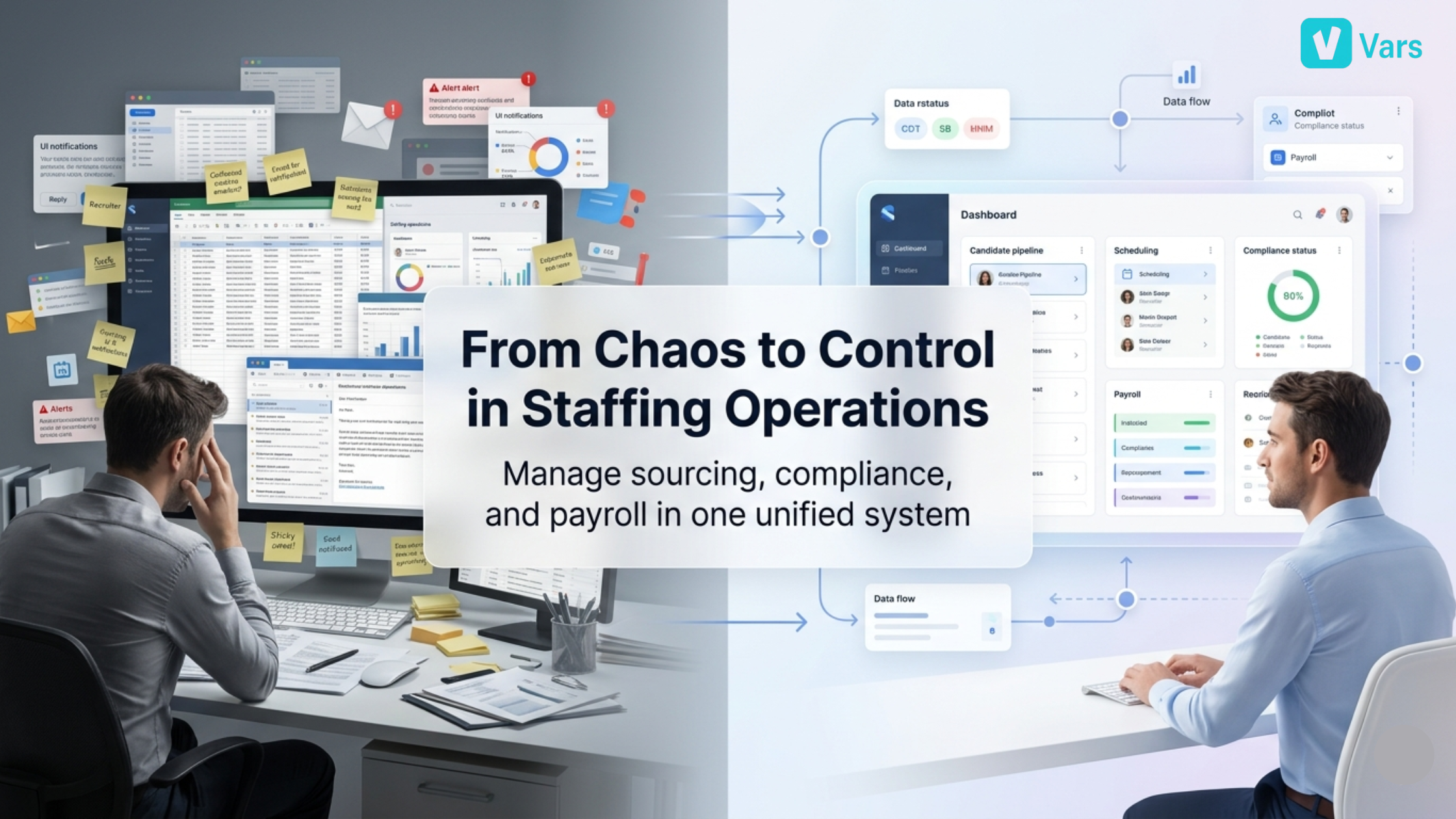
If you’re running a large staffing agency, you already know this:
Recruiting isn’t the hard part anymore; operations are.
At a smaller scale, you can get away with:
Spreadsheets
Disconnected tools
Manual follow-ups
But once you cross a certain volume, multiple recruiters, multiple clients, multiple locations, things start slipping.
Candidates fall through cracks.
Compliance gets delayed.
Payroll errors creep in.
That’s exactly where staffing agency software for enterprise operations becomes less of a “tool” and more of an operating system for your business.
What are the top features of enterprise staffing agency software?
Most platforms will tell you they have an ATS. That’s expected.
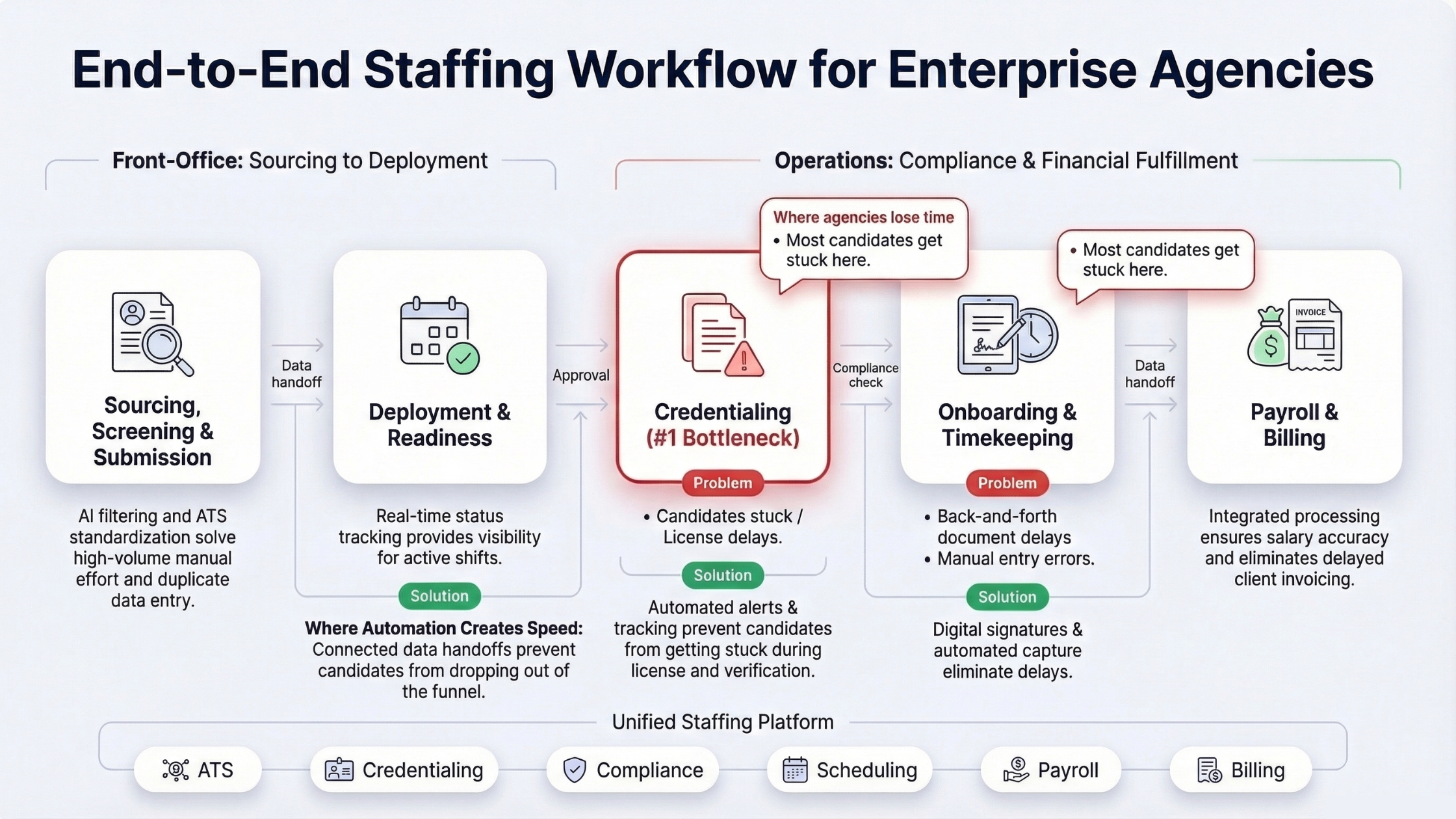
But enterprise agencies don’t need just an ATS; they need end-to-end workflow control.
Because in reality, your process doesn’t stop at sourcing.
It looks more like this:
Source → Screen → Submit → Credential → Onboard → Deploy → Track time → Bill → Pay
And if your system breaks anywhere in between, the entire chain slows down.
The features that actually matter in real operations:
ATS + CRM in one system: You’re not just managing candidates, you’re managing clients, job orders, and relationships. Platforms that combine both reduce duplication and confusion, similar to how modern systems unify workflows in an applicant tracking system for staffing agencies.
Automated onboarding workflows: Collecting documents manually is one of the biggest time drains. Good systems automate document collection, verification, and approvals using staffing candidate onboarding software.
Credentialing and compliance tracking: Especially in healthcare staffing, this isn’t optional. You need license tracking, expiry alerts, and audit-ready records powered by healthcare credentialing software for staffing agencies and supported by compliance management software for staffing agencies.
Scheduling and deployment tools: For shift-based roles or multi-location staffing, coordination becomes a full-time job without proper tooling like staffing scheduling software for shift-based workforce management.
Timekeeping, payroll, and billing integration: If these are disconnected, errors are inevitable. Integrated systems reduce reconciliation work and improve accuracy through staffing payroll and billing software.
Reporting and analytics: Not just dashboards, but actionable insights powered by staffing analytics and reporting software:
Time-to-fill
Time-to-deploy
Recruiter performance
What usually breaks at scale
This is something you only really notice after growth:
Recruiters working in one system, compliance in another
Payroll teams are fixing errors manually
No visibility into “who is actually ready to deploy”
Key takeaway:
Enterprise software isn’t about having more features.
It’s about connecting the workflow end-to-end.
How do staffing agencies manage high candidate volume without losing control?
See how Vars covers this for your agency
Scheduling, credentialing, and payroll in one platform.
A pattern I’ve seen repeatedly with large agencies:
They don’t have a candidate shortage.
They have a clarity problem.
One operations manager told me:
“We had thousands of candidates, but couldn’t tell who was actually ready.”
That’s the real issue.
Where things go wrong
Candidates move through stages, but no one owns the full lifecycle:
Recruiters push profiles forward
Compliance teams wait for documents
Operations wait for clearance
Meanwhile, candidates sit in limbo.
What actually works in practice
Defined lifecycle stages
Sourced
Screened
Credentialed
Deployment-ready
Automation between stages
Missing document alerts
Workflow triggers
Status updates
Centralized visibility: Everyone sees the same candidate status, no guesswork.
Modern systems like AI-powered staffing software for candidate lifecycle management are built exactly for this.
Where Join Vars fits in
In real implementations, this is where teams start seeing impact:
Recruiters no longer chase updates
Compliance teams work from structured workflows
Operations know exactly who is ready
That shift alone improves:
Time-to-deploy
Placement velocity
Team coordination
How enterprise staffing agency software improves recruiter productivity
Most recruiters aren’t underperforming; they’re overloaded.
If you sit with a recruiter for a day, you’ll notice something:
They spend more time managing the process than actually recruiting.
Common productivity drains
Switching between systems
Following up on missing documents
Re-entering candidate data
Lack of visibility into job requirements
What changes with the right setup
AI-assisted candidate matching helps shortlist faster using AI candidate matching software for staffing agencies
Automated communication workflows. Follow-ups, reminders, and updates happen using staffing communication and engagement tools
Single source of truth, no duplicate entries, no conflicting data
Pro tip for staffing agencies
Stop measuring recruiter activity (calls, emails).
Start measuring placements per recruiter.
That’s where software should create impact.
How to choose enterprise staffing agency software for healthcare staffing
Healthcare staffing is a different beast altogether, especially when using healthcare staffing software solutions designed for compliance-heavy environments.
You’re not just placing candidates, you’re dealing with:
Licenses
Certifications
Background checks
Compliance audits
Miss one step, and it’s not just a delay, it’s a risk.
What to evaluate before choosing a system
Requirement
Why it matters
Credentialing workflows
Prevents deployment delays
Compliance tracking
Keeps you audit-ready
Payroll & billing integration
Avoids financial errors
Scheduling tools
Critical for shift roles
Reporting
Enables operational decisions
Common mistakes agencies make
They choose software based on recruiting features only.
But in healthcare staffing, the real bottleneck is almost always:
credentialing + compliance
What are the essential reporting and analytics tools in staffing software?
At the enterprise level, decisions can’t rely on gut feeling.
You need visibility across the entire pipeline using staffing analytics and reporting software.
Metrics that actually matter
Time-to-fill
Time-to-deploy
Submission-to-placement ratio
Credentialing turnaround time
Payroll accuracy
How enterprise staffing software supports payroll, billing, and compliance together
This is where most agencies underestimate the problem.
They treat payroll and billing as “back-office.”
But in reality, this is where revenue is secured or lost.
What an integrated system change
What an integrated system changes is best seen in integrated staffing management platforms that connect payroll, billing, and compliance:
Automated time capture
Accurate payroll calculations
Faster invoicing cycles
Alignment with compliance records
How to choose the right software for a growing staffing business?
If you’re evaluating enterprise staffing agency software for growing firms, don’t start with feature lists.
Start with your workflow.
A more practical approach
Map your current process end-to-end
Identify where delays happen
Prioritize:
Onboarding delays
Compliance gaps
Payroll errors
Then choose software that fixes those exact points
FAQs
What are the top features of enterprise staffing agency software?
ATS + CRM, onboarding automation, compliance tracking, scheduling, payroll integration, and reporting are essential.
How does enterprise staffing agency software improve recruiter productivity?
By reducing manual work, automating workflows, and improving visibility into candidate readiness.
What is the best way to manage high-volume candidates?
Use a centralized system with defined lifecycle stages and automated workflows.
Can staffing software handle compliance and background checks?
Yes, modern systems include credential tracking, document storage, and automated alerts.
How to choose enterprise staffing agency software for healthcare staffing?
Focus on compliance, credentialing workflows, payroll integration, and reporting, not just ATS features.
What reporting tools are essential?
Dashboards for time-to-fill, time-to-deploy, recruiter performance, and compliance tracking.
Final thoughts for staffing leaders
At enterprise scale, staffing isn’t just about hiring; it’s about coordination.
And coordination breaks faster than recruitment.
The agencies that scale successfully are the ones that:
reduce manual handoffs
connect teams through systems
gain visibility across the entire workflow
If you’re thinking about your next step, don’t start with demos.
Start here:
Map your workflow from sourcing to payroll
Identify where things slow down
Because that’s exactly where the right staffing agency software platform for scaling operations starts making a real difference.
Frequently Asked Questions
What are the top features of enterprise staffing agency software?
Enterprise agencies need high-volume candidate management, automated compliance tracking, and reporting that scales across branches, not just a bigger version of small-agency tools.
How do staffing agencies manage high candidate volume without losing control?
Automating sourcing, screening, and credential checks keeps recruiter workload manageable even as candidate volume grows, which is where most manual processes break down first.