The fastest way to lose a candidate you just placed is to make them wait. Staffing has a narrower window than most hiring: a candidate who agrees to a shift today expects to be working within days, sometimes hours, not filling out paperwork for two weeks while a background check crawls through committee review. Onboarding software exists to close that gap, and for staffing specifically, that means something different than it does for a company hiring twelve people a year.
We looked at four platforms agencies actually use to solve this: Vars, WorkBright, Avionté, and BambooHR.
What Makes Staffing Onboarding Different From Regular HR Onboarding?
A typical company onboards a handful of people a month, usually into one location, one set of forms, one manager. A staffing agency might onboard dozens of candidates a week into different client sites, each with its own compliance requirements, credential needs, and start date pressure. Rehire rules add another layer: a worker who did a three-month assignment last year and comes back needs a faster path through paperwork the system has already seen, not a full restart.
Common operational mistake: treating onboarding software as a one-time setup task instead of an ongoing compliance system. Credentials expire. I-9 reverification comes due, the same tracking gap compliance software is built to close. A platform that handles the initial paperwork well but has no tracking for what happens six months later just moves the compliance risk further down the calendar instead of removing it.
What Should Actually Matter When Choosing Onboarding Software?
See how Vars covers this for your agency
Scheduling, credentialing, and payroll in one platform.
Three things, in order of how often they cause real problems: whether the entire flow works on a phone with no app download (many candidates start the process from a text message, not a desktop), whether I-9 and credential status update automatically instead of needing someone to manually check expiration dates, and whether the system talks to your ATS and payroll so a completed onboarding actually triggers shift eligibility instead of sitting in a separate silo waiting for someone to notice.
Best Onboarding Software Options for Staffing Agencies in 2026
1. Vars
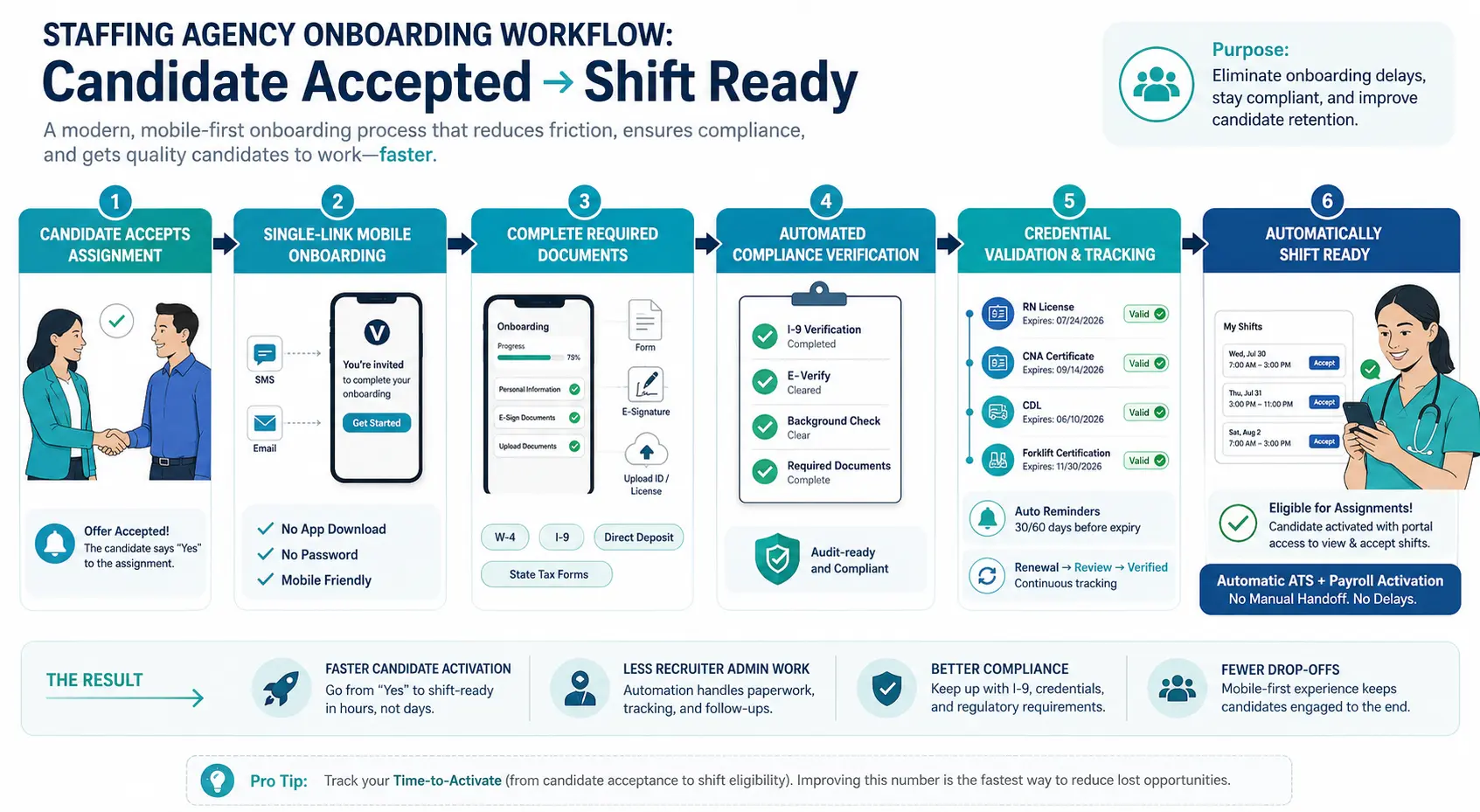
Vars runs the entire onboarding journey through a single-link mobile flow: candidates get a text or email invite with no app download or password required, then complete forms, e-signatures, and document uploads on their phone. I-9 and E-Verify compliance, W-4 completion, state tax withholding, and direct deposit enrollment feed the same payroll system and are built into the same flow, and credential status updates automatically as documents come in. Once every requirement is met, the candidate is automatically activated with portal access to view and accept shifts, the same shared-data handoff that shows up on the applicant tracking system side of the platform, so there’s no manual handoff between “onboarding done” and “eligible to work.”
2. WorkBright
WorkBright is built specifically around compliance speed, particularly remote I-9 verification, and it’s genuinely strong here: staffing and recruiting is its top industry vertical. Pricing is tiered by hiring volume rather than a flat per-user rate, with smaller tiers running roughly $9.50 to $24 per admin per month and larger volume tiers priced separately. Where WorkBright Fits: agencies whose main pain point is compliance risk and remote verification specifically. The tradeoff is depth outside that lane: form customization and deeper HRIS or payroll integrations are thinner than a full staffing platform offers.
3. Avionté
Avionté bundles onboarding into a full staffing suite alongside ATS, CRM, payroll, and billing, so a completed onboarding flows directly into the same system handling placements and pay. Pricing runs from roughly $299 to $750+ per month depending on the source and configuration, positioning it for mid-size to larger agencies rather than a small shop. Where Avionté Fits: agencies that want one vendor covering the entire front-to-back-office workflow. The tradeoffs reviewers raise most often are slower implementation timelines and support response times compared to newer, narrower SaaS tools.
4. BambooHR
BambooHR is a full HRIS with a genuinely solid onboarding module: digital new-hire packets, e-signatures, custom task checklists, and automatic syncing into the employee record. It’s a strong pick for a single-employer HR team. Where BambooHR Fits: it’s not built as a staffing-first platform, though. It doesn’t model multi-client placements, rehire rules, or the redeployment workflow a staffing agency actually runs on, so agencies that pick it usually do so for the HR polish, not because it solves the staffing-specific onboarding problem.
How Do Staffing Agencies Manage Onboarding at Scale Without Losing Candidates to Slow Paperwork?
The mechanism that actually works is removing every unnecessary step between “candidate says yes” and “candidate can start,” not just digitizing the same steps. A single magic link that requires no password and no app download removes an entire category of drop-off, since candidates who have to create an account before they can even see what’s required tend to abandon the process at exactly that point.
Pro tip for staffing agencies: track time-to-activate as a specific metric, not just “onboarding completion rate.” A candidate who completes onboarding in four days after saying yes on day one has already had four days to get an offer somewhere else. The clock that matters starts at yes, not at form submission.
What Happens When a Rehire Comes Back Mid-Assignment Cycle?
This is where generic HR onboarding tools tend to fall short. A worker who completed a full onboarding six months ago and is coming back for a new assignment shouldn’t have to re-enter information the system already verified, only re-confirm what’s actually changed (a new I-9 reverification date, an updated address, a credential renewal). Platforms built for staffing specifically handle this as a shortened rehire flow. Generic HR platforms, built around a single continuous employment relationship, often don’t have a clean answer for “this person left and came back,” which forces recruiters to either fully re-onboard or manually patch records together.
Key takeaway for operations leaders: if your onboarding tool treats every candidate as a brand-new hire regardless of history, you’re paying the full onboarding cost every time, even for your best repeat workers.
How Do Staffing Agencies Manage Credentialing Without It Becoming a Bottleneck?
Credentialing is where onboarding stops being a paperwork problem and becomes an ongoing operational one. A license, certification, or clearance that was valid when a candidate first onboarded does not stay valid forever, and a staffing agency placing the same worker across multiple client sites over months or years needs a system that tracks expiration dates the same way it tracked the initial document.
The agencies that handle this well treat credentialing as a standing status, not a one-time checkbox. That means the system flags a credential 30 or 60 days before it lapses, routes the renewal request to the worker automatically, and blocks shift eligibility if a required credential expires before it’s renewed, rather than relying on a recruiter remembering to check a spreadsheet.
The agencies that handle it badly find out a credential lapsed the same way a client does: after a compliance audit or an incident at the job site. By then the exposure has already happened. This is also usually where the case for combining onboarding and compliance tracking in one system is strongest, since a credentialing gap that shows up in a separate tool from the one tracking active assignments is a gap someone has to notice manually.
Common operational mistake: assuming that because a candidate passed initial onboarding, the compliance work is done. For roles with recurring certification requirements (forklift operators, CNAs, CDL drivers), initial onboarding is the start of an ongoing tracking relationship, not the end of one.
What Does Rolling Out New Onboarding Software Actually Look Like?
Switching onboarding tools mid-stream is lower risk than switching a CRM or ATS, since onboarding is a discrete, front-loaded process rather than something touching every ongoing relationship at once. That said, a rushed rollout still creates real problems.
First two weeks: configure the forms, compliance rules, and credential types for your highest-volume client accounts first, not every account at once. Run a handful of real candidates through the new flow while the old process stays available as a fallback.
Weeks three and four: once the pilot group completes onboarding cleanly, including a real credential renewal cycle if timing allows, expand to the rest of your active accounts. Watch specifically for candidates who drop off mid-flow, since that’s usually a sign a form step is confusing or a required document isn’t clearly explained.
The full switch, from decision to every new candidate going through the new system exclusively, usually takes three to six weeks for a mid-size agency. Trying to compress that into a single weekend cutover is where most onboarding-software rollouts create the exact candidate drop-off problem the new software was supposed to fix.
Frequently Asked Questions
How long does it take to onboard a candidate with staffing-specific software?
With a mobile-first, single-link flow, most candidates complete the full process within minutes to a few hours once they start, compared to days for paper-based onboarding. The bigger variable is usually how fast the candidate starts the process after receiving the invite, not how long the forms themselves take.
What features actually matter for compliance tracking in onboarding software?
Automated I-9 and E-Verify workflows, credential expiration tracking that flags renewals before they lapse, and an audit trail that shows exactly when each requirement was met. Manual tracking in spreadsheets is where compliance gaps usually start.
Can small staffing agencies benefit from dedicated onboarding software?
Yes, and the case is often stronger for smaller agencies, since a five-person back office does not have the bandwidth to manually track credential expirations and I-9 reverification dates across a growing candidate pool the way a larger compliance team might.
Does onboarding software replace the need for a background check provider?
No. Onboarding software handles forms, compliance documentation, and activation. Background screening is typically a separate, specialized service (providers like Checkr or Sterling are common pairings), and the two usually integrate rather than one replacing the other.
What is the difference between a staffing-specific onboarding tool and a general HRIS onboarding module?
A staffing-specific tool is built around multi-client placements, rehire shortcuts, and a redeployment workflow, much like a staffing agency CRM is built around an ongoing client relationship instead of a one-time deal. A general HRIS onboarding module, like BambooHR’s, is built around one continuous employer-employee relationship and does not natively handle a candidate cycling in and out of different assignments.
The agencies that lose the least talent to slow onboarding aren’t the ones with the most features. They’re the ones that removed the most friction between a candidate saying yes and actually starting a shift. Start by timing your own onboarding process end to end, from the moment a candidate accepts to the moment they’re eligible for their first shift. That number will tell you more about what to fix than any feature comparison, and it’s the same groundwork worth doing before evaluating staffing agency software more broadly.