Most nanny agencies start with a spreadsheet, and for the first dozen candidates, it works fine. One tab for candidates, one for active placements, maybe a third for certifications. The spreadsheet stops working long before most agency owners admit it’s the problem, and by the time they do, the cost usually shows up as a lost placement rather than a slow afternoon.
What Are the Signs a Nanny Agency Has Outgrown Its Spreadsheet?
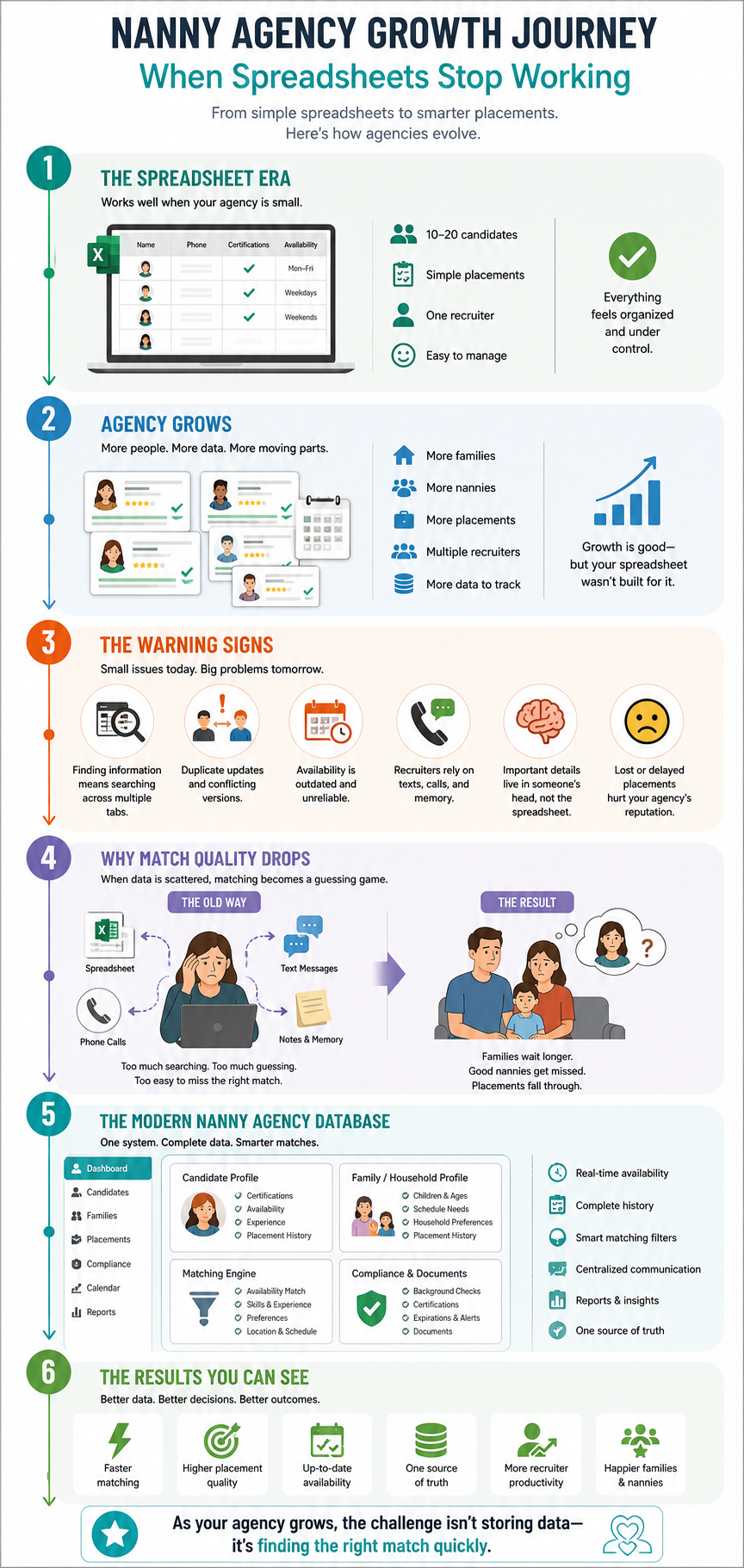
A few signals show up before the system fully breaks. Finding a specific candidate’s status takes searching across multiple tabs instead of one lookup. Two people update the same candidate’s record at different times, and one version overwrites the other. A family calls asking about a nanny’s availability and the answer requires texting the nanny directly to check, because the spreadsheet hasn’t been updated since last week.
Common operational mistake: treating each of these as an isolated annoyance rather than a pattern. Individually, a stale spreadsheet cell looks like a minor inconvenience. Together, they mean the agency’s actual source of truth is scattered across group texts and someone’s memory, not the spreadsheet at all.
What Should a Real Nanny Agency Database Actually Track?
See how Vars covers this for your agency
Scheduling, credentialing, and payroll in one platform.
A candidate database built for this vertical needs to hold more than contact information. It needs current certification and background check status, availability by day and time (not just “available” or “not available”), placement history so a returning family can be matched with a nanny they’ve worked with before, and family preferences (schedule needs, household requirements, prior placement notes) tied to the same record system.
How Should an Agency Structure Family and Household Records, Not Just Candidate Records?
Most agencies build their spreadsheet, and later their database, entirely around the nanny side of the business. Families end up as a secondary afterthought, usually just a name and a phone number in a separate tab. That’s backwards, because a placement is a match between two full records, and if only one side of that match has real data, the matching itself stays shallow.
A household record worth having tracks more than contact information. It needs the ages and needs of the children, any specific requirements (allergies, medical needs, language preferences), the family’s schedule pattern (is this a fixed weekly arrangement or does it shift by month), and a history of which nannies have worked with this family before and how those placements went. That last point matters more than it seems: a family that had a great experience with a particular nanny’s approach to bedtime routines is a family worth matching with a similar personality next time, and that’s information a spreadsheet almost never captures in a searchable way.
Agencies that build out both sides of this properly find that matching stops being a memory exercise entirely. Instead of a recruiter thinking about who they know that might work for this family, the actual match criteria (schedule compatibility, specific household needs, past placement fit) becomes something the system can filter on directly.
How Does a Weak Database Actually Hurt Match Quality?
This is the part that doesn’t show up until it’s already cost the agency a placement. When candidate records are incomplete or scattered, matching becomes a memory exercise for whoever happens to know the roster best, rather than a search against real data. A candidate matching system that draws on a genuinely complete record, verified certifications, real availability, and actual placement history surfaces the right nanny for a family faster and more accurately than a recruiter cross-referencing three spreadsheet tabs from memory.
Key takeaway for operations leaders: a spreadsheet can hold information. It can’t actively surface the right match at the moment a family calls. That distinction is usually the real reason agencies outgrow spreadsheets, not the sheer number of rows.
What Happens to Historical Placement Data When Agencies Switch Systems?
This is a question agency owners tend to underestimate until they’re mid-migration. Years of placement history, notes on which nannies worked well with which families, and past compliance records don’t automatically carry meaning just because the rows get copied into a new system. A candidate’s certification history is easy to migrate as a date field. A recruiter’s informal note that a nanny was great with a strong-willed toddler but not a fan of overnight stays is much harder to structure, and it’s exactly the kind of detail that made the old spreadsheet valuable despite its flaws.
The practical answer is to migrate the structured data (certifications, contact info, formal placement records) automatically, and treat the informal notes as a separate, deliberate cleanup task. Someone who actually knows the roster needs to go through the old notes and decide what’s worth carrying forward into a proper field in the new system, rather than dumping unstructured text into a notes box and calling the migration done. Skipping this step is how agencies end up with a shiny new database that’s technically complete but has quietly lost the institutional knowledge that made the old messy spreadsheet actually useful.
What Does Moving Off Spreadsheets Actually Involve?
Pro tip for staffing agencies: migrate your active candidate roster first, not your full historical archive. Get every currently placeable nanny fully into the new system, verified certifications and real availability included, before worrying about years of old records that may never get referenced again.
A full transition for a small agency usually takes one to two weeks of data entry and verification, concentrated on the active roster. The value shows up the first time a family calls with an urgent request and the answer comes from a database lookup instead of a round of texts.
Frequently Asked Questions
When does a nanny agency actually need dedicated database software instead of a spreadsheet?
Once matching a family to a nanny requires checking more than one source, a spreadsheet plus a text thread plus someone’s memory of who’s available, that’s the practical signal, regardless of exact candidate count.
What’s the most commonly missing field in a nanny agency’s candidate records?
Real-time availability by day and time. Most spreadsheets track a static “available” flag that goes stale within days, rather than an actual current schedule.
Does a better database replace the need for a recruiter’s judgment in matching?
No. It removes the memory and cross-referencing burden so a recruiter’s judgment gets applied to good, current data instead of being spent reconstructing what the data should say.
Should family and household information get the same level of detail as candidate records?
Yes. Matching quality depends on both sides of the record being complete. A detailed nanny profile matched against a thin family record still produces a shallow match.
What’s the biggest risk when migrating years of spreadsheet history into a new database?
Losing informal notes and institutional knowledge that never had a proper field to live in. Structured data migrates cleanly. The recruiter’s judgment calls written in margin notes need a deliberate human review, not an automatic import.