Home care agency scheduling software needs to handle caregiver availability, client care plans, credential and certification tracking, and last-minute call-out coverage together, since these four rarely stay in sync when they’re managed in separate spreadsheets or a generic scheduling tool. A pattern we see across home care agencies: the agencies that struggle most with scheduling usually aren’t missing a calendar app; they’re missing a system that ties scheduling to who’s actually qualified and available to cover a shift. Vars is built specifically around that tie-together, matching availability, credentials, and care needs in one system.
What makes home care scheduling different from general scheduling software?
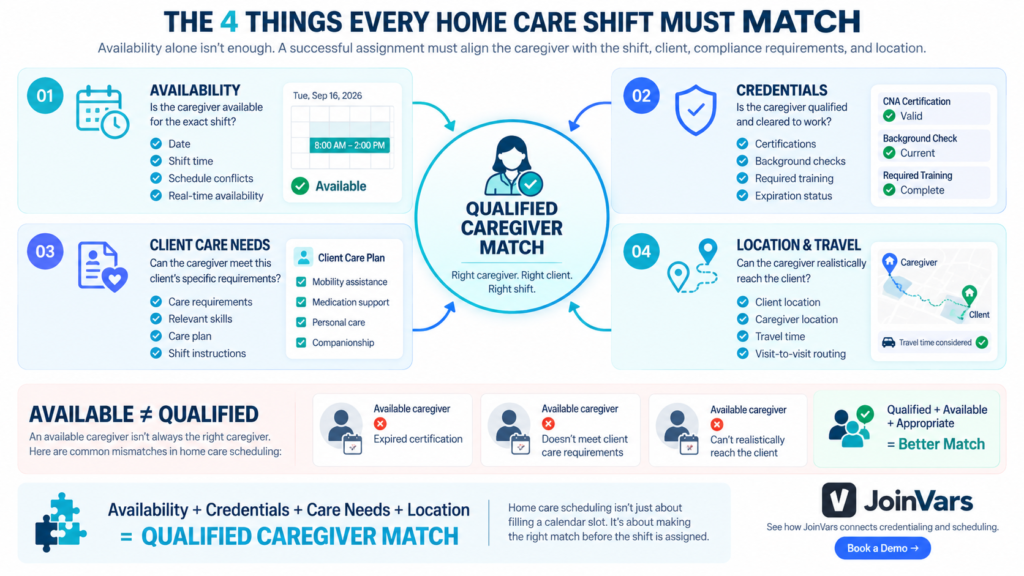
A generic scheduling tool assumes any available person can cover any shift. Home care scheduling doesn’t work that way: a caregiver has to be certified for the client’s specific care needs, cleared on background checks, geographically able to reach the client, and available at the right time, all at once. Missing any one of those isn’t a minor scheduling hiccup, it’s a compliance and client-safety issue. That’s the core reason purpose-built home care scheduling software exists instead of agencies just using a shared calendar.
What should home care agencies look for in scheduling software?
See how Vars covers this for your agency
Scheduling, credentialing, and payroll in one platform.
- Credential-aware matching — the system should only surface caregivers actually qualified and cleared for a specific client, not just anyone marked available
- Real-time call-out coverage — fast rebooking when a caregiver cancels, ideally with automated notifications to qualified backups rather than manual phone calls
- Client care plan visibility — caregivers should see relevant care instructions tied to the shift, not a bare time slot
- Geographic and travel-time logic — scheduling that accounts for realistic travel between clients, not just calendar availability
- Payroll integration — scheduled and worked hours should flow into payroll without manual re-entry, especially across mixed employment types
Key takeaway for operations leaders: the highest-cost scheduling failures in home care aren’t scheduling gaps, they’re mismatches, a caregiver without the right certification covering a shift they shouldn’t, or a client visit missed because the backup process was a phone tree instead of a system. Software that prevents mismatches by design matters more than software that just fills calendar slots faster.
How does call-out coverage typically break down without the right software?
Common operational mistake: relying on a scheduling coordinator manually calling down a list of caregivers when someone calls out, often starting from whoever’s easiest to reach rather than whoever’s actually the best-qualified available match. This works at small scale and breaks down fast as caseloads grow, since the coordinator becomes a single point of failure and clients experience inconsistent coverage.
What does credential tracking need to look like for home care scheduling?
Certifications, background checks, and required training all need expiration tracking that actively prevents an out-of-compliance caregiver from being scheduled, not just a report that flags it after the fact. The difference matters: a passive compliance report tells you about a problem after a shift has already happened; active credential-aware scheduling stops the problem before it’s assigned.
How does Vars handle home care agency scheduling?
Vars is built around exactly this problem, through several connected modules rather than one generic calendar: Staffing & Scheduling matches qualified, credentialed caregivers to shifts based on real-time availability, certification status, and client requirements, with automated coverage workflows when a caregiver calls out; Credentialing tracks certification and background-check status so an out-of-compliance caregiver never gets surfaced as an option; Timekeeping and Billing turns worked hours directly into payroll without manual re-entry; and a White Label Mobile App gives caregivers their schedule and client care plan details in an app carrying the agency’s own branding, not Vars’. Scheduling, credentialing, and payroll run on the same system rather than three disconnected tools, so a shift assignment reflects who’s actually eligible to work it.
Pro tip for staffing agencies: when evaluating scheduling software, ask a vendor to demonstrate the call-out workflow specifically, not just the calendar view. That single workflow is where most of the actual time savings and compliance risk live.
What questions should you ask before choosing home care scheduling software?
- How does the system prevent scheduling a caregiver whose certification has expired?
- What happens automatically when a caregiver calls out, versus what still requires a coordinator’s manual work?
- Does scheduled and worked time flow into payroll without re-entry, including for a mixed W-2 and contractor workforce?
- Can caregivers see client care plan details relevant to their shift directly in the app?
Frequently Asked Questions
What is home care agency scheduling software?
Software that matches caregivers to client shifts based on availability, credentials, and care requirements, and manages coverage when a caregiver calls out.
Why can’t home care agencies just use a general scheduling tool?
General tools assume anyone available can cover any shift. Home care requires matching on certification, background checks, and client-specific care needs at the same time.
How does credential-aware scheduling prevent compliance issues?
It actively blocks scheduling a caregiver whose certification or background check has expired, rather than flagging the problem after a shift has already happened.
Does home care scheduling software connect to payroll?
It should. Scheduled and worked hours flowing directly into payroll avoids manual re-entry, especially across mixed W-2 and contractor caregiver workforces.
What’s the biggest scheduling risk for home care agencies?
Mismatches, an uncertified or unqualified caregiver covering a shift, or a missed client visit due to a manual call-out process, rather than simple calendar gaps.
Conclusion
The right home care scheduling software prevents mismatches by design, tying availability, credentials, and client care needs together instead of leaving a coordinator to catch problems manually. Start by counting how many call-outs your team filled manually last month and how long each one took to resolve — that number is usually the clearest case for automating credential-aware matching. See how Vars’ staffing and scheduling tools handle credential-aware matching and call-out coverage, or explore the full healthcare staffing software platform to see how scheduling connects to hiring and payroll. Book a demo with Vars to walk through your agency’s specific coverage workflow.