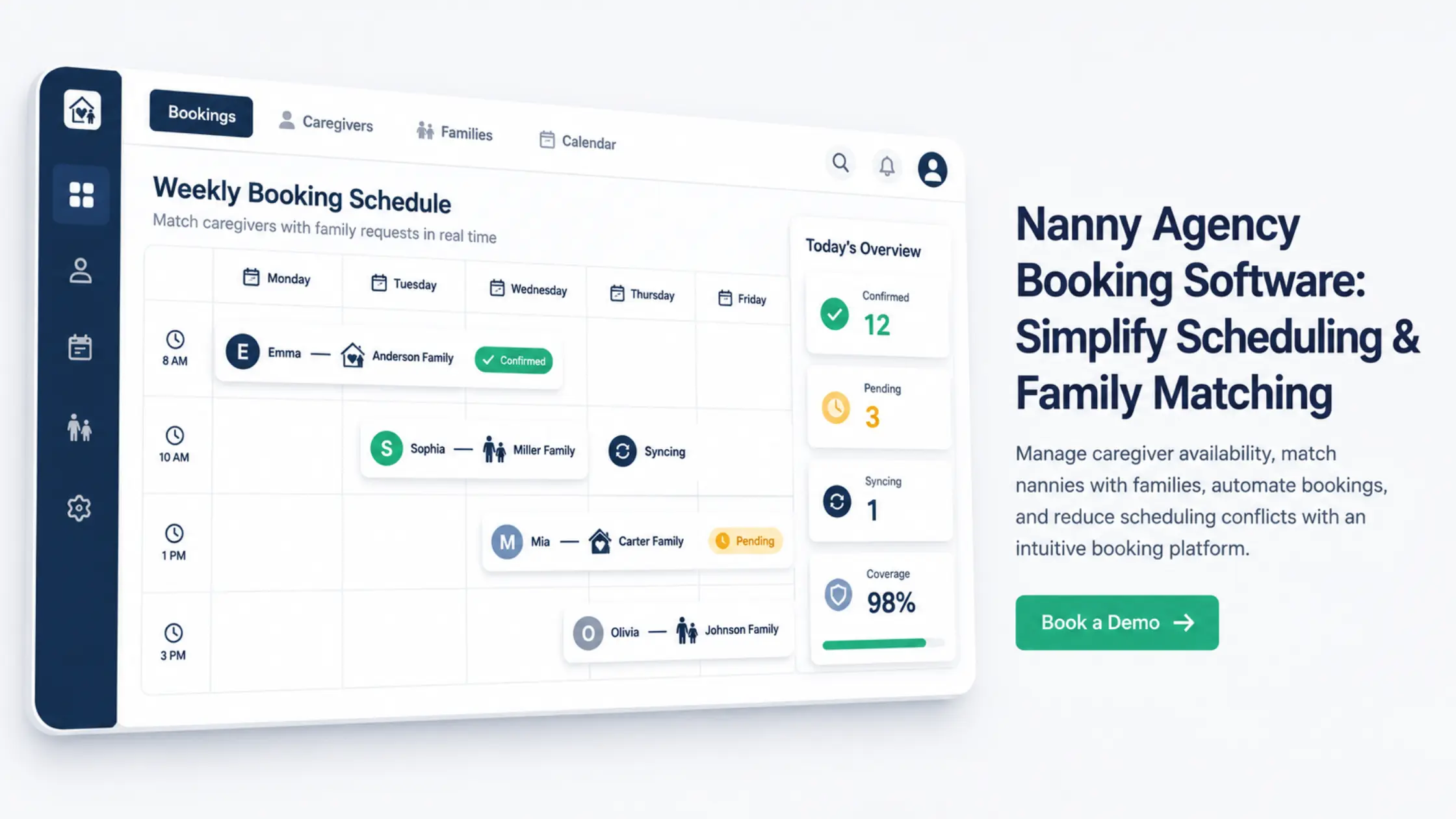
If you run a nanny or babysitter placement agency, nanny agency booking software isn’t a nice-to-have. It’s the layer that decides whether your coordinators spend the day placing caregivers or chasing texts. At its core, it’s a system that syncs caregiver availability, family requests, and confirmations in one place, so a booking made at 9pm on a Sunday doesn’t turn into a double-booked Tuesday morning. It’s the operational layer underneath any nanny agency management software worth using.
This guide walks through how that scheduling flow actually works in practice, where agencies most often lose time, and what separates a booking tool from a real operational system.
Why does manual nanny scheduling break down as agencies grow?
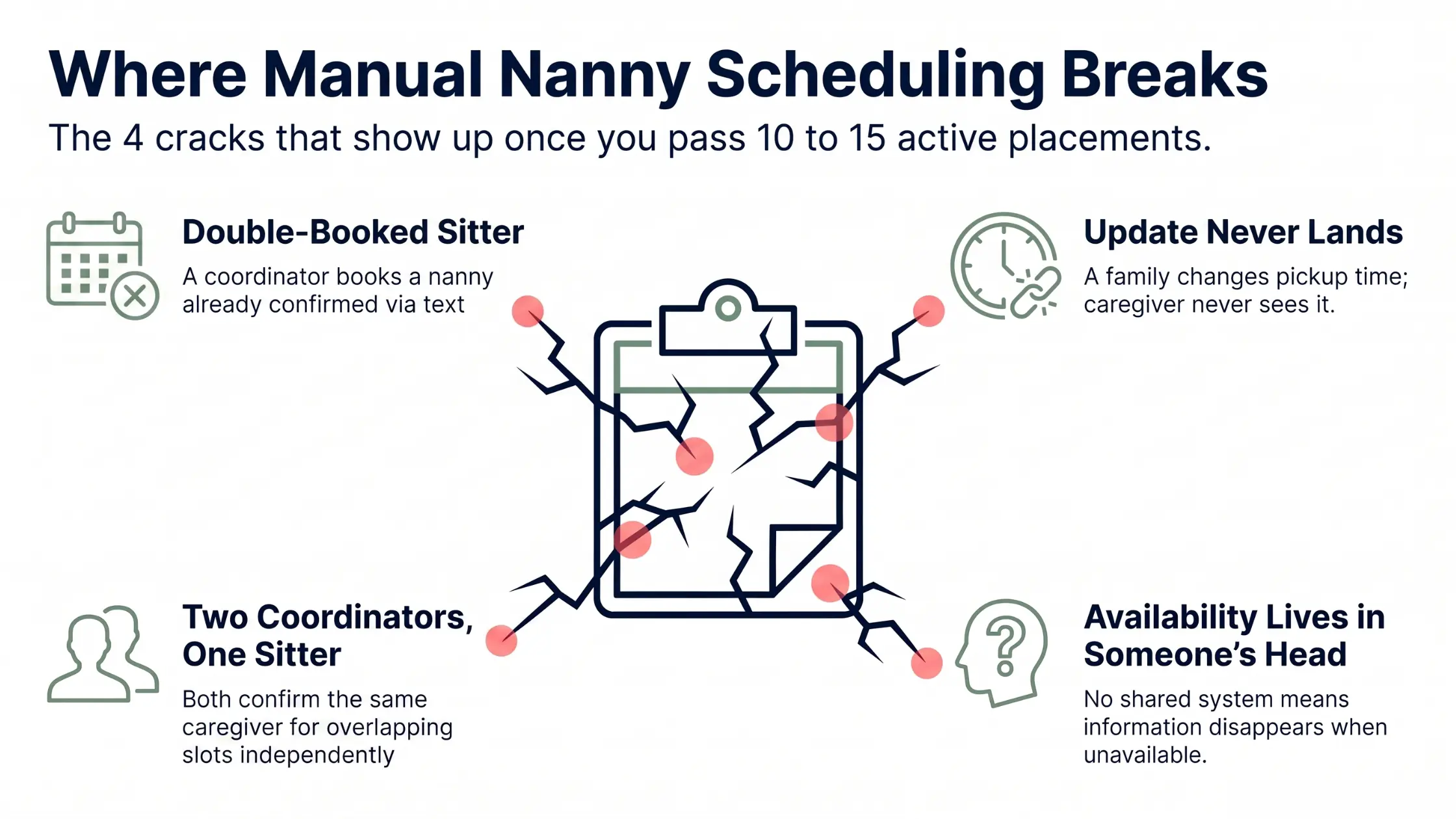
At 10 to 15 active placements, a shared calendar and a group text usually hold together. Past that, the cracks show up fast:
- A coordinator books a nanny for a family, but the nanny already accepted a shift with someone else over text
- A family changes pickup time and the update never reaches the caregiver
- Two coordinators independently confirm the same sitter for overlapping slots
- Availability lives in someone’s head, not in a system anyone else can check
Common operational mistake: treating scheduling as a communication problem (more group chats, more phone calls) instead of a data problem (one shared, real-time source of truth for who’s available, when, and where).
None of this means your coordinators are bad at their jobs. It means the tools weren’t built to hold state. A spreadsheet doesn’t know a nanny just accepted a shift five minutes ago on someone else’s phone.
How does nanny agency booking software actually work, step by step?
See how Vars covers this for your agency
Scheduling, credentialing, and payroll in one platform.
Underneath the “book a nanny” button, a working system runs through a specific sequence:
- Family submits a request: dates, hours, child ages, location, and any care preferences (language, certifications, driving).
- The system checks live caregiver availability against that request, not a static roster, but who’s actually free for that window right now.
- Matching rules filter the pool by location radius, certifications (CPR, First Aid), experience level, and any family-specific preferences.
- Coordinator reviews and confirms. The system surfaces ranked matches instead of the coordinator manually scrolling every caregiver profile.
- Caregiver accepts through their own portal or app, and availability updates instantly for everyone else the moment they do.
- Confirmation, reminders, and updates go out automatically to both the family and the caregiver, without a coordinator typing the same message twice.
The part agencies underestimate is step 5. If a caregiver’s acceptance doesn’t update the shared calendar in real time, you’re still one phone-tag delay away from a double-booking. You’ve just added software on top of the same manual gap.
What features actually prevent double-bookings and last-minute gaps?
Not every “scheduling” feature earns its place. These are the ones that actually reduce coordinator workload rather than just digitizing a paper process:
| Feature | What it actually solves |
|---|---|
| Real-time availability sync | Caregiver accepts/declines instantly updates everyone’s view, closing the lag between “said yes” and “system knows” |
| Rule-based matching | Filters by location, certifications, and family preference before a coordinator ever looks at a profile |
| Family self-service portal | Families check placement status and request changes without a phone call |
| Caregiver mobile access | Nannies confirm, decline, or update availability from their phone, not a shared spreadsheet |
| Automated reminders | Reduces no-shows and last-minute cancellations without manual follow-up |
| Credentialing/background-check tracking | Surfaces expiring documents automatically instead of a coordinator checking folders; see how credentialing and document verification works |
Pro tip for staffing agencies: when evaluating any scheduling tool, ask specifically how fast a caregiver’s acceptance reflects in every other coordinator’s view. That single detail is usually the difference between a booking system and a booking-adjacent calendar.
How should booking software connect to payroll and billing?
This is where a lot of agencies quietly lose money. Scheduling and billing often live in separate tools, which means:
- Hours worked don’t automatically become an invoice line
- Family billing and caregiver pay are reconciled by hand, monthly
- Rate changes (holiday pay, overtime, mileage) get applied inconsistently
What usually breaks at scale: once an agency crosses roughly 20 to 30 active placements, manual reconciliation between “what was scheduled” and “what gets invoiced” becomes a part-time job in itself. This is one of the areas where a connected platform, rather than a standalone booking tool, actually earns its cost. In practice, this is where a platform like Vars fits into the workflow: its scheduling and availability dashboard feeds directly into payroll and billing, so confirmed hours flow into invoicing and caregiver pay without a coordinator re-entering the same numbers in two systems. It’s a fit for the reconciliation problem specifically, not a general claim about “best” software. The tool only helps if scheduling data is accurate to begin with.
Is nanny booking software worth it for small or mid-size agencies?
The honest answer depends on placement volume and how many coordinators are involved:
- Under 10 placements, one coordinator: a well-organized shared calendar can genuinely work. The ROI on a full platform is lower here.
- 10 to 30 placements, or more than one coordinator: this is where manual coordination starts costing real hours weekly, and a real system pays for itself in coordinator time alone.
- 30+ placements or multiple locations: manual coordination isn’t really an option anymore. The question shifts from “should we” to “how fast can we implement.”
Key takeaway for operations leaders: the decision isn’t really about agency size in the abstract. It’s about how many people currently have to be in sync for a single booking to happen correctly. One coordinator with a clear system can outperform three coordinators without one.
What to fix first vs. what to add later
Agencies moving off spreadsheets often try to solve everything at once. A more realistic sequence:
Fix first:
- Get caregiver availability into one live, shared system
- Standardize the intake request (same fields, every time, for every family)
- Turn on automated confirmations and reminders
Add once the above is stable:
- Family self-service portals, this is what Vars’ communication suite is built for
- Rate-based automated billing
- A branded mobile app for caregivers and families, like Vars’ white-label mobile app
Trying to launch a fully white-labeled app before your underlying availability data is clean just moves the chaos onto a nicer interface. Software doesn’t fix a scheduling process that was never standardized. It makes an already-consistent process faster.
Frequently Asked Questions
1. How long does it take to implement nanny agency booking software?
Most agencies can migrate caregiver and family data and run their first live bookings within 1 to 2 weeks, assuming the intake process is already reasonably standardized and onboarding data is clean going in. Agencies still relying on ad hoc spreadsheets usually need an extra week to clean and structure that data first.
2. What features actually matter for a nanny agency, versus a generic scheduling tool?
Real-time caregiver availability sync, rule-based family-caregiver matching, and a caregiver-facing mobile portal matter most. Generic scheduling tools built for shift-based industrial or healthcare labor often lack placement-specific matching logic and family communication tools.
3. Can a small nanny agency (2 to 10 staff) benefit from booking software?
Yes, mainly on the coordination side. Even a solo coordinator benefits from not having to manually track caregiver availability across texts and calls. The ROI is smaller than for larger agencies but still measurable in hours saved weekly.
4. Does booking software replace the need for a dedicated coordinator?
No. It removes the manual, repetitive parts of the job, checking availability, sending reminders, reconciling hours, so a coordinator can focus on matching quality and family relationships instead of logistics.
4. How does booking software handle last-minute cancellations or backup coverage?
A properly connected system flags the gap the moment a cancellation is logged and can immediately filter available backup caregivers by the same location, certification, and preference rules used for the original booking, instead of a coordinator starting the search from scratch.
Getting Started
If scheduling conflicts are already costing your team real hours each week, the first useful step isn’t picking software. It’s mapping your current booking process end to end: where does a request come in, who checks availability, and where does the handoff to confirmation actually happen. That map will tell you exactly which piece to fix first, and it’s the same map any platform, Vars included, will ask you for during a demo walkthrough. This kind of coordination problem shows up across every staffing industry Vars supports, not just childcare.
How long does it take to implement nanny agency booking software?
Most agencies can migrate caregiver and family data and run their first live bookings within 1 to 2 weeks, assuming the intake process is already reasonably standardized.
What features actually matter for a nanny agency, versus a generic scheduling tool?
Real-time caregiver availability sync, rule-based family-caregiver matching, and a caregiver-facing mobile portal matter most.
Can a small nanny agency (2 to 10 staff) benefit from booking software?
Yes, mainly on the coordination side. Even a solo coordinator benefits from not having to manually track caregiver availability across texts and calls.
Does booking software replace the need for a dedicated coordinator?
No. It removes the manual, repetitive parts of the job so a coordinator can focus on matching quality and family relationships instead of logistics.
How does booking software handle last-minute cancellations or backup coverage?
A properly connected system flags the gap the moment a cancellation is logged and filters available backup caregivers by the same rules used for the original booking.