
If your team is still tracking background check status and certification expiration dates in spreadsheets or a shared inbox, the real cost is not the admin time. It is the placements that stall, or worse, the family that finds out a caregiver’s certification lapsed after the fact. This is the single most common operational gap we see when working with nanny and babysitter placement agencies using nanny agency staffing software, and it is one of the easier problems to fix once you understand where it actually breaks down.
Why do background checks and certification tracking break down as nanny agencies grow?
At low volume, manual tracking works fine. A coordinator remembers who is pending, who needs a renewal, and who cleared last week. The trouble starts at scale, which is usually the point where agencies start considering digital transformation in staffing agencies instead of adding more manual reminders.
Once an agency is running 30, 60, or 100+ active caregivers, a few things happen at once:
- Renewal dates stop being visible. First aid, CPR, driving checks, and background screenings all expire on different cycles. Nobody owns a master calendar.
- Handoffs create gaps. A recruiter clears a candidate, but the coordinator who schedules placements never gets a clean signal that credentials are current.
- Spreadsheets go stale. The moment two people edit the same tracker, or a candidate’s status changes mid-week, the source of truth is unclear.
What usually breaks at scale: it is rarely the background check process itself. It is the handoff between the person who ran the check and the person who books the placement. That gap is where expired credentials slip through.
What does manual credentialing tracking actually cost a nanny placement agency?
See how Vars covers this for your agency
Scheduling, credentialing, and payroll in one platform.
The direct cost is coordinator time spent chasing candidates for expired documents, re-requesting proof, and manually updating trackers. In real implementations, this typically eats several hours a week per coordinator once an agency crosses a few dozen active caregivers, a pattern outlined in more detail when evaluating the best staffing agency software for scaling operations.
The indirect cost is bigger. When a family later discovers a lapsed certification, or a compliance question comes up during an insurance review, the agency has no clean audit trail to point to. That is a trust problem, and for a domestic staffing business built on family trust, it is the one risk owners tend to underestimate.
Key takeaway for operations leaders: the goal of automating credentialing is not just saving time. It is having a defensible, timestamped record of who was verified, when, and against what standard.
How can nanny agencies automate background check verification without losing oversight?
Automation here does not mean removing human judgment from vetting decisions. It means removing the manual busywork around tracking status, sending reminders, and updating records, so your team’s time goes toward reviewing actual candidates instead of chasing paperwork.
A workable structure looks like this:
1. Centralize document collection. Caregivers upload background check consent, certifications, and references through a single onboarding portal instead of email attachments.
2. Automate reminders, not decisions. The system should nudge candidates and coordinators when something is missing or approaching expiration. A human still reviews the actual result.
3. Connect status to booking eligibility. A caregiver with an expired or unverified credential should not be schedulable for a placement using staffing and scheduling software, without a coordinator having to remember to check.
4. Keep an audit trail. Every verification, renewal, and reminder should be timestamped and retrievable, not buried in an email thread.
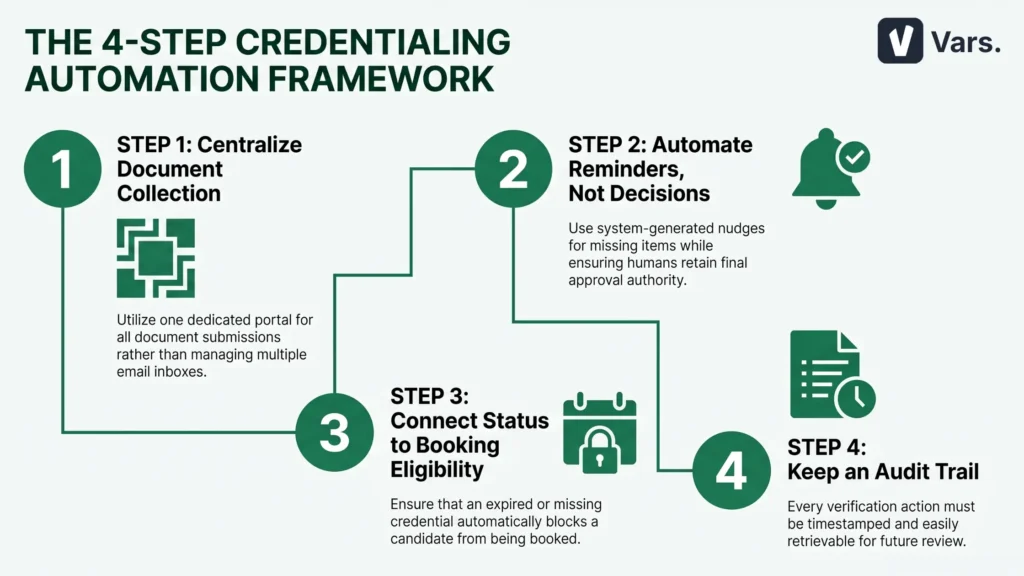
This is where nanny agency booking software earns its place in the workflow. When credentialing status is tied directly to the scheduling and placement system, an expired certification is not just flagged, it actually blocks the booking, reflecting how a connected CRM for staffing agencies keeps credentialing and client-facing operations in sync.
Pro tip for staffing agencies: build your reminder cadence around the shortest-cycle credential you track (often first aid or CPR), and let the system escalate automatically as the expiration date approaches, rather than relying on a single reminder email.
What certification tracking looks like when it’s built into nanny agency booking software
In practice, agencies that fix this problem are not adopting an entirely new vetting philosophy. They are consolidating tools that were already doing pieces of the job.
Vars, for example, is a workforce management platform (not a staffing agency or recruiter itself) that nanny and babysitter placement agencies use to run onboarding, credentialing, scheduling, and payroll in one place. In this workflow, document automation handles reference checks, background verification, and certification uploads, with automated reminders going to candidates directly instead of coordinators manually following up. Credentialing status then feeds the scheduling dashboard, so a caregiver missing a current background check or certification simply is not available to book for a family placement.
The caregiver portal and family client portal both matter here too, similar to the efficiency gains agencies report from a staffing agency client portal. Caregivers can see exactly what is outstanding without calling the office, and families can see that a placement has been fully vetted without needing to ask. For agencies also managing household employment compliance across multiple states, having this sit inside one system, rather than split across a spreadsheet, an email inbox, and a background check vendor’s separate portal, is what actually closes the audit trail gap.
Custom API connections to background check providers matter for agencies with an existing vendor relationship, which is part of the broader question of what vendor management software actually does inside a staffing workflow. Rather than replacing that vendor, the software becomes the layer that pulls status into your operational system and ties it to booking eligibility.
Where does technology stop and process still matter?
Software will not fix an agency that has no defined credentialing standard in the first place, a point covered in more depth in this guide to workforce compliance software for staffing agencies. Before automating anything, an agency needs a clear answer to:
- Which certifications are mandatory versus optional for each caregiver type (full-time nanny, part-time sitter, on-call babysitter, au pair)?
- What is the renewal cycle for each credential?
- Who has final sign-off authority when a background check result is ambiguous?
Common operational mistake: agencies sometimes automate reminders and document collection before defining these standards clearly, which just means the system reminds people about an inconsistent process faster. Get the policy right first, then let the system enforce it.
What to fix first vs. later when digitizing background check and certification tracking
For an owner deciding where to start, sequencing matters more than trying to fix everything at once.
Fix first:
- Centralized document upload so credentials stop living in email
- A single source of truth for certification expiration dates
- A hard link between credentialing status and booking eligibility
Fix later:
- Deeper API integrations with specific background check vendors, alongside broader employee onboarding software trends worth tracking as the agency scales
- Custom vetting workflows per caregiver type
- Advanced reporting on time-to-clear or vetting bottlenecks
Trying to build the advanced layer before the basics are solid is a common reason digital transformation projects stall in domestic staffing agencies specifically, since the caregiver-family trust relationship makes owners cautious about changing too much at once.
Common mistakes agencies make during this transition
- Treating automation as a one-time setup. Certification requirements and state-level compliance rules change, which is why ongoing review matters as much as the initial move toward on-demand workforce management software.
- Not training candidates on the new process. If caregivers still email documents out of habit, the portal only captures half the picture.
- Skipping the audit trail requirement. Some agencies automate reminders but never confirm the system actually retains a timestamped verification record, which is the part that matters most if a family or insurer asks questions later.
FAQ
How long does it take to implement credentialing automation for a nanny agency?
Most small to mid-size agencies can move core document collection and reminders online within a few weeks. Full integration with existing background check vendors and scheduling systems typically takes longer, depending on how many disconnected tools are being replaced.
What features actually matter most for background check and certification tracking?
Centralized document upload, automated expiration reminders, a booking system that checks credentialing status before confirming a placement, and a retrievable audit trail. Everything else is secondary to these four.
Can a small nanny or babysitter agency benefit from this, or is it only worth it at scale?
Small agencies (2 to 10 staff) often benefit the most early on, since they typically have the least formal process in place and the most to gain from removing manual tracking before volume increases.
Does automating credentialing replace the need for a background check vendor?
No. The software layer, similar to a vendor management system, manages tracking, reminders, and booking eligibility. The actual background check is still run by your chosen vendor; the system just connects that result to your operational workflow instead of leaving it in a separate portal.
What is the biggest sign that a nanny agency needs to fix its credentialing process now?
If a coordinator cannot answer “which caregivers have a credential expiring in the next 30 days” without manually checking multiple files, that is the clearest signal the current process will not hold at higher volume.
A practical next step
You do not need to overhaul your entire tech stack this week. Start smaller: pull together a simple list of every credential your agency currently tracks, the renewal cycle for each, and where that information currently lives. If the answer involves more than one spreadsheet, an email inbox, and a vendor portal, that audit alone will show you exactly where the automation should start, and where a connected staffing agency software platform can take over.
How long does it take to implement credentialing automation for a nanny agency?
Most small to mid-size agencies can move core document collection and reminders online within a few weeks. Full integration with existing background check vendors and scheduling systems typically takes longer.
What features actually matter most for background check and certification tracking?
Centralized document upload, automated expiration reminders, a booking system that checks credentialing status before confirming a placement, and a retrievable audit trail.
Can a small nanny or babysitter agency benefit from this, or is it only worth it at scale?
Small agencies (2 to 10 staff) often benefit the most early on, since they typically have the least formal process in place.
Does automating credentialing replace the need for a background check vendor?
No. The software layer manages tracking, reminders, and booking eligibility. The actual background check is still run by your chosen vendor.
What is the biggest sign that a nanny agency needs to fix its credentialing process now?
If a coordinator cannot answer which caregivers have a credential expiring in the next 30 days without manually checking multiple files, that is the clearest signal.