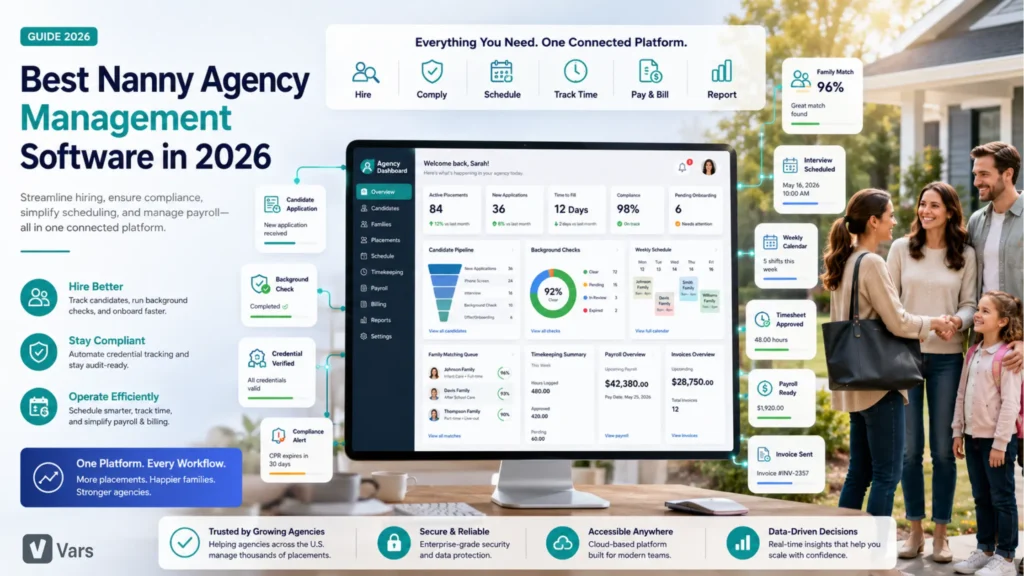
If you run a nanny or babysitting agency, the software question in 2026 isn’t whether you need a system — it’s which parts of your operation are still held together by spreadsheets, texts, and manual background-check follow-ups. Nanny agency management software now covers four core jobs: sourcing and vetting caregivers, background checks and credentialing, matching and scheduling, and payroll and billing. Agencies running purpose-built nanny agency staffing software fill families’ needs faster and lose fewer qualified nannies to slow onboarding.
What does nanny agency management software actually do?
At its core, this category of software replaces the manual coordination that happens between four groups: your recruiters sourcing candidates, your compliance team running background checks, your placement coordinators matching nannies to families, and your finance team handling payroll and client billing.
In a typical unmanaged setup, a candidate’s background check status lives in one spreadsheet, their availability lives in a group text, and their pay rate lives in someone’s inbox. When a family calls asking to start a placement in 48 hours, someone has to manually reconcile all three. That reconciliation step is where most agencies lose time.
Key takeaway for operations leaders: The software itself doesn’t create trust with families — your vetting process does. What software does is make that vetting process visible, trackable, and fast enough that it doesn’t cost you the placement.
What features actually matter when choosing babysitters agency management software?
See how Vars covers this for your agency
Scheduling, credentialing, and payroll in one platform.
Not every feature on a vendor’s site matters equally. For a nanny or babysitting agency specifically, these are the ones that affect day-to-day operations:
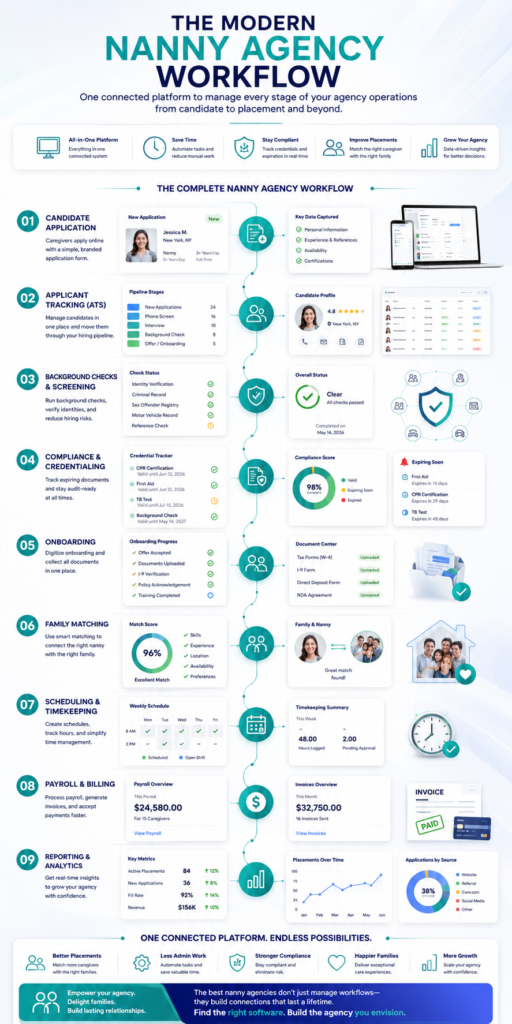
- Candidate tracking (applicant tracking system): one record per nanny or babysitter, from application through active placement, instead of scattered resumes and email threads.
- Background check and credentialing and compliance tracking: visibility into which checks are pending, expiring, or cleared, without opening a separate portal for every candidate.
- Onboarding workflow: a structured sequence for documents, references, and orientation so nothing gets skipped when volume increases.
- Scheduling and placement matching: matching nanny availability, skills, and location to family requests without manual cross-referencing.
- Timekeeping and billing: accurate hours worked feeding directly into family invoicing and caregiver pay, especially for live-in or multi-family arrangements.
- Communication tools: a shared channel between recruiter, family, and caregiver that doesn’t rely on personal phone numbers.
- Reporting and visibility: owner-level view of time-to-fill, active placements, and compliance status across the whole roster.
How do nanny agencies manage background checks and compliance at scale?
Background checks are the single biggest trust factor for families, and also the most common bottleneck. Below a certain size, agencies can track this manually. Past roughly 40–50 active caregivers, manual tracking starts producing two specific failures: expired checks that nobody caught, and cleared candidates who sit idle because paperwork wasn’t marked complete.
A workable compliance process for a nanny agency needs three things: a single source of truth for check status, automatic flags before a certification or background check expires, and a record that’s easy to hand a family or a compliance auditor without assembling it manually.
Common operational mistake: Treating background checks as a one-time gate at hiring, rather than an ongoing status that needs re-verification. Many agencies lose placements not because a nanny failed a check, but because a check quietly expired mid-placement and nobody noticed.
This is where Join Vars‘ credentialing and compliance tools apply directly — the same approach covered in how staffing agencies handle workforce compliance — agencies use it to track check status, expiration dates, and required renewals against each active caregiver, so a coordinator can see compliance status in the same view as availability and placement history, rather than switching between a background-check vendor portal and an internal spreadsheet.
What is the best way to reduce onboarding delays when hiring nannies and babysitters?
Onboarding delay is usually not one big problem — it’s several small handoffs that each add a day or two. A reference that takes three days to reach the right person. A signed agreement that sits in an inbox before someone re-keys it into a roster. A cleared candidate who isn’t told they’re cleared until someone remembers to check.
Reducing this delay is less about adding software and more about mapping the actual handoff sequence first, then deciding which steps genuinely need a system and which need a process fix. A tool will not fix a step where nobody has been assigned ownership.
- Map every step from application received to first placement, and write down who owns each step today.
- Identify where a candidate currently waits on a person, rather than a process.
- Move only the steps with real bottlenecks into a tracked workflow first — not the whole pipeline at once.
Join Vars’ onboarding module is built around this sequence, similar to the approach in top employee onboarding software for 2026 — documents, references, and orientation tracked as one workflow per candidate — so a coordinator can see exactly where a candidate is stuck instead of asking three people for a status update.
How should nanny agencies handle scheduling, timekeeping, and payroll?
Scheduling in a nanny agency is different from shift-based staffing: placements are often longer-term, family-specific, and involve live-in or split-household arrangements. Timekeeping needs to reflect that reality rather than a generic shift model.
The practical requirement is that hours logged by the caregiver flow directly into both the family invoice and the caregiver’s pay, without a coordinator manually re-entering hours into two separate systems. This is also where billing errors most often originate — not from bad math, but from the same hours being typed twice.
Agencies that also staff childcare centers can see this workflow in childcare management software for agencies.
What usually breaks at scale: Once an agency passes roughly 30–40 concurrent placements, manually reconciling timesheets against invoices becomes a recurring source of billing disputes with families. This is usually the first process that needs a dedicated system, even if everything else is still manual.
Join Vars’ timekeeping and billing tools connect logged hours directly to invoicing and payroll — the exact gap covered in choosing the best staffing agency timesheet software, which is the specific gap that causes double entry and disputes in growing agencies.
Nanny agency software: core capability checklist
| Capability | Manual process risk | What a system should provide |
| Candidate tracking | Duplicate or lost applicant records | One record per candidate, full history |
| Background checks | Expired checks go unnoticed | Status visibility with expiration alerts |
| Onboarding | Candidates stall between steps | Sequenced workflow with clear ownership |
| Scheduling / matching | Manual cross-referencing of availability | Matching by skill, location, availability |
| Timekeeping & billing | Hours re-typed, billing disputes | Hours flow directly into pay and invoices |
| Reporting | No owner-level visibility | Time-to-fill, compliance, and roster views |
Where does Join Vars fit into a nanny agency’s workflow?
Join Vars is not a nanny agency and does not place caregivers itself. It’s a workforce management platform that agencies use to run their own operations — candidate tracking, credentialing, onboarding, scheduling, timekeeping, and billing — in one connected system instead of several disconnected tools.
In practice, agencies bring Join Vars in at the point where a specific handoff is breaking: a compliance team that can’t keep up with expiring checks, a coordinator manually matching availability, or a billing process built on re-typed timesheets. The AI-assisted candidate matching and voice-based recruiter tools apply earlier in the pipeline, when an agency is trying to screen a high volume of applicants without adding recruiting headcount.
Pro tip for staffing agencies: Start with the one workflow that’s costing you placements today — usually onboarding or compliance tracking — rather than migrating every function at once. Agencies that try to switch everything in one pass tend to stall halfway through.
What should agencies fix first vs. later during digital transformation?
Fix first: whichever handoff is currently causing lost placements or compliance gaps — this sequencing question is covered in more depth in digital transformation strategies for staffing agencies. For most nanny agencies, that’s either onboarding delay or expiring background checks — both are visible, measurable, and directly tied to revenue.
Fix later: reporting dashboards, advanced AI matching, and white-label branding. These add polish and efficiency once the core operational workflow is stable, but they don’t solve an active bottleneck on their own.
Common operational mistake: Buying a full platform and trying to configure every module in the first month. Agencies that succeed with new software usually roll out one workflow, stabilize it with the team, then add the next.
Common mistakes agencies make when adopting nanny agency software
- Choosing software before mapping the actual current workflow — leading to a system that doesn’t match how the team actually works.
- Assuming a tool alone fixes a broken handoff, when the real issue is that no one owns that step.
- Migrating all candidate and compliance data at once instead of validating with a smaller active roster first.
- Not training coordinators on the new system before turning off the old spreadsheet, which causes a data gap during transition.
Frequently asked questions
How long does it take to implement nanny agency management software?
For a single workflow — onboarding or compliance tracking, for example — most agencies see a working setup within two to four weeks. Full platform rollout across scheduling, billing, and reporting typically takes longer and should be sequenced rather than done all at once.
What features actually matter most for compliance tracking?
Status visibility across all active caregivers, automatic alerts before a check or certification expires, and a record that’s easy to produce for a family or auditor without manual compilation.
Can a small nanny or babysitting agency benefit from this kind of software?
Yes, particularly around onboarding and background check tracking, since those bottlenecks show up even at low volume. Scheduling and billing automation tend to matter more once an agency passes 15–20 concurrent placements.
Does adopting software replace the need for a strong vetting process?
No. Software makes an existing vetting process visible and trackable — it does not replace the judgment involved in reference checks, interviews, and family matching.
What is the difference between an ATS and full agency management software?
An ATS tracks candidates through hiring. Full agency management software extends that to onboarding, credentialing, scheduling, timekeeping, and billing, so a caregiver’s record follows them through an active placement, not just through the hiring stage.
A practical next step
If you’re evaluating nanny agency management software in 2026, the most useful first move isn’t a demo — it’s a 30-minute internal audit. Walk through your last five placements and note where a candidate or a family waited on a step that should have taken hours instead of days. That list tells you exactly which workflow to fix first, and which type of software actually matters for your agency. From there, a short walkthrough of how Join Vars handles that specific workflow is a faster way to evaluate fit than a generic feature tour.
Frequently Asked Questions
What does nanny agency management software actually do?
It unifies candidate sourcing, background checks, scheduling, and payroll for nanny and babysitting agencies in one connected system instead of scattered spreadsheets and tools.
How do nanny agencies manage background checks and compliance at scale?
Automated background check and certification tracking flags expirations before they become compliance gaps, rather than relying on manual spreadsheet monitoring.