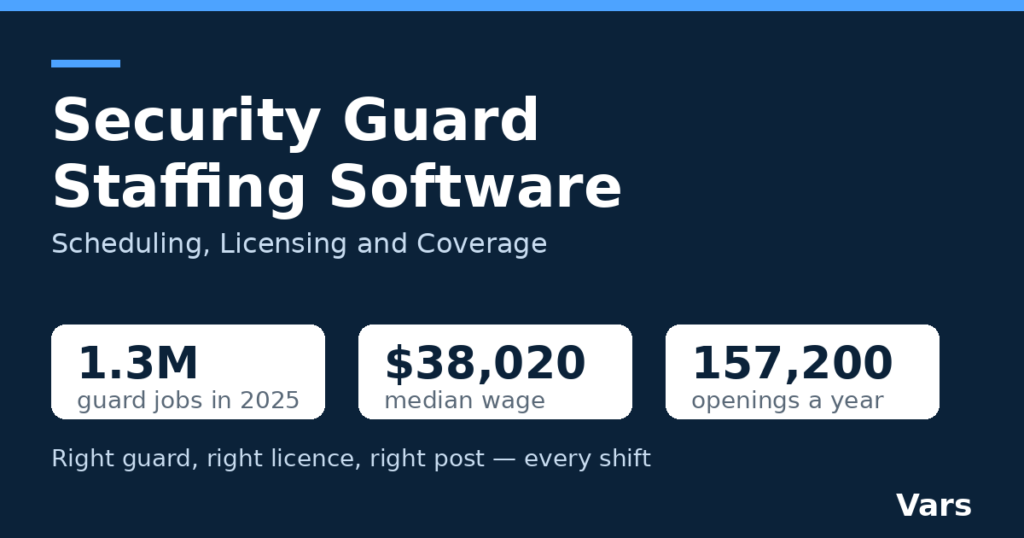
A security guard staffing agency does not sell hours. It sells coverage: the right guard, with the right licence, at the right post, for the whole shift, every shift. When one piece is wrong — the wrong licence, a guard card that expired last week, a no-show at 11pm — the client notices immediately, and the agency answers for it.
Guard staffing is harder to run on spreadsheets than most staffing work. A guard is not interchangeable with another guard: each carries a licence tied to a state, sometimes a separate armed credential, and each post carries its own requirements. The software has to track all of that, or the agency tracks it by hand — and by hand is where coverage breaks. Vars is software for staffing agencies. It does not place guards, and it is not a staffing firm.
What security guard staffing actually involves
The post changes the job. A lobby post needs a guard who can manage entry, log visitors and stay calm with the public. A mobile patrol post needs someone driving a route, checking sites and writing reports. A hospital post needs someone who can work around patients and staff without getting in the way of care. Retail, industrial, event and port posts each bring their own site rules.
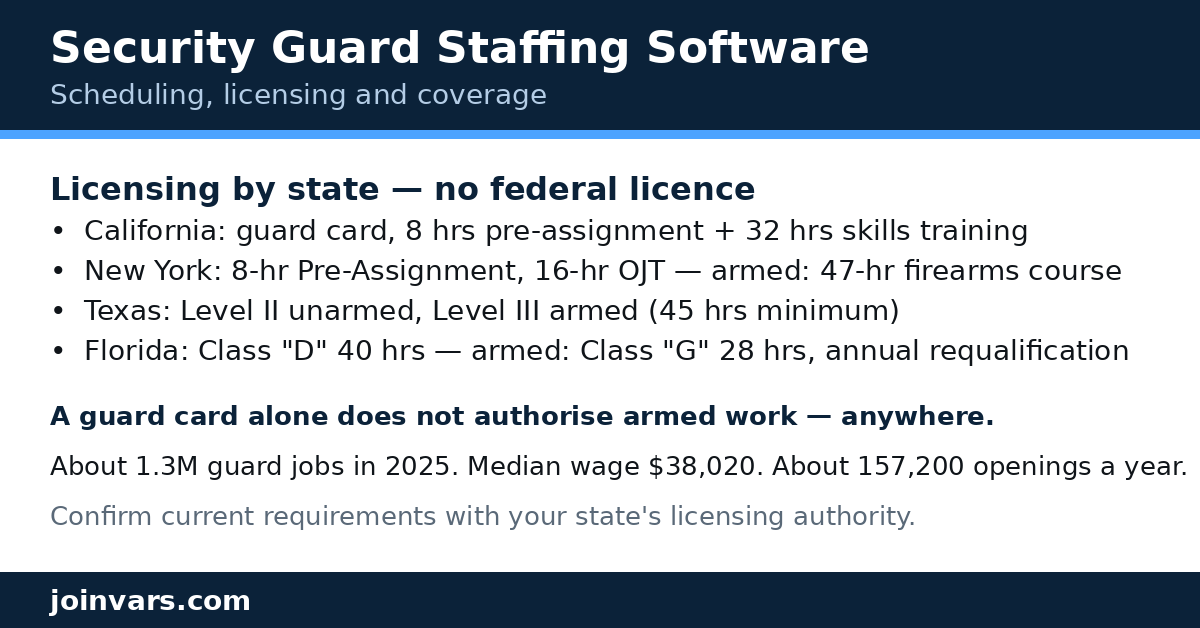
The split that matters most is armed versus unarmed. They are not the same credential, in any state that licenses guards: a guard card alone does not authorise armed work. The armed credential sits on top of the unarmed licence, with its own training and renewal.
Guard posts run around the clock, including nights, weekends and holidays, and a post left empty is a post left unguarded. Filling a shift means finding a guard who holds the right licence for that state, the right credential for that post, and who is available, confirmed and able to reach the site on time.
The licence problem: one guard, one state, one expiry date
See how Vars covers this for your agency
Scheduling, credentialing, and payroll in one platform.
There is no federal security guard licence. Each state licenses guards itself, and some cities add their own rules. A guard licensed in one state cannot simply work a post in another. An agency operating across state lines is running several licensing systems at once, each with its own credential names, training hours and expiry dates.
The table below is this post’s linkable asset: licensing in four large states, checked against each state’s licensing agency. Training hours and fees change, so agencies should confirm current requirements with their state’s licensing authority. This post is not legal advice.
| State | Agency | Unarmed credential | Armed add-on |
|---|---|---|---|
| California | Bureau of Security and Investigative Services (BSIS) | Guard card: 8 hours pre-assignment Powers to Arrest, then 32 hours of skills training within 6 months (16 within 30 days), 8 hours continuing training a year; Live Scan fingerprinting to CA DOJ and FBI | Separate Exposed Firearm Permit |
| New York | Department of State / Division of Criminal Justice Services | 8-Hour Pre-Assignment course, 16-Hour On-the-Job Training within 90 days, 8-hour annual in-service | 47-hour firearms course, plus a valid NY pistol permit; armed holders take an extra 8-hour annual in-service |
| Texas | Department of Public Safety, Private Security Program | Level II course for non-commissioned (unarmed) officers; registration tied to employment with a licensed company | Level III for commissioned (armed) officers, minimum 45 hours |
| Florida | Department of Agriculture and Consumer Services (FDACS) | Class “D” licence, unarmed, 40 hours at an FDACS-licensed school | Class “G” firearm licence: 28 hours (20 classroom, 8 range), annual requalification; Class G sits on Class D, not standalone |
The point is structural: credential, hours and renewal all change by state, and the armed credential is separate everywhere. Track state, credential type, armed status and expiry date per guard, per state — and know when each runs out before the guard is scheduled, not after.
What the numbers say about the guard workforce
The U.S. Bureau of Labor Statistics counts about 1.3 million security guard jobs in 2025 — 1,294,300 for security guards alone, and 1,304,000 for the combined occupation of security guards and gambling surveillance officers. The median annual wage for security guards alone was $38,020 in May 2025. The combined occupation’s median was $38,050 — a combined figure, not a guard-only one. Gambling surveillance officers alone earned a median of $43,370.
Pay spreads widely: the lowest 10 percent earned $30,210 a year, the highest 10 percent $58,840. Where a guard works matters: the median was $44,920 in healthcare and social assistance, $44,250 in educational services, $37,640 in accommodation and food services, $37,350 in investigation, guard and armored car services, and $35,640 in retail trade. An agency pricing a hospital post and a retail post at the same rate is pricing two different labour markets as if they were one.
Employment is projected to grow 1 percent from 2025 to 2035, slower than average, with about 157,200 openings a year on average, mostly from workers leaving the occupation. The work is mostly replacement hiring, so agencies compete for the same pool, and retention matters as much as recruitment. Typical entry is a high school diploma and short-term on-the-job training.
Where coverage breaks
Coverage breaks in a small number of repeatable ways. First, the no-show: a guard does not turn up, the post is empty, and the agency finds out from the client. The fix is shift confirmation before the shift, a backup guard who is actually available and qualified for that post, and a record of who confirmed what and when.
Second, the expired guard card: a licence lapses, nobody notices, and the guard works a post unlicensed. The fix is expiry tracking with warnings ahead of the date, not a check at scheduling — and not after the shift has already happened.
Third, the wrong licence for the post: a guard licensed in one state sent to a post in another, or an unarmed guard sent to an armed post. The fix is matching the guard to the post’s requirements before the shift is offered, with licence, state and armed credential all checked as part of the match. Fourth, the wrong guard for the post type: a guard excellent on a quiet lobby post may not fit a hospital or event post. The fix is a record of where each guard has worked, so the next assignment is based on experience, not on who happens to be free.
What the software has to track
A security guard staffing system has to track, per guard: the licence and its expiry date, by state; the armed credential, separately from the unarmed licence; the post requirements the guard is qualified for; availability; and shift confirmation.
Licence and expiry tracking is the core: state, credential name, issue and expiry dates, and armed status, with warnings before an expiry, not on the day. Post requirements are the second half: the system should match guards to posts on state, credential, armed status and site rules, so a guard without the right credential does not appear as available. Availability and confirmation close the loop — who is available, who has confirmed, visible before the shift starts, while there is still time to find a replacement. Timesheets and payroll sit on top, so the guard is paid correctly and the client is billed correctly.
Where Vars fits in the workflow
Vars is software for staffing agencies. It fits into the workflow above: the scheduling, the credential tracking, the timesheets and the payroll that sit around the guard posts. An agency uses it to keep the roster, the licences and the shifts in one place, so the match between a guard and a post is checked before the shift, the expiry is warned about before it happens, and the hours worked flow into payroll without being retyped from a spreadsheet. Vars does not place guards, recruit on an agency’s behalf, or run the agency’s posts. The agency runs its posts; the software keeps the record that lets it run them without the record falling apart when the week gets busy.
FAQs
Q: Do security guards need a licence in every state?
A: Licensing is state-by-state, and there is no federal security guard licence. Confirm current requirements with the relevant state licensing authority.
Q: What is the difference between a guard card and an armed guard permit?
A: A guard card is the unarmed licence. Armed work needs a separate credential on top — California’s Exposed Firearm Permit, New York’s 47-hour firearms course with a pistol permit, or Florida’s Class G licence.
Q: How much do security guards earn?
A: The median annual wage for security guards alone was $38,020 in May 2025, according to the U.S. Bureau of Labor Statistics. It varies by industry: $44,920 in healthcare and social assistance, $35,640 in retail trade.
Q: How many security guard jobs are there?
A: About 1.3 million in 2025 — 1,294,300 for security guards alone. About 157,200 openings a year are projected on average from 2025 to 2035, mostly from workers leaving the occupation.
Conclusion
Security guard staffing is a coverage business, won or lost on the details: the right licence, the right state, the right credential, the right post, the right shift. The agencies that keep posts covered check those details before the shift, every time, and keep a record that stays accurate when the week gets busy. That is what the software is for — not to replace the agency’s judgment, but to make sure the judgment is made with the facts in front of it, before the guard is sent, not after the client calls. Agencies should confirm current licensing requirements with their state’s licensing authority, as training hours and fees change.
Sources
- U.S. Bureau of Labor Statistics, Occupational Outlook Handbook — Security Guards and Gambling Surveillance Officers: https://www.bls.gov/ooh/Protective-Service/Security-guards.htm
- California Bureau of Security and Investigative Services, guard fact sheet: https://www.bsis.ca.gov/forms_pubs/guard_fact.shtml
- New York Department of State, security guard training requirements: https://dos.ny.gov/security-guard-training-requirements
- Texas Department of Public Safety, Private Security Program / 37 TAC §35.141
- Florida Department of Agriculture and Consumer Services, Chapter 493 F.S.