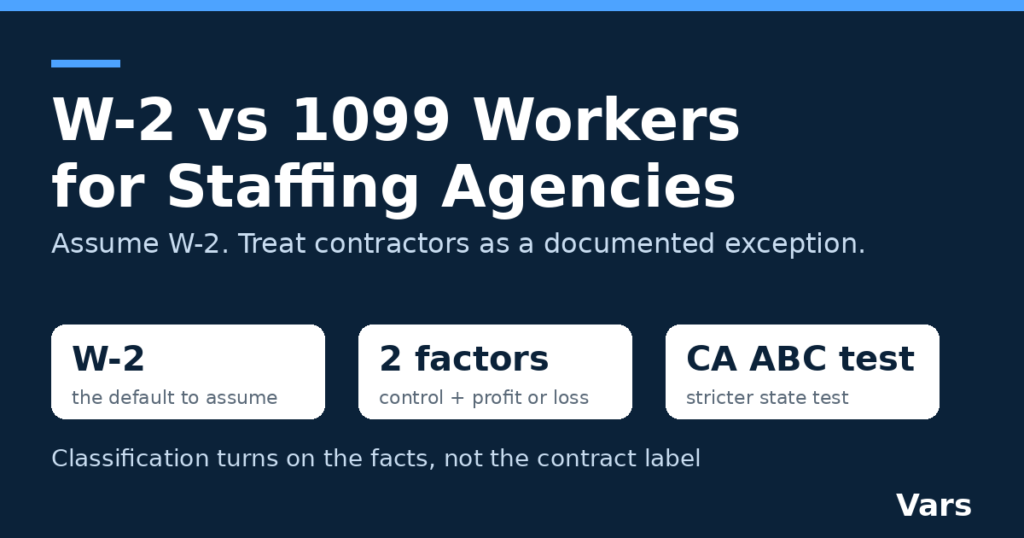
For W-2 vs 1099 staffing, the default most agencies should assume is W-2. Placed workers usually follow the agency’s or client’s direction, and classification turns on the facts of the relationship, not on the contract label. 1099 arrangements are the exception, they need documentation, and in strict states such as California they are hard to defend.
What is the practical difference between W-2 and 1099?
W-2 employee: the agency withholds income tax and the employee share of payroll taxes, pays the employer share, buys workers’ compensation, pays unemployment insurance and follows minimum wage and overtime law. 1099 contractor: the worker runs their own business, pays their own taxes and carries their own insurance. The cost gap is large, which is why misclassification is tempting and regulators watch it.
Why do most staffing agencies use W-2?
See how Vars covers this for your agency
Scheduling, credentialing, and payroll in one platform.
The agency typically controls pay, assignments and onboarding, and clients often require the agency to carry workers’ comp and payroll responsibilities. Light industrial, clerical and many healthcare roles are almost always W-2. 1099 use concentrates in healthcare per diem, consulting and gig-style marketplaces.
How is worker classification decided at the federal level?
The DOL applies an “economic reality” test: is the worker in business for themselves or economically dependent on the employer (HR Morning)? In February 2026 the DOL proposed a rule to rescind the 2024 rule and restore a framework emphasizing two core factors, control and opportunity for profit or loss (FordHarrison via JD Supra). The 2024 rule remained in effect while the proposal was pending (Goldberg Segalla), so check current status. Commentators also note the federal rule’s legal impact may be limited because courts apply their own versions of the test (JD Supra).
How do state tests change the answer?
Several states apply stricter standards. Even if federal rules loosen, employers must still navigate stricter state standards, including California’s ABC test (DLA Piper). States also have separate tests for unemployment insurance and workers’ compensation.
Common operational mistake: relying on a signed contractor agreement. Labeling a worker an independent contractor does not determine status (Inova Payroll).
Which facts point to employee or contractor?
| Points to employee | Points to contractor |
|---|---|
| Agency sets hours, rate, location | Worker markets to multiple clients |
| Follows agency or client instructions | Sets own price, can decline work |
| Work is core to the agency’s business | Own entity, insurance and tools |
| Ongoing, exclusive relationship | Project-based engagement |
| Agency provides tools and supervision | Can profit or lose from how they manage work |
What can misclassification cost an agency?
Back wages and overtime, unpaid payroll taxes with penalties and interest, unpaid unemployment and workers’ comp premiums, state penalties and potential joint liability with the client. A reclassification audit of a group of workers can erase a year of margin.
What usually breaks at scale: marketplace models, where shift flexibility is mistaken for contractor status.
Where does Vars fit in the workflow?
When agencies run W-2, the operational pain is hours, rates, overtime and tax treatment spread across systems. Vars staffing payroll services and compliance tooling record hours, pay rates and tax treatment in one place so audits are answerable. Software records the classification you chose; it does not make a risky classification safe.
What should you do first?
- Default to W-2 for placed workers.
- Use 1099 only for workers who genuinely run their own business, and document the facts.
- Get a written legal opinion for any contractor-based model, especially in strict states.
- Review the model annually.
- Keep contracts, contractor invoices and proof of other clients.
What mistakes do agencies make with worker classification?
Relying on a contract label is the first. Treating one state’s answer as universal is the second. Ignoring joint employment with the client is the third. Letting practice drift: a contractor who starts working fixed schedules under direction becomes an employee in practice.
Key takeaway for operations leaders: classification is a living fact pattern; review it annually.
What does a realistic review look like?
List every group paid on 1099, document the control and profit-or-loss facts for each, get a lawyer’s opinion for any doubtful group and move doubtful groups to W-2 on a planned date. Expect weeks, not days.
FAQs
Can a worker choose 1099? Preference does not decide status.
Does the DOL proposal change state law? No; stricter state tests still apply.
Who is liable, agency or client? Both can be, depending on joint-employment facts.
Is 1099 ever right for healthcare per diem? Sometimes, in a true registry model; get state-specific advice.
Conclusion
On W-2 vs 1099 staffing, assume W-2, treat contractors as a documented exception and recheck the rules every year.
Next step for compliance managers: list every group of workers you pay on 1099 and test each against the control and profit-or-loss factors.
General information, not legal advice. Consult an employment attorney about your model.