Nanny and childcare placement agencies get asked some version of this question constantly, by new agency owners, by agencies outgrowing spreadsheets, by anyone trying to figure out if their current setup is actually enough. Here’s a straightforward answer, broken into the questions that actually come up most.
What Is Nanny Agency Software?
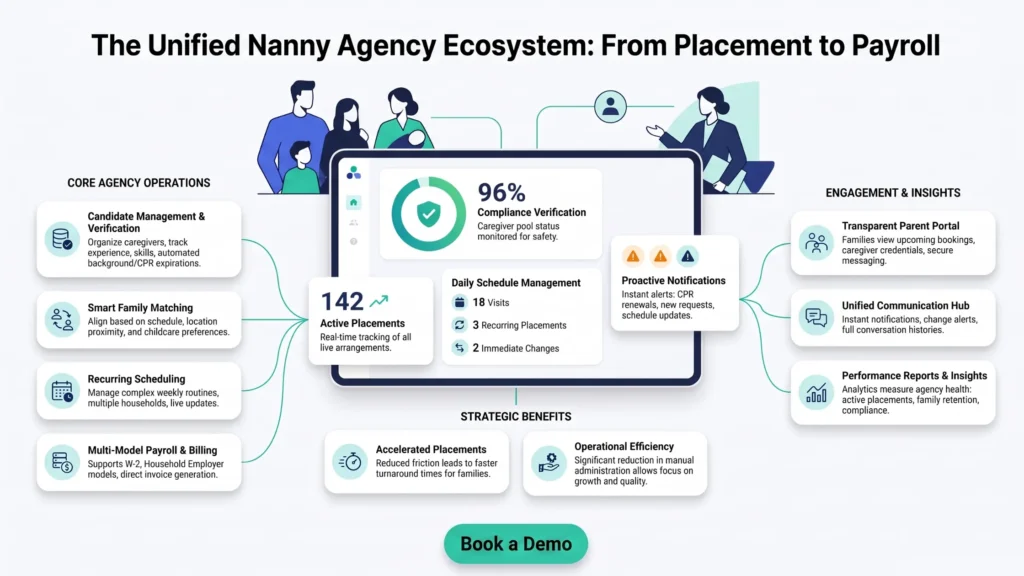
Nanny agency software is a system built to run the specific operational model of placing caregivers with families: sourcing and vetting candidates, tracking background checks and certifications, matching nannies to family requests, scheduling recurring and multi-household bookings, and handling payroll and family billing, in one connected system instead of scattered spreadsheets, texts, and separate portals. See our full comparison of nanny agency management platforms for what to look for when evaluating options.
Do Nanny Agencies Need Different Software Than General Staffing Agencies?
See how Vars covers this for your agency
Scheduling, credentialing, and payroll in one platform.
Yes, more than most agency owners expect going in. General staffing software is usually built around shift-based placement: a worker fills a defined shift at a defined site. Nanny placement is often recurring and relationship-based instead, the same nanny working with the same family across weeks or months, sometimes across multiple households in a week. Background checks and certifications also carry more direct weight here, since trust with a family is the actual product being delivered, not just a compliance checkbox.
Do Nanny Agencies Need Different Software Than Babysitting Agencies?
The two overlap enough that agencies sometimes assume one platform serves both, and that’s usually only partly true. Babysitting placements tend to be shorter, more one-off, and less relationship-driven. A family booking a Saturday night sitter cares about availability and basic vetting more than long-term fit. Nanny placement is closer to a recurring employment relationship, with schedule consistency, deeper family compatibility, and often payroll considerations that a one-off babysitting booking never touches.
An agency running both models under one roof needs software flexible enough to handle a same-day booking workflow and a long-term recurring placement workflow without forcing one model’s assumptions onto the other. Trying to run recurring nanny placements through a system built purely for one-off bookings tends to show up as scheduling friction: the tool assumes every booking needs to be arranged fresh, when a lot of nanny work is really about managing an ongoing arrangement with occasional adjustments.
What Matters Most for Background Check and Certification Tracking?
Automated expiration tracking that flags a lapsing certification before it lapses, not after a family asks about it. See our full breakdown on automating background check and certification tracking for what this actually looks like in practice.
How Does Booking Work Differently From Shift-Based Staffing?
A family isn’t booking a single shift, they’re usually setting up a recurring weekly arrangement, sometimes across more than one household, with changes that need to reach both the nanny and the family in real time. Nanny agency booking software is built around that recurring, multi-household reality instead of a one-shift-at-a-time model.
What Should a Client Portal Include for Parents?
Verified caregiver credential status, visible schedule for upcoming bookings, and a single communication thread the family can reference, so trust doesn’t depend entirely on a phone call. This is covered in more depth in what parents actually expect from a client portal.
What Happens When an Agency Outgrows Its Spreadsheet?
Candidate records, family placements, certifications, and scheduling all living in one spreadsheet works fine at a small scale, until matching a family to a nanny requires cross-checking multiple sources instead of one lookup. See why spreadsheets stop working for the specific signs an agency has outgrown one.
How Does Payroll Work for Nanny Placements?
This is one of the more confusing parts for agencies moving off manual processes, mostly because nanny payroll can involve a mix of arrangements depending on how the placement is structured. Some nannies are placed as W-2 employees of the agency, some work under a household employer arrangement where the family handles payroll directly, and some independent arrangements use 1099 contracting, though that classification carries real legal risk if the working relationship doesn’t actually meet the criteria for contractor status.
Payroll software built for this space needs to support more than one of these models, since agencies rarely run a single arrangement across their entire placement book. Getting worker classification wrong isn’t just an administrative headache. It carries real tax and labor law exposure, which is exactly why payroll handling deserves more attention in a software evaluation than it usually gets.
What Does Implementation Actually Take for a Nanny Agency Switching Systems?
Most agencies underestimate this, expecting a software switch to be mostly about picking the right vendor. In practice, the bulk of the work is data migration and family and nanny communication about the change, not the software setup itself.
A realistic timeline starts with migrating active candidate and family records first, the ones currently in placement or actively being matched, while historical records get a slower, more deliberate review. Families need a heads-up before their portal access changes, ideally with a short explanation of what’s new for them specifically (a way to check schedules without calling, for instance) rather than a generic system-upgrade notice. Most small to mid-size agencies can expect a full transition, including staff getting comfortable with the new workflow, to take three to six weeks.
What’s the Actual Cost of Nanny Agency Software?
⚠️ Pricing varies by agency size and feature set, and we’d rather point you to a real conversation than guess at a number here. Book a demo for current Vars pricing specific to your agency’s placement volume.
Frequently Asked Questions
What is nanny agency software?
A connected system for sourcing, vetting, matching, scheduling, and billing caregiver placements, replacing the spreadsheets and group texts most agencies start with.
Do nanny agencies need different software than general staffing agencies?
Yes. Recurring, relationship-based placement and heavier reliance on verified trust with families set nanny placement apart from shift-based staffing models.
What matters most for background check and certification tracking?
Automated expiration alerts before a certification lapses, not a manual spreadsheet check that only gets noticed after something has already expired.
How does nanny booking software differ from general shift scheduling?
It is built around recurring, multi-household family arrangements rather than single, one-off shift assignments.
What should a nanny agency client portal include?
Verified credential status, visible upcoming schedule, and a persistent communication log between the agency and the family.