A gig staffing platform such as Indeed Flex gives clients access to a marketplace of pre-verified workers. Event staffing software gives an agency the tools to run its own crew pool: scheduling, check-in, onboarding, pay and billing. They solve different problems, but clients now weigh event staffing software vs gig platforms when they choose a supplier, so agencies that cannot match the speed and experience of an app risk losing routine work. This guide explains the difference and what agencies can do about it. If you want the agency side first, see event staffing software for agencies.
What is the real difference between event staffing software vs gig platforms?
Indeed Flex describes itself as a temporary staffing platform that connects workers with flexible jobs, offering businesses a pre-verified workforce on demand, smart matching, shift booking, ratings and attendance tracking. Event staffing software is a different kind of product: it is a tool an agency licenses to run its own operations.
| Question | Gig marketplace | Event staffing software for agencies |
|---|---|---|
| Who supplies the workers? | The platform’s worker marketplace | Your own pool of workers |
| Who does the client deal with? | The platform | Your agency |
| Who owns the worker relationship? | The platform | You |
| What do you manage? | Requests and shifts inside the platform | Scheduling, check-in, onboarding, pay and billing |
| Whose brand do workers see? | The platform’s | Yours |
One is a place to find workers. The other is the system you use to run the workers you already have. Check each platform’s own terms for how employment and payment work, because the details differ by market.
Why do clients consider gig platforms for event staffing?
See how Vars covers this for your agency
Scheduling, credentialing, and payroll in one platform.
Clients rarely switch because of ideology. They switch because something about their experience with agencies is slow or opaque. Common reasons:
- Speed. A request can be posted and filled the same day.
- Visibility. Profiles, ratings and attendance records are visible to the client.
- A familiar app experience. Booking and confirming from a phone feels normal.
- Worker appeal. Platforms advertise features such as same-day pay, which attracts workers away from slower agencies.
What clients notice: not the technology itself, but how long it takes to get an answer and how clearly they can see who is coming.
What can agencies offer that a marketplace cannot easily match?
Agencies have real advantages when they use them: crews trained for specific events, supervisors who know the client, local knowledge of venues, one point of accountability and consolidated invoicing across many events. A marketplace shows a profile. An agency can vouch for a person who has worked a hundred events with you.
Agencies that keep repeat clients usually do it on accountability, a named coordinator and a clean close-out, not on being the cheapest option.
The advantage only holds if operations keep up. A client will not wait three days for a roster or ask twice about who is checked in. Clients compare you with the experience they get in an app, so the gap to close is speed and visibility, not trust.
How do the costs and risks of a marketplace compare with running your own crew?
Price comparisons between a marketplace and an agency are rarely like for like, so ask for the full picture before you compare numbers. A marketplace sets its own fee structure, booking rules and cancellation terms, and those can change, so read the current terms for your market. An agency running its own crew sets the pay rate, the bill rate and the margin itself, and carries the cost of recruiting, onboarding and admin. Software changes that last part: it cuts the time each of those tasks takes, which is where much of the hidden cost sits.
| Cost or risk | Marketplace route | Own-crew route with software |
|---|---|---|
| Pay and bill rates | Set within the platform’s rules | Set by you, per client and role |
| Recruiting and onboarding effort | Handled through the platform’s worker pool | Yours, reduced by phone-first onboarding |
| Admin per event | Requests and shifts inside the platform | Roster, check-in, timesheets and invoice in your own system |
| Control of the worker relationship | Sits with the platform | Sits with you |
| Reporting to the client | The platform’s reports | Your own records, in your format |
What do employment, compliance and liability look like in each model?
Who employs the worker, who pays them and who is responsible for rules on hours, breaks and insurance depends on the model and on the market. Do not assume either route removes your obligations. Before you commit event volume to any supplier or platform, ask these questions:
- Who is the employer of record for the worker on this shift?
- Who handles payroll taxes and the timing of worker pay?
- Who carries the insurance a venue or client requires?
- What records can you produce for a client or auditor, and how quickly?
- What happens when a worker does not show or leaves early?
Take the answers to your payroll provider or legal counsel. This guide is not legal advice, and the details differ by country and state.
What does one urgent request look like under each model?
Take a client who asks on Tuesday for 40 crew for a Friday evening event, with six roles and two zones.
Through a marketplace, the client posts the shifts, workers who match the filters apply or are matched, and the client sees profiles and ratings. Speed is the strength. The client then runs the event with workers who may not know the venue or each other, and the platform holds the records.
Through an agency with software, the coordinator builds the roster by zone and role, shortlists from the agency’s own pool by availability and qualifications, publishes the roster and workers confirm on their phones. The agency’s supervisor knows the crew, the client sees who is confirmed, and check-in shows arrivals on the night. Speed depends on how clean the agency’s pool and process are, which is exactly what software improves.
The point is not that one route always wins. The agency route wins when the pool, the supervisor and the process are strong. It loses when the roster takes three days and nobody can say who is confirmed.
How can agencies close the speed and experience gap?
- Onboard digitally. Collect documents from the worker’s phone before the event, not at the door. See onboarding for how this works in Vars.
- Confirm every shift. A clear confirmation process is the quickest way to reduce no-shows. Our guide to event staff scheduling covers the process.
- Show the client who is on site. Check-in against the roster gives the client the visibility a marketplace promises. Read about check-in for event crews.
- Shortlist fast for open roles. Use matching to find available, qualified workers in minutes rather than hours.
- Pay and bill from the same hours. Predictable pay keeps good workers with you, and accurate invoices keep clients. See event payroll and invoicing.
Common operational mistake: competing on price alone. Marketplaces set the price expectation. Agencies win on reliability, accountability and a clean close-out.
Pro tip for staffing agencies: ask your best clients what they like about the app they compare you with. It is usually speed and visibility, not price, and both can be improved without changing your pay rates.
How does Vars help an agency compete with a gig platform?
Vars is software that agencies use to run their operations. It is not a staffing agency or a marketplace. In a typical week, an agency using Vars can onboard crew from their phones, build and publish rosters, let workers confirm, release and claim shifts, check them in with the mobile app and feed approved hours into payroll and billing.
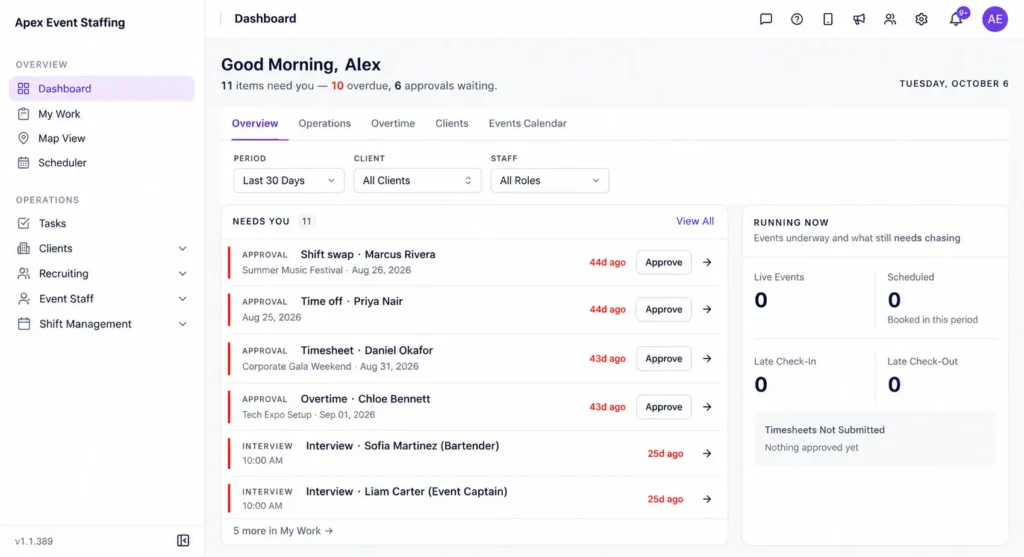
For open roles, Vars offers AI Candidate Matching to shortlist available, qualified workers from your own pool. The point is to give the agency the same speed a marketplace promises while the worker relationship and the client relationship stay with the agency. Confirm which features and branding options your plan includes.
What does a worker notice when comparing an agency with a gig app?
Workers choose where to pick up shifts, and they compare quickly. They notice how fast they can sign up, how clear the shift details are, whether they are told early when something changes and how quickly they are paid. An agency that sends a paper packet, a late schedule and a vague pay date will lose its best crew first, because good workers have options.
What usually breaks at scale: manual confirmations by phone and text. They work for one request at a time and fall behind when several clients ask for rosters on the same day.
This is why the worker side of your operation matters as much as the client side. A phone-first onboarding flow, a roster the worker can see, one place to confirm or release a shift and clear pay records all make your agency easier to work for. None of this needs a marketplace. It needs a consistent process, and software that makes the consistent process the easy one.
When does a marketplace suit the client, and when does an agency?
A fair guide should say when the other side is the better fit. A marketplace tends to suit routine shifts with light supervision needs, unfamiliar locations and short-notice surges where the client mostly wants people on site. An agency tends to suit events where the crew needs training or a uniform, the client wants one accountable contact, the same crew returns for repeat events, or the invoice has to match a purchase order and an approval process.
- Lean toward a marketplace when: the roles are simple, the stakes are low and the client wants a one-off fill.
- Lean toward an agency when: roles need specific skills, supervision matters and the client wants consistency across events.
- Consider both when: demand spikes beyond your pool and you need overflow, with clear terms on who manages those workers.
Position yourself on the second list and be honest about the first. Clients trust a supplier who says what they are not the best at.
Should an agency use a gig platform at all?
Sometimes. Some agencies use a marketplace to cover surge demand or unfamiliar locations. Others avoid it because it puts workers and client relationships on someone else’s platform. Read the terms carefully before you decide, and keep your own records of who worked which event so your pool stays yours.
Key takeaway for operations leaders: a marketplace competes on access to workers, and software helps you compete on service. You can only win on service if your operations are fast, visible and accurate.
How should you answer a client who mentions a gig platform?
Most clients are not asking you to match a price. They are asking whether you can match an experience. Prepare short, honest answers to the questions you are most likely to hear:
- “Can you fill this by tomorrow?” Give a real answer based on your pool, and show the confirmed roster as it builds.
- “How do we know who is coming?” Show confirmation status in advance and live check-in against the roster on the night.
- “Why should we pay for an agency?” Talk about accountability: a named coordinator, a supervisor who knows the crew, one invoice and a clean close-out.
- “What if someone does not show?” Describe your standby and backfill process and how fast you can shortlist replacements.
Avoid criticizing the platform. Clients who use one usually have a good reason, and the conversation goes better when you ask what they value and then show how you deliver it.
What should you measure to prove you match the app experience?
A claim like “we are as fast as an app” needs numbers from your own operation. Track a small set of measures over a quarter and use them in client reviews:
- Time to a confirmed roster: from the client’s request to every shift confirmed.
- Confirmation rate: the share of shifts confirmed by workers before the event.
- On-time check-in rate: the share of workers checked in by call time.
- Fill rate on urgent requests: how often you fully staff requests that come in under your normal notice period.
- Invoice accuracy: the share of invoices approved without a correction.
- Time to pay workers: from approved hours to money in the worker’s account.
These figures are yours, not a benchmark, so compare them with your own earlier results. After a few events you will see which measure drags and which fix is worth doing first. If you have no data yet, start by recording time to a confirmed roster for every request. It takes a minute and tells you more than any opinion about speed. For how connected scheduling and cost data help, see event staffing cost management.
What should a client ask any supplier, agency or marketplace?
If a client asks you for guidance on comparing suppliers, give them the questions that matter. It builds trust, and it keeps the comparison on service instead of price alone:
- How quickly can you give me a confirmed roster, and how do I see its status?
- Who is my single point of contact before and during the event?
- How do I know each worker has the documents and qualifications this event needs?
- What happens if someone does not arrive, and how quickly is a replacement found?
- How will I see who is on site during the event?
- How are hours approved, and what does the invoice show?
- Who is responsible if something goes wrong on site?
An agency that can answer all seven with a process and a screen, not a promise, is in a strong position. If you cannot answer one of them yet, that is your improvement list.
What does a 30-day plan to close the gap look like?
You do not need a full overhaul to start. A month is enough to remove the biggest points of friction:
- Week 1: record how long each of your last five requests took to become a confirmed roster, and list where time was lost.
- Week 2: move onboarding to the worker’s phone and set a standard confirmation message with a clear deadline.
- Week 3: run check-in against the roster for one event and share the live view with the client.
- Week 4: compare scheduled, checked-in and billed hours for that event, and fix any gap before the next one.
At the end of the month, repeat the first measurement. If time to a confirmed roster has dropped and the client noticed, you have a concrete result to bring to your next client review. If you want the scheduling steps in more detail, read our guide to event staff scheduling software and the walkthrough of check-in for event crews.
What should you fix first?
Start with speed of response: how quickly you can turn a client request into a confirmed roster. Then add visibility, with check-in the client can see. Pay speed and reporting can follow. A tool alone will not fix a thin worker pool, so keep recruiting and treat your best workers well.
FAQ
Is Indeed Flex a staffing agency or software?
It describes itself as a temporary staffing platform that connects workers with flexible work. It is not software an agency licenses to run its own operations.
Can event staffing software replace a gig marketplace?
They do different jobs. Software helps you run your own pool, while a marketplace gives access to a wider pool. Some agencies use both.
What is the best alternative to a gig platform for agencies?
Agencies usually do not need an alternative marketplace. They need tools to match the speed and visibility clients see in apps, using their own workers.
How do I keep workers from leaving for gig apps?
Pay accurately and on a predictable schedule, give clear shift details and treat reliable workers well. Slow onboarding and unclear pay push workers away.
Does using software mean I lose my workers to a platform?
No. With software, workers and records stay in your system. Review any vendor’s terms on data ownership to be sure.
How fast should an agency be able to fill an urgent event request?
There is no single standard. Measure your own time to a confirmed roster, compare it with what your best clients expect and improve the slowest step first.
Do clients prefer gig platforms to agencies?
Some do for routine, low-risk shifts, and many still want an agency for larger or higher-stakes events. The deciding factors are usually speed, visibility and accountability.
What records should agencies keep to protect their worker pool?
Keep each worker’s contact details, qualifications, onboarding documents, event history and performance notes in your own system, and check any vendor’s terms on who owns that data.
Can a small agency compete without software?
For a few events, yes, with a tidy spreadsheet and a clear confirmation routine. Once you run several clients at once, the manual steps start to cost you speed, and software becomes worth testing.
Conclusion: your next step
Event staffing software vs gig platforms is not a head-to-head contest. A marketplace gives access, and software gives control. Agencies that pair their own crews with fast, visible operations keep the advantage clients value.
Your next step: time how long it takes you to turn a client request into a confirmed roster, then compare that with how fast an app would do it. The gap shows you where to start. To see this workflow in Vars, book a demo.
Related reading: Best Event Staffing Software and Event Staffing Software.